
Your inbound form is working. Paid campaigns are driving traffic. Demo requests are up. Yet the sales team is frustrated because volume and quality aren't the same thing.
Most startups hit a wall as SDRs start spending their day triaging bad-fit leads, chasing students doing research, routing duplicate contacts, and trying to infer intent from scattered signals across forms, chat, email, and CRM notes. Lead qualification turns into a manual sorting job when it should be an operational system.
AI for lead qualification works when you treat it like a production workflow, not a prompt experiment. The model matters, but the model alone won't save a broken handoff, a vague ICP, weak permissions, or an agent that can't push decisions into HubSpot or Salesforce. The teams that get this right build an agent like they would onboard a new employee. They define criteria, control access, wire it into the stack, and monitor it after launch.
Table of Contents
- Why Your Sales Team Needs an AI Qualification Agent
- Defining Your Lead Qualification Matrix
- From Prompt Engineering to Logic Flows
- Connecting AI to CRMs and Communication Channels
- Managing Access Security and Multiple Agents
- Monitoring Performance and Driving Continuous Improvement
- Your AI Workforce Starts Here
Why Your Sales Team Needs an AI Qualification Agent
At 9:12 a.m., a demo request hits the inbox from a company that fits your ICP. By 11:00, the rep has not opened it because they are still sorting webinar signups, student emails, competitors, and low-intent form fills. That is how good pipeline gets buried under cheap volume.
An AI qualification agent fixes that intake problem at the front door. It handles the first-pass work with the same rules every time, then pushes only the right leads into a sales rep's queue. The operational payoff is straightforward. Reps spend less time triaging and more time working real opportunities. The Starr Conspiracy's AI lead generation benchmarks for 2025 reports that manual qualification still takes a large share of SDR time, qualified lead costs vary widely, AI lead scoring adoption is rising, and teams that implement AI-powered lead generation often see materially higher qualified lead volume.
That matters early, not just at enterprise scale.
In practice, the agent takes over four jobs that usually live in a mix of spreadsheets, CRM views, inbox rules, and rep memory:
- Signal collection: Pull form fields, page visits, enrichment data, CRM history, and recent messages into one working record.
- Qualification checks: Apply your scoring and routing rules the same way on every lead, even during busy periods.
- Next-step decisions: Route sales-ready leads to an AE or SDR, send weak fits to nurture, and flag ambiguous cases for review.
- CRM hygiene: Write back summaries, scores, tags, ownership, and recommended actions so the system stays usable.
The strongest teams do not treat this as a chatbot project. They treat it as an operations project with an AI layer on top.
That distinction matters because the model is only one part of the system. A production-grade qualification agent needs event triggers, CRM writebacks, audit logs, fallback rules, and permission boundaries. If you plan to boost predictable revenue, sales and marketing need one shared qualification process that is explicit in the system, not buried in Slack threads or stuck in one SDR's head.
I usually recommend building this earlier than founders expect. Small teams feel lead handling mistakes more sharply because each missed meeting costs real pipeline. A well-configured agent gives the team a repeatable intake layer now, then scales into a true AI employee later, with role-based access control, separate agents for different segments or channels, and a multi-instance setup that can grow without turning CRM workflows into a mess.
Defining Your Lead Qualification Matrix
Most failed lead qualification agents have the same root problem. The team never defined what "qualified" means in operational terms.
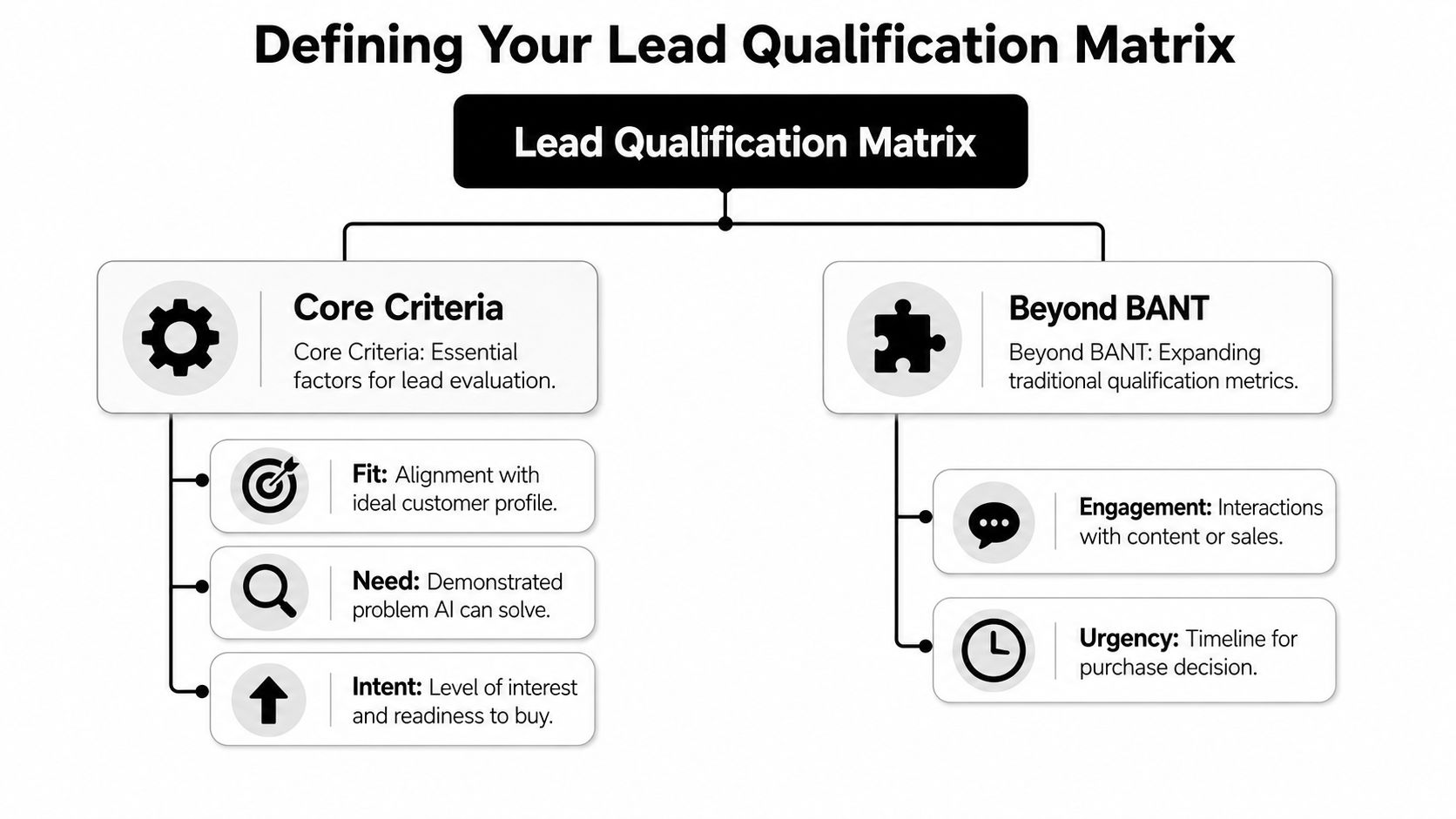
A usable matrix has to convert sales judgment into structured inputs the agent can evaluate. That means separating fit from need, and need from timing. It also means deciding which factors are hard gates, which are weighted signals, and which should trigger human review.
Start with fit need and intent
I recommend building the matrix in three layers.
| Layer | What to include | How the agent should use it |
|---|---|---|
| Fit | Industry, company size, geography, team structure, tech environment | As gating or high-weight scoring criteria |
| Need | Stated pain point, workflow gap, replacement project, process friction | As conversational evidence, not just form data |
| Intent | Demo request, pricing page behavior, urgency, reply quality, stakeholder involvement | As routing and priority logic |
Traditional BANT can still help, but it's too narrow on its own. Strong AI for lead qualification also needs softer operational signals such as repeat visits to product pages, language that suggests active evaluation, and signs that the contact can bring in the buying team.
Two practical rules matter here:
- Don't mix curiosity with intent. A lead can consume content heavily and still be a poor sales fit.
- Don't over-index on job title. Titles vary wildly across startups, mid-market companies, and enterprises.
If your team needs a useful refresher on qualification frameworks before translating them into agent logic, it's worth taking a look at sales qualification on hireSDR.io.
Handle the cold start without guessing
Predictive models need history. Effective AI models require at least 1,000 converted historical leads for training, and for startups without that volume, a workable fallback is to use industry benchmarks or route any AI-assessed lead to a human when confidence is below 70%, based on this AI-powered lead scoring guide.
That gives you two different implementation paths.
- Data-rich path
Use past closed-won and closed-lost records to derive scoring features from actual outcomes. - Data-light path
Start with a rules-first matrix based on your ICP, common objections, and observed sales calls. Then add confidence-based routing so the model doesn't pretend certainty it doesn't have. - Hybrid path
Use a lightweight model for language understanding, but wrap it in deterministic business rules for fit and routing.
Practical rule: If your historical data is thin, don't ask the agent to predict win probability. Ask it to classify fit, summarize intent, and escalate uncertainty.
That distinction saves a lot of frustration. Startups usually don't need a magical scoring engine on day one. They need an agent that can consistently ask the right questions, apply clear criteria, and avoid flooding the sales team with noise.
From Prompt Engineering to Logic Flows
A lead qualification agent isn't one prompt. It's a chain of decisions.
The prompt tells the model how to reason. The logic flow decides when to call the model, what context to include, what fields are required, how to handle low-confidence output, and which downstream action fires next. Teams that ignore the logic layer end up blaming the model for process mistakes.
Choose the model for the job
For conversational qualification, most startups don't need the largest model on every interaction. They need a stack that balances reasoning, latency, and cost.
A practical pattern looks like this:
- LLM for dialogue and extraction: Use a strong general model for interpreting open text, identifying need, and producing structured output.
- Rules engine for hard constraints: Use application logic for territory, blacklists, existing customer checks, or minimum firmographic requirements.
- Workflow orchestrator: Use a service layer to manage retries, webhook processing, CRM writes, and task creation.
- Memory and context store: Keep recent conversation state, known account attributes, and previous qualification outcomes in a database such as Postgres.
For the app layer, a common stack is Next.js or React for the internal UI, Node.js or Python for orchestration, Postgres for structured records, Redis for queues or short-lived state, and CRM APIs for write-back. If you're handling chat channels, add a message broker or event queue so one slow integration doesn't block the rest of the system.
Write prompts like operating instructions
Prompt quality has a direct impact on qualification quality. A common failure point is not defining the ICP in a verbatim 4 to 5 sentence system prompt, which can cause false positives and a 10 to 15 percentage point drop in qualification rate. Reviewing every transcript for the first 100 leads matters because 90% of accuracy gains occur there, according to this B2B AI lead qualification guide.
A good system prompt is boring in the best way. It should read like internal operating instructions.
Example structure
- Role: You are a lead qualification agent for a B2B SaaS company.
- Objective: Determine whether the lead matches the ICP and whether sales should engage now.
- ICP definition: State it in explicit, plain language. Include company profile, buyer role, problem fit, and exclusions.
- Conversation policy: Ask concise follow-up questions only when required data is missing.
- Output format: Return JSON with score, confidence, qualification reason, disqualifiers, recommended route, and CRM summary.
Here is the kind of output schema I prefer:
| Field | Purpose |
|---|---|
| fit_score | Measures alignment with ICP |
| intent_summary | Captures why the lead appears interested |
| confidence | Indicates whether routing can be automated |
| route | Sales, nurture, disqualify, or manual review |
| crm_note | Gives the rep a usable summary immediately |
"If the model can't explain why the lead is qualified in one short paragraph, it shouldn't be allowed to route the lead automatically."
That single rule catches a lot of bad outputs.
Add deterministic logic around the model
The model shouldn't decide everything. Use code for the parts of qualification that require consistency and auditability.
Examples:
- Existing account check: If the email domain matches an active customer, route to customer success or account management.
- Territory routing: If the lead is qualified and in EMEA, assign to the EMEA owner.
- Missing required data: If company size is unknown and confidence is low, ask one follow-up question or send to review.
- Disallowed categories: If the lead is a student, competitor, or job seeker, mark as non-sales.
A clean logic flow often looks like this:
- Ingest lead from form, chatbot, email, or messaging app.
- Enrich known data from CRM and firmographic provider.
- Run hard validation rules.
- Send normalized context to the model.
- Parse JSON output and validate required fields.
- Apply routing policy based on score, confidence, and exclusions.
- Write results to CRM and notify the owner.
That's how you build AI for lead qualification that survives contact with real traffic.
Connecting AI to CRMs and Communication Channels
An agent that can't act inside your stack is just an expensive opinion generator. Qualification only creates value when the decision lands in the systems your team already works in.
That usually means two connection layers. First, inbound channels where leads appear. Second, systems of record where decisions need to be stored and acted on.
DIY plumbing versus platform orchestration
You can build this yourself with webhooks, queue workers, API clients, and channel adapters. Many teams do.
The trade-off is maintenance. Every channel has its own payload shape, auth model, retry behavior, and edge cases. Email adds another layer because deliverability affects whether your agent's follow-ups even reach the lead. If your qualification flow includes outbound replies, this guide to email deliverability for AI Agents is useful because messaging quality isn't enough when infrastructure and sending reputation are weak.
A side-by-side view helps:
| Approach | Strength | Weakness |
|---|---|---|
| DIY integration stack | Full control over logic and data flow | More engineering overhead, more monitoring, more breakpoints |
| Integration platform | Faster deployment, less API maintenance | Less low-level control in some edge cases |
If you're evaluating prebuilt connectors, review the available AI workflow integrations carefully and map them to your actual intake channels before choosing a path.
A practical event flow
A common production workflow looks like this:
- Slack or website chat receives a lead
The message event lands in your orchestration layer with raw text, contact info, and timestamp. - Enrichment runs before the model
The system checks CRM history, account ownership, previous conversations, and firmographic data. - The model classifies and summarizes
It returns structured output such as qualification status, confidence, missing fields, and next action. - CRM write-back happens immediately
HubSpot or Salesforce gets the updated score, lifecycle stage, summary note, and owner assignment. - Human follow-up is triggered
If the lead is sales-ready, the system creates a task, sends a Slack alert, or opens a sequence.
The practical mistake I see most often is routing before enrichment. If you score the lead before checking whether the account already exists, your agent will create duplicate work and annoy the team.
Another one is pushing the full transcript into the CRM without summarization. Reps don't want a wall of text. They want a concise note: why this lead matters, what the lead asked for, and what should happen next.
Managing Access Security and Multiple Agents
The first agent is usually manageable. Problems start when the company adds another product line, another region, or another client environment.
At that point, lead qualification stops being only a workflow question. It becomes a governance problem. Who can edit prompts. Who can see transcripts. Which agent can access which CRM. Which logs are available when something goes wrong.
Why single-agent setups break
A single shared agent often fails in three ways.
First, prompt sprawl. One team edits the ICP for one use case and accidentally changes behavior for everyone else.
Second, data leakage risk. If multiple business units or clients share one runtime and one datastore, someone eventually sees records they shouldn't.
Third, unclear ownership. When the agent starts misrouting leads, nobody knows whether the issue came from the prompt, the integration, or a silent config change.
Security for AI agents isn't only about encryption. It's about limiting who can change behavior and what data each agent is allowed to touch.
What good governance looks like
For startups growing into agencies or multi-product companies, I recommend a multi-instance setup with strict isolation between workloads. One instance per client, business unit, or sensitive environment is far easier to reason about than one giant shared agent.
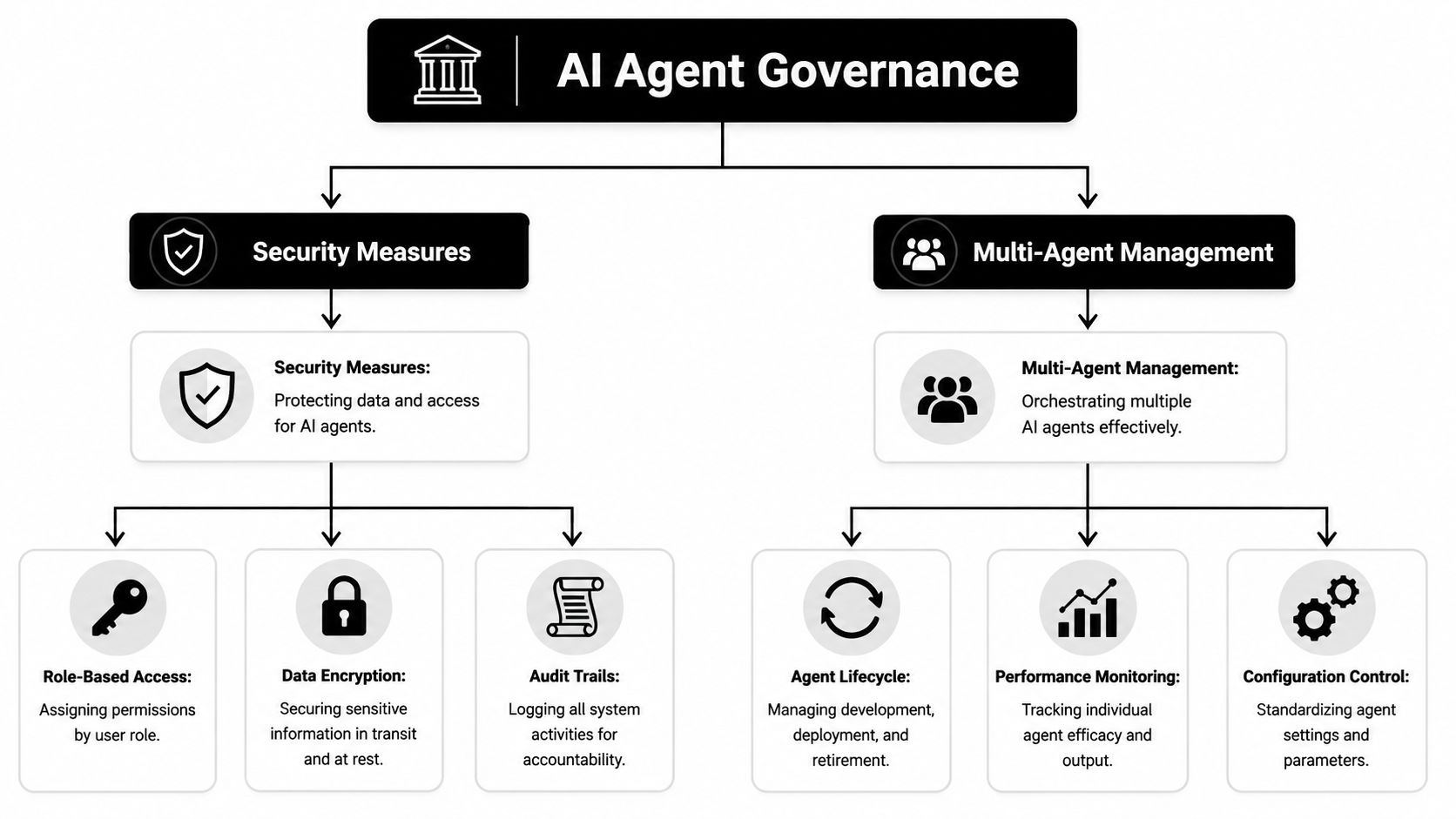
That governance model should include:
- Role-based access control
Builders can edit prompts and workflows. Sales users can view outputs. Executives can access reporting. Not everyone needs admin rights. - Scoped credentials
Each instance should use only the CRM, inbox, and messaging credentials assigned to that environment. - Audit logs
Every prompt edit, workflow change, and routing action should be traceable. - Data boundaries
Leads for Client A should never be queryable by the agent serving Client B.
If you're formalizing those controls, it helps to review a concrete AI platform security policy and use it as a checklist for RBAC, logs, and isolation requirements.
A good test is simple. If a rep, contractor, or client admin signs in, can you predict exactly which agents, transcripts, and settings they can access. If the answer is fuzzy, the system isn't ready to scale.
Monitoring Performance and Driving Continuous Improvement
Launch day matters less than the next ninety days. Qualification agents degrade when teams don't inspect decisions, compare them against outcomes, and retrain or recalibrate based on what sales closes.
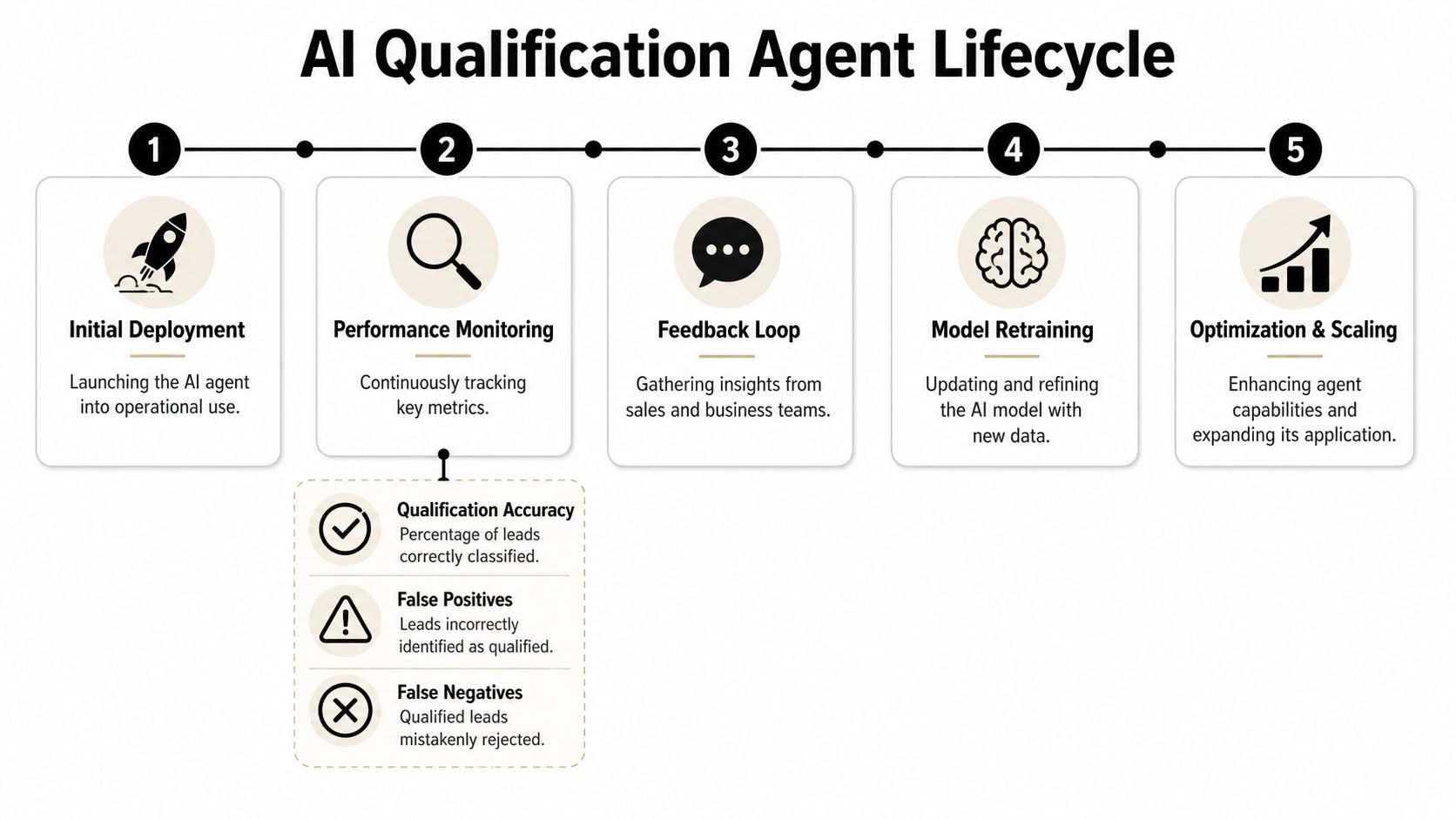
The easiest way to miss problems is to track only volume. You need a dashboard that tells you whether the agent is making good decisions, not just many decisions.
Build a review system not a vanity dashboard
Without intervention, AI scoring models can drift by 15 to 25% in accuracy within 3 months. A useful monitoring protocol should include weekly sampling of qualified leads and automated retraining triggers when false-positive rates or other key metrics cross a defined threshold, based on this guidance on AI qualification drift.
That means your dashboard should include operational metrics such as:
- Qualification precision
Of the leads marked qualified, how many moved forward. - False positives
Leads the agent sent to sales that shouldn't have been there. - False negatives
Leads the agent rejected or nurtured that later proved sales-worthy. - Confidence band distribution
Whether the model is becoming overconfident or unusually uncertain. - CRM completion quality
Whether the records produced by the agent are usable by reps.
A strong review process also needs human commentary. Sales should be able to flag bad handoffs in one click, and those flags should feed back into transcript review.
Here is a helpful walkthrough on building and improving AI sales workflows:
Use a rollout cadence that protects the pipeline
Don't give the agent full routing authority on day one. Start in shadow mode.
In shadow mode, the agent scores and recommends actions, but humans keep final control. This gives you a clean way to compare agent decisions against rep decisions without risking pipeline quality.
A practical rollout cadence looks like this:
- Week 1
Run the agent in shadow mode and compare outputs to human qualification. - Early launch window
Review every transcript from the first live batch and track why the agent was right or wrong. - Controlled automation
Allow auto-routing only for high-confidence cases that meet clear rules. - Expanded authority
Give the agent broader control only after the false-positive pattern is understood.
Field note: Most teams don't need a smarter model first. They need tighter review loops, cleaner CRM fields, and better thresholds.
When to retrain recalibrate or reroute
Different failures need different fixes.
| Symptom | Likely cause | Best response |
|---|---|---|
| Too many junk leads reach sales | ICP prompt too broad or poor fit criteria | Tighten exclusions and review positive examples |
| Good leads get stuck in nurture | Thresholds too conservative | Recalibrate routing cutoffs and review missed wins |
| Summaries look plausible but weak | Prompt lacks schema discipline | Enforce structured output and field validation |
| Performance drops after new campaign types | Data drift from new lead sources | Retrain or revise prompts using fresh examples |
Quarterly calibration is a strong default practice, but major campaign changes, pricing shifts, or ICP changes should trigger review sooner. The model doesn't know your GTM strategy changed unless you tell it.
The operational goal isn't perfection. It's controlled improvement. A lead qualification agent earns trust when the team can see what it decided, why it decided it, and how those decisions change over time.
Your AI Workforce Starts Here
The hard part of AI for lead qualification isn't getting a model to answer questions. It's building an operating layer around that model so it behaves like a reliable team member.
That means defining qualification criteria before writing prompts. It means connecting the agent to your CRM and channels so decisions create action. It means setting permissions so one team can't accidentally alter another team's workflow. And it means reviewing live outputs often enough that drift doesn't imperceptibly erode pipeline quality.
Start small, but build with production habits from day one. One qualification agent can handle intake for a single product or channel. A mature setup can support multiple agents for regions, business units, client accounts, or different stages of the funnel. The architecture should let you expand without rebuilding everything every time.
If you want the fastest path from idea to a working AI employee, look at platforms built for deployment, governance, and scale rather than just prompt experimentation. A good starting point is exploring how AI employees are structured when they're treated as operational assets instead of side projects.
If you're ready to deploy lead qualification as a real operational system, Donely gives you a practical path to do it without the usual DevOps burden. You can launch production-ready AI employees, connect them to your tools and channels, isolate workloads by instance, control access with granular RBAC, and manage growth from one agent to many from a single dashboard.