
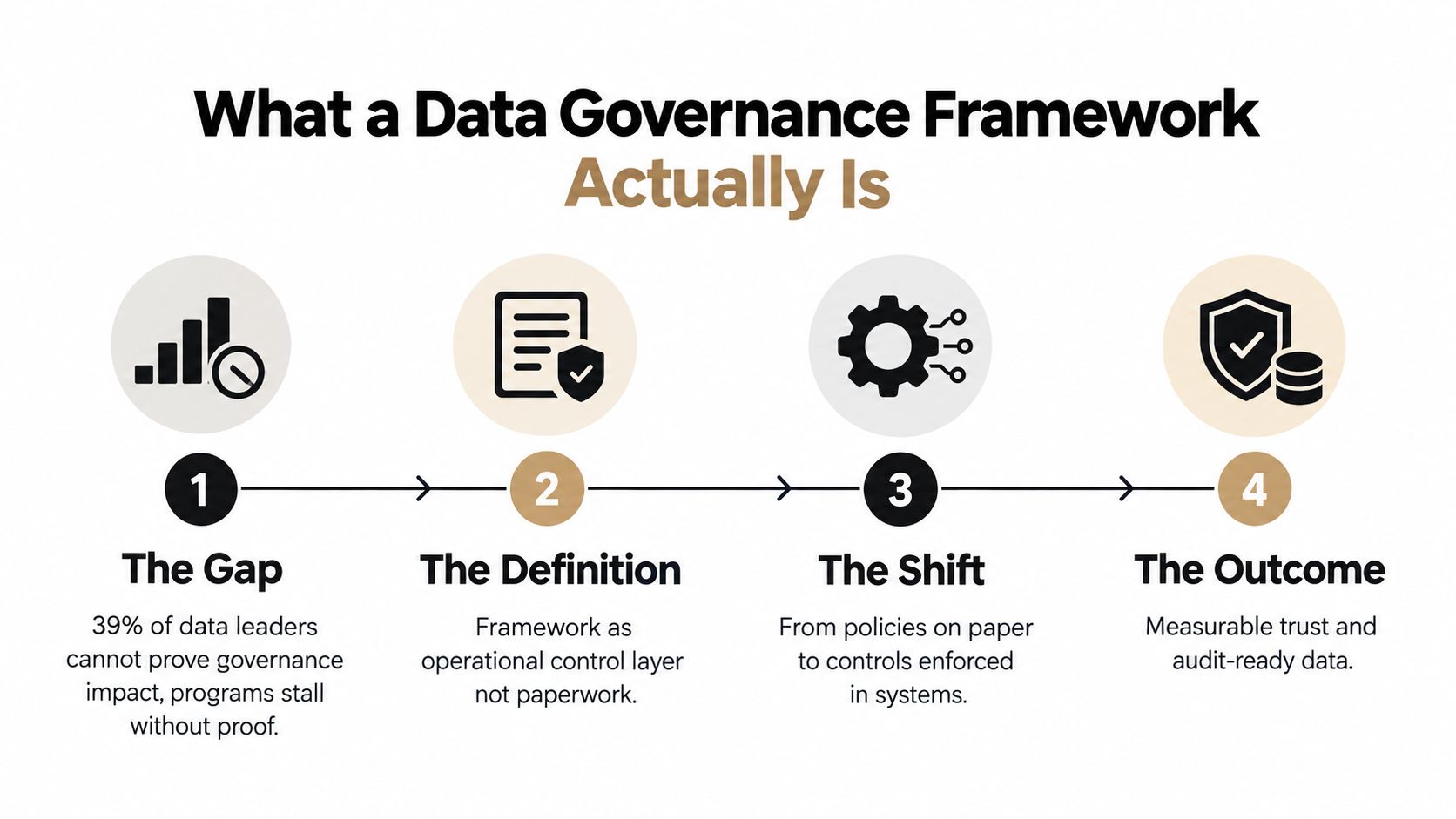
39% of data leaders say demonstrating governance impact is their biggest modernization challenge, and no single operating model dominates: centralized and federated governance each account for 36%, while hybrid governance accounts for 29% (2025 State of Enterprise Data Governance report). A data governance framework is a structured set of policies, roles, controls, and metrics that defines who can do what with which data, when, and under what evidence.
That finding is counterintuitive. Governance programs usually don't stall because leaders can't list the required components. They stall because nobody can show which control reduced risk, shortened an investigation, improved data reliability, or made an AI workflow safer.
After rolling out governance across three companies, I've learned to reject the document-first approach. A framework that lives in a shared drive is a reference document. A framework that controls access, validates data, records decisions, assigns ownership, and produces evidence is governance.
Table of Contents
- What a Data Governance Framework Actually Is
- Comparing the Major Frameworks Side by Side
- The Seven Components That Make a Framework Work
- Choosing the Right Framework for Your Organization
- Governing AI Agents and Instance-Based Platforms Like Donely
- Implementation Roadmap and KPIs That Survive Audit
- Common Pitfalls and How to Avoid Them
What a Data Governance Framework Actually Is
A data governance framework is an operating control layer, not a policy library. It specifies who owns each data asset, which uses are allowed, what quality standard applies, how access is approved, and what evidence the action produces.
A practical framework connects those decisions to the systems that handle data. Controls should reach ingestion, transformation, access, sharing, retention, and monitoring. A rule that exists only in a document does not govern a pipeline, application, analyst, or AI workflow.
The evidence standard is simple: a reviewer should be able to identify the responsible owner, see the applicable rule, verify the decision, and inspect the resulting record. That record might include an approval, validation result, access change, exception, or monitoring event. Governance becomes operational when people and systems encounter those controls during ordinary work.
From IT oversight to governed data products
The field has moved from IT oversight toward enterprise data accountability. ISO/IEC 38500 was first published in 2008, revised in 2015 and 2024, and the current ISO/IEC 38500:2024 version was published in February 2024. ISO/IEC 38505-1:2017 extended governance principles specifically to data, as described in this Cambridge Data & Policy review of data governance research.
That shift changes what a framework must cover. Technology processes and control objectives still matter, but governed data products also need owners, consumers, definitions, service expectations, quality rules, and lifecycle evidence. These details let teams operate a dataset consistently instead of treating it as an unmanaged file or table.
Use this definition when assessing any framework:
Governance is live only when a control changes what a person or system can do, and the organization can prove that the control operated.
Keep framework selection downstream of that standard. Stewardship, metadata, quality management, privacy, and AI-agent controls are implementation choices. The fixed requirement is operational control supported by evidence.
For sensitive data, privacy commitments should appear in the same operating model as access and lifecycle controls. Donely's privacy manifesto provides a practical reference for treating privacy as an operating responsibility rather than a policy appendix.
Comparing the Major Frameworks Side by Side
Frameworks solve different problems. DAMA DMBOK gives practitioners breadth, DCAM assesses capability maturity, COBIT connects technology controls to enterprise governance, ISO provides board-level accountability, and NIST helps organizations structure risk and control assessment.
The mistake is buying the most model before identifying the question leadership needs answered. Start with the next audit, the data domains that matter most, and the control vocabulary your existing risk teams already use.
Major Data Governance Frameworks Compared
| Framework | Origin | Primary Lens | Best Fit | Time-to-Value |
|---|---|---|---|---|
| DAMA DMBOK 2.0 | Data management professional body of knowledge | Data assets and management disciplines | Mid-market teams needing flexible, broad guidance | Fast for a focused domain, slower if adopted wholesale |
| EDM Council DCAM | Industry capability assessment model | Organizational capability and maturity | Financial services and teams needing a structured benchmark | Moderate, because assessment precedes improvement |
| COBIT 2019 | IT governance and control objectives | Processes, risks, and control performance | IT-heavy regulated enterprises with established audit functions | Faster when control infrastructure already exists |
| ISO/IEC 38500 and ISO/IEC 38505 | International governance standards | Governance accountability and principles | Boards, executives, and organizations needing formal accountability | Moderate, with value concentrated in alignment and assurance |
| NIST SP 1500-100 | NIST data and information reference work | Risk, information management, and control context | Organizations adding a maturity and risk overlay | Fast as a complement, not as a complete operating model |
DAMA DMBOK 2.0 is my default starting shelf for a team building governance from scratch. It gives data leaders a shared vocabulary across quality, metadata, security, architecture, and stewardship without forcing a rigid organizational design. Its weakness is also its strength: teams must translate the guidance into decision rights and executable controls.
DCAM fits organizations that need to assess capability consistently, especially financial services teams with established risk expectations. It's useful when leadership wants a maturity roadmap, but it can become an assessment exercise unless every finding receives an owner, deadline, and control implementation.
COBIT 2019 is the practical choice when the CIO, CISO, internal audit, and compliance functions already operate through formal controls. It speaks the language of processes and risk. Don't use it alone if your data team still lacks basic definitions, domain ownership, and catalog discipline.
ISO/IEC 38500 and ISO/IEC 38505 help executives establish accountability and governance principles. They aren't a replacement for daily stewardship workflows. NIST works best as a risk-management overlay, particularly when privacy, cybersecurity, and AI risks must be evaluated together.
Ask three questions before committing:
- What must be defensible next? Choose the framework that maps to the next audit or executive decision.
- Who will operate it? A model that stewards can't use will fail regardless of its pedigree.
- Which controls already exist? Extend working systems instead of creating a parallel governance bureaucracy.
Don't pay for a complete framework when a focused operating model solves the immediate constraint.
The Seven Components That Make a Framework Work
A framework earns its place when staff can operate it and auditors can inspect the resulting evidence. Use the seven components below as an operational control layer, not as separate documentation projects. NIST links data governance with quality, privacy, cybersecurity, and AI risk, which means the controls must connect in daily workflows (NIST Data Governance and Management profile concept paper).
Seven controls worth implementing
Policies and standards
Version each policy, name an approver, and enforce applicable rules in code. A classification standard becomes real when pipelines, storage systems, and access workflows use it. Observable signal: every production policy has a current version, named owner, approval record, and mapped control ID.Roles and stewardship
Skip RACI wallpaper. Give the data owner decision rights, the steward operational duties, and an escalation path authority to resolve disputes. Observable signal: every critical data domain has an accountable owner, while each open issue belongs to a person rather than a committee.Data quality
Define quality dimensions, thresholds, severity levels, and exception queues. Poor data can weaken security, privacy, and AI risk decisions, so failed checks must create work that someone can close. Observable signal: each failure becomes a tracked incident with a status, owner, and service expectation.Metadata and lineage
Capture business definitions, sensitivity, ownership, and lineage as data enters or changes systems. Retrofitting context after a model or report fails leaves gaps and costs more. Observable signal: tier-one assets document their source, transformations, consumers, owner, and downstream impact.Privacy and access
Apply role-based or attribute-based controls where appropriate, then tie access to a stated purpose and scope. The record should show who accessed data and why the request was permitted. Observable signal: access reviews close within the defined service expectation, and each exception has an approver and expiry.Audit and evidence
Preserve records for access decisions, policy changes, quality exceptions, approvals, and remediation. Link every observed action to the control that authorized it. Observable signal: an auditor can trace a control from policy to implementation, event, and review outcome.Lifecycle management
Turn retention, archival, deletion, and legal holds into executable workflows. A retention statement without deletion proof remains an intention. Observable signal: completed actions record the asset, rule, operator or system, timestamp, and outcome.
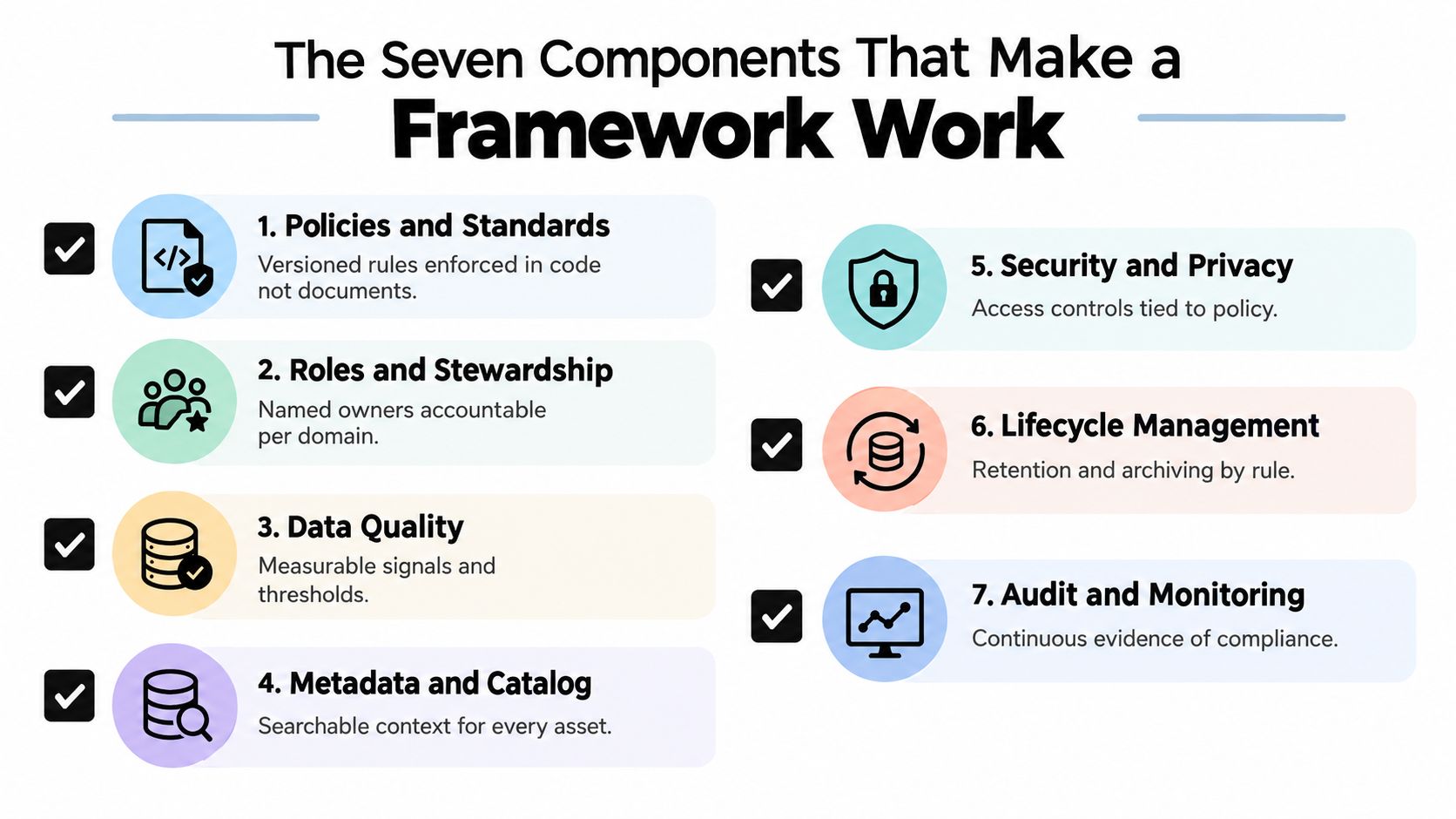
Connect the controls instead of measuring them as isolated checklists. Metadata identifies sensitivity, access policy uses that classification, audit captures the decision, and lifecycle rules determine how long the record stays available. That chain is how governance demonstrates impact, including on AI-agent and instance-based platforms such as Donely.
The following video provides another visual introduction to the operating pieces of data governance:
Choosing the Right Framework for Your Organization
Don't select a framework by brand prestige. Select it according to your organization's operating reality, regulatory exposure, and ability to sustain stewardship work.
A small startup doesn't need a full enterprise charter. Start with a short policy set, named owners for sensitive and business-critical domains, a practical catalog, and a repeatable access approval process. Use DAMA DMBOK's stewardship and metadata guidance as a reference shelf, but don't implement every knowledge area before the company has enough complexity to justify it.
A mid-market company needs more structure, especially when departments have developed conflicting definitions. DAMA DMBOK is usually the most adaptable starting point. DCAM is a stronger option when leadership needs a formal capability assessment or when financial-services controls already shape the operating environment.
Larger enterprises and organizations facing multi-jurisdiction audits should layer models. Use DAMA for practitioner depth, then add COBIT or ISO/IEC 38505 where technology risk, board accountability, or audit evidence requires a common language.
Framework Selection by Organization Profile
| Org Profile | Recommended Framework | Primary Driver | Risk If Mismatched |
|---|---|---|---|
| Early-stage or small team | Focused DAMA-based operating model | Clear ownership and basic control discipline | Excessive documentation with little adoption |
| Mid-market organization | DAMA DMBOK or DCAM | Domain accountability, quality, and repeatable workflows | Assessment activity without operational enforcement |
| IT-heavy regulated enterprise | DAMA with COBIT | Existing control, audit, and technology-risk structures | Data work remains disconnected from enterprise risk |
| Board-accountable or multi-jurisdiction organization | DAMA with ISO/IEC 38505 or ISO/IEC 38500 principles | Executive accountability and governance assurance | Principles remain too abstract for daily operations |
Use three selection signals:
- The audit you face next: Pick the language your auditors and risk leaders already understand.
- Your domain count and complexity: More domains require stronger federated decision rights and common standards.
- Your leadership structure: A functioning CDO or data council can support a broader model; without one, start narrower.
The right framework is the smallest one that creates repeatable decisions and credible evidence. Expand only after the first governed domain works.
Governing AI Agents and Instance-Based Platforms Like Donely
Governance for an AI platform differs from governance for a database. A database primarily serves queries and transactions. An AI agent retrieves context, interprets instructions, calls tools, generates an output, and may trigger a business action.
On a multi-instance platform such as Donely, each customer deployment should be treated as its own data tenant. A global policy isn't enough. Controls must apply at the instance level so an agent configured for tenant A can't read tenant B's records merely because both deployments use the same underlying model.
The control pattern
Take an agency managing separate client agents. The agency may use one platform, but each client needs its own data boundary, approved tools, access rules, and evidence trail.
Implement four controls:
- Instance-scoped RBAC: Bind each user, agent, and operator to the relevant instance and dataset. A shared administrator interface must not imply shared data access.
- Scoped retrieval and tool use: Apply least-privilege rules to every retrieval, tool call, and prompt context. The policy should specify which records, folders, projects, and integrations an agent may use.
- Immutable decision records: Record the prompt, response, retrieved material, tool action, and human override. This makes replay and investigation possible when an output is challenged.
- Continuous evidence collection: Map controls to the applicable HIPAA Security Rule safeguards and SOC 2 CC6 and CC7 criteria where those obligations apply. Don't wait until an audit request arrives to reconstruct the trail.
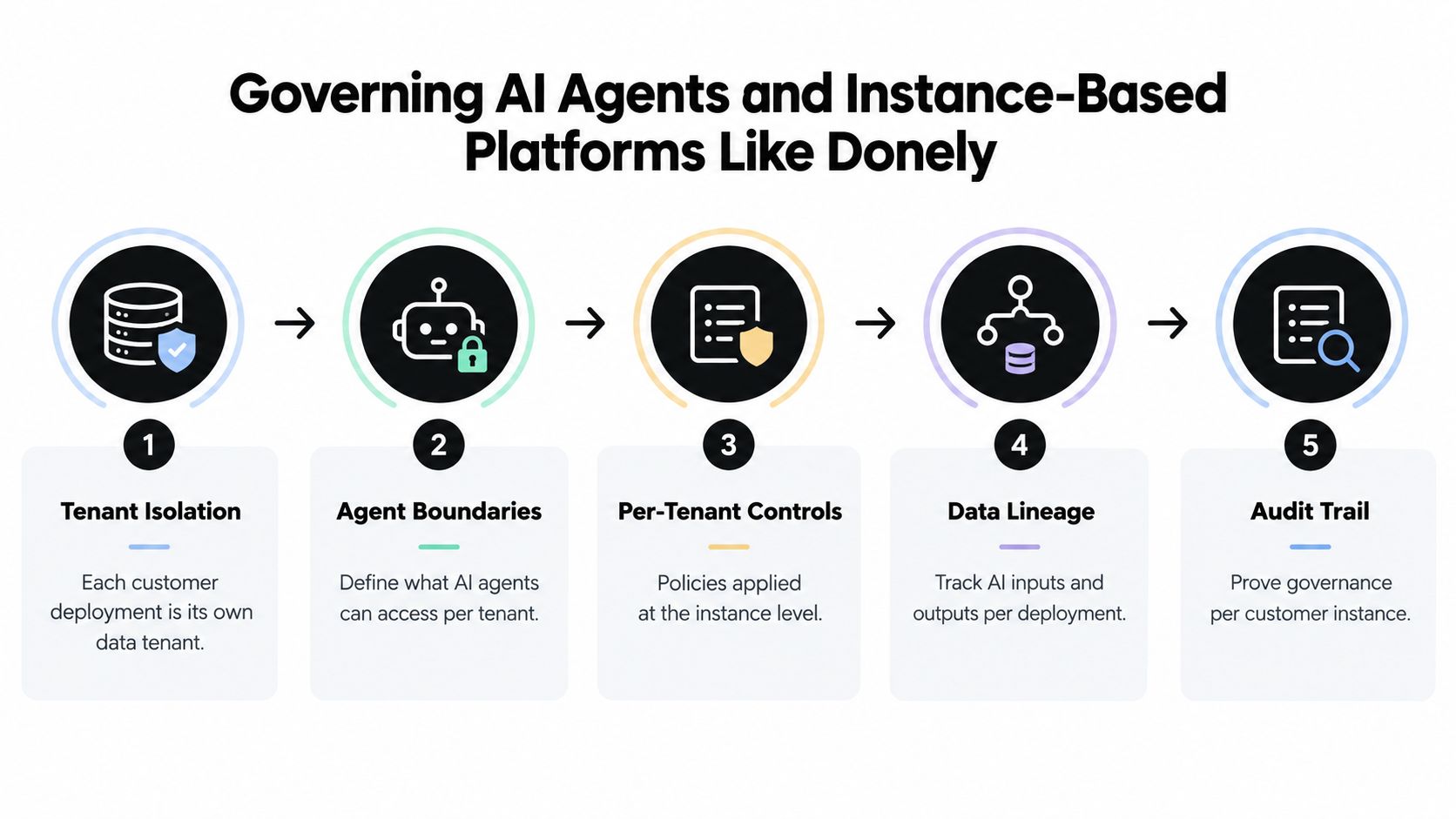
Treat every instance policy as a versioned governance artifact. Before a steward approves a new source, document the source owner, sensitivity, permitted purpose, retrieval scope, retention rule, and escalation path.
A platform's controls should support the framework, not replace it. You still need a decision owner, a review process, and a definition of acceptable use. Technology makes enforcement and evidence easier, but it can't decide whether a business purpose is legitimate.
For a closer look at the agent layer, review Donely's Hermes agent platform alongside your own control requirements. Evaluate it against tenant isolation, scoped permissions, human approval, audit replay, and evidence export rather than treating AI deployment as a separate governance universe.
Implementation Roadmap and KPIs That Survive Audit
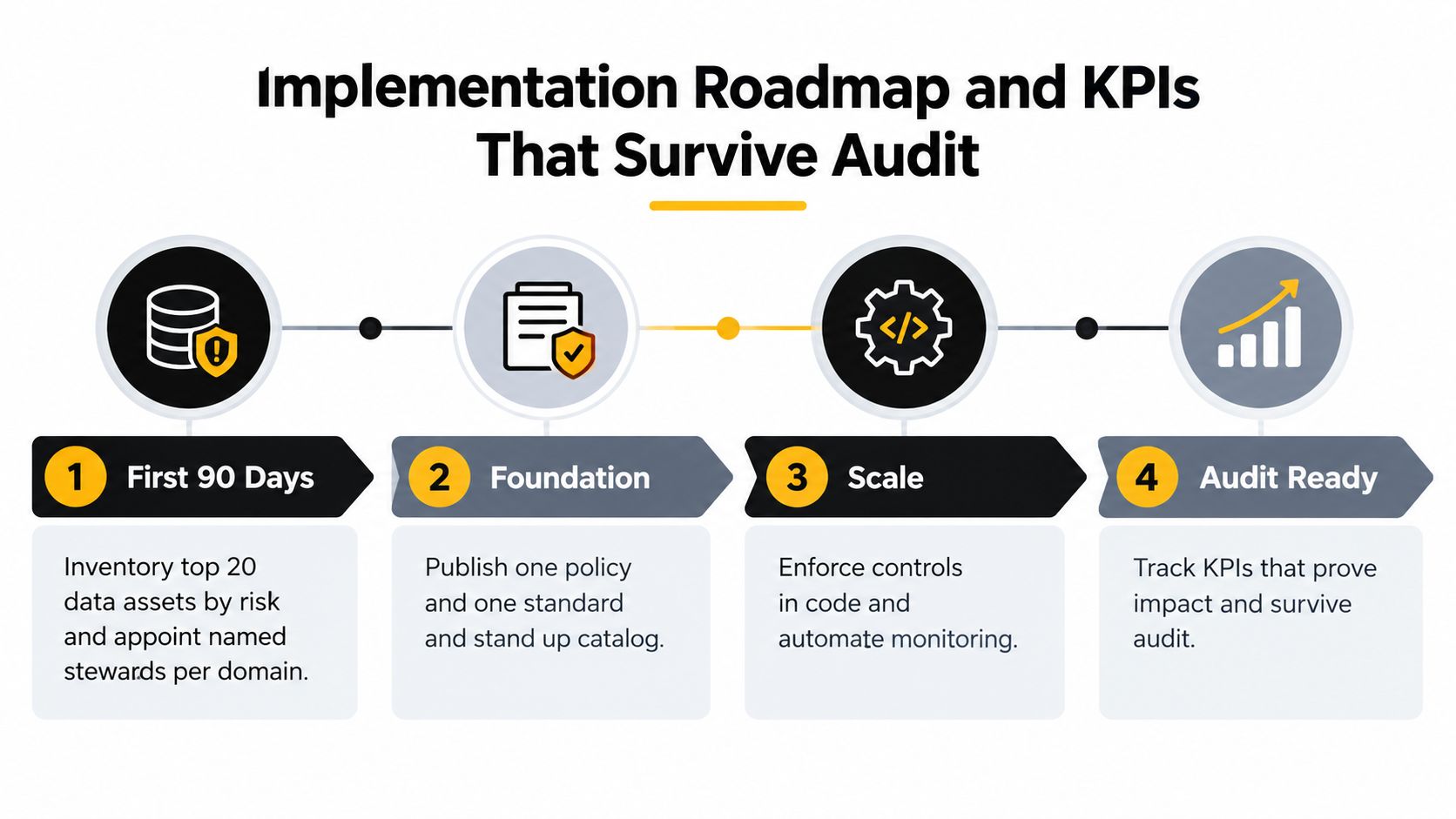
Run governance as an operating cycle, not a project that ends with a charter. NIST's framework describes a repeatable process for categorization, control selection, implementation, assessment, authorization, and monitoring (NIST Privacy Framework brief). Build your roadmap around that loop, with evidence produced during normal work.
First 90 days
Start with the highest-risk assets. Inventory the top 20 data assets by risk, name a steward for each relevant domain, publish one policy and one standard, and establish one authoritative metadata source.
The first deliverable is a working control on a defined asset set. It needs an owner, an approval path, and evidence that someone used it.
Days 90 to 180
Put those controls into operating routines. Run access recertification, apply quality rules to critical assets, document lineage from source to report, and convene the data council every two weeks.
Track exceptions by owner, age, risk, and decision status. A council that produces discussion without closed decisions is overhead, not governance.
Days 180 to 365
Automate evidence collection, run a dry-run audit, and connect governance measures to business outcomes. Use this nonprofit audit process overview to give non-specialists a clear model for evidence, testing, findings, and remediation.
Your monthly executive dashboard should include:
- Steward coverage: The share of critical assets with a named, active steward.
- Access review timeliness: The share of reviews completed within the defined service expectation.
- Quality incident resolution: Mean time to resolve critical data quality incidents.
- Remediation performance: Audit findings remediated within the agreed service expectation.
- Shadow-source reduction: The change in unapproved or duplicate data sources over time.
Report monthly, review quarterly, and re-baseline annually. A 2025 industry survey found that 39% of data leaders struggle most with demonstrating impact, so avoid vanity metrics. Count controls that operate, incidents that close, risks that shrink, and decisions that become faster or more defensible.
For AI deployments, measure evidence at the instance level: approved sources, retrieval boundaries, agent actions, human overrides, and policy versions. Donely's security policy for platform control requirements offers a reference for mapping platform behavior to your evidence standards.
Common Pitfalls and How to Avoid Them
The first failure is policy-only governance. Rules sit in a shared drive, while pipelines, applications, and agents continue operating unchanged. A quarterly warning signal is a policy library with no recent approvals, control mappings, or implementation evidence.
The fix is simple but essential: version policies, assign owners, map each rule to a control, and enforce the control through workflow or code. If a rule can't change behavior, classify it as guidance rather than governance.
The second failure is static governance. New pipelines, SaaS tools, and agent data sources arrive, but the control inventory stays frozen. Watch for shrinking control coverage as the estate expands, unexplained assets in the catalog, or new sources that lack classification and lineage.
Tie governance checks to change management and CI/CD. A new source shouldn't reach production without owner approval, sensitivity classification, access scope, and monitoring.
The third failure is vague ownership. A steward appears on an organization chart but can't approve access, set quality expectations, or resolve a dispute. Monitor unresolved tickets, repeated escalations, and decisions that remain open because nobody has authority.
Operating rule: If ownership isn't assigned before go-live, the business will assign it during the incident.
Use audit findings and incident trends as detection mechanisms, not just retrospective paperwork. The programs that last are the ones that surface control gaps early and make remediation visible to executives.
Donely provides isolated AI-agent instances, per-instance RBAC, scoped data access, unified audit logs, and centralized monitoring for teams that need governance to follow each deployment. Visit Donely to evaluate how its instance-based architecture can support enforceable data boundaries and audit-ready evidence for your AI workforce.