
Most PCI DSS compliance advice starts with the wrong question. Teams ask, “Which checklist do we need to complete?” when the harder question is, “Can our architecture prove who accessed payment-related systems, what they could reach, what changed, and how we detected it?”
That distinction matters for AI platforms and multi-tenant SaaS. A payment workflow may involve a hosted checkout, an embedded script, a support agent, an automation worker, a vendor integration, and several internal services. Passing an assessment doesn't automatically make that chain secure. PCI DSS v4.0.1 compliance is an operating discipline built into identity, isolation, logging, change management, and evidence collection.
Table of Contents
- Why PCI DSS Compliance Is Not a Checkbox Exercise
- What PCI DSS Is and Who It Applies To
- The 12 Core Requirements Grouped by Intent
- Merchant Levels and Assessment Types Explained
- A Practical Compliance Roadmap for Modern Teams
- How Platform Architecture Supports PCI DSS Controls
- Common Pitfalls and Misconceptions to Avoid
Why PCI DSS Compliance Is Not a Checkbox Exercise
PCI DSS compliance becomes difficult when the architecture cannot produce evidence without manual reconstruction. The framework has evolved with payment channels, technologies, and threats. PCI DSS was introduced in December 2004, governance was formalized through the PCI Security Standards Council in September 2006, and PCI DSS v4.0 was published on March 31, 2022, as documented by the PCI Security Standards Council.
The move from v3.2.1 to v4.0 changed implementation work, not just wording. The prior version retired on March 31, 2024, after a two-year implementation window. Some v4.0 requirements applied immediately, while others became mandatory by March 31, 2025. PCI DSS v4.0.1 became the current assessment version on January 1, 2025, according to the PCI SSC.
The assessment is an output of operations
Assessors review whether controls operate consistently and whether your team can produce credible evidence. A policy requiring privileged-access reviews has limited value if access records are incomplete, approvals remain in chat, or former users retain permissions. The same problem appears in AI platforms when agents, workers, and human operators share broad credentials.
A 2025 readiness survey found that 64% of organizations identified documentation and encryption updates as requiring the greatest effort and cost, while only 32% felt fully prepared (Protegrity). The figures reflect an engineering burden. Teams may understand the requirements while lacking dependable ownership, evidence pipelines, and repeatable control tests.
Practical rule: If a control depends on a person remembering to collect evidence, it will probably become an assessment problem.
Architecture determines future effort
A narrow cardholder data environment reduces the systems, people, and workflows requiring direct scrutiny. Tenant isolation limits cross-customer exposure. RBAC makes access reviews explainable by tying permissions to roles rather than informal exceptions. Centralized, searchable audit logs preserve who acted, what they accessed, and which configuration changed. For multi-tenant SaaS, those design choices affect both security and the assessor's ability to verify control operation.
Privacy and security decisions also need clear explanations for customers and internal stakeholders. Donely's privacy manifesto offers a factual example of explaining a technology provider's approach to trust and data handling.
AI companies often discover compliance costs in prototype shortcuts. Shared service accounts obscure accountability. Broad agent permissions complicate least-privilege reviews. Untracked scripts and logs scattered across cloud accounts make evidence collection slow and incident analysis incomplete. Designing isolation boundaries, role ownership, and immutable logging early usually costs less than rebuilding them during an assessment.
What PCI DSS Is and Who It Applies To
PCI DSS, or the Payment Card Industry Data Security Standard, defines security controls for entities that store, process, or transmit cardholder data and for service providers whose systems can affect that environment. It isn't a general “secure company” certification. Its scope follows payment data and the systems, connections, people, and providers that can influence its security.
The standard is governed by the PCI Security Standards Council and is enforced in practice through payment brands, acquirers, processors, and contractual arrangements. A SaaS business may not consider itself a merchant if another provider handles checkout, but that assumption can be wrong when its website controls the payment page, its scripts interact with payment fields, or its platform supports payment-related workflows.
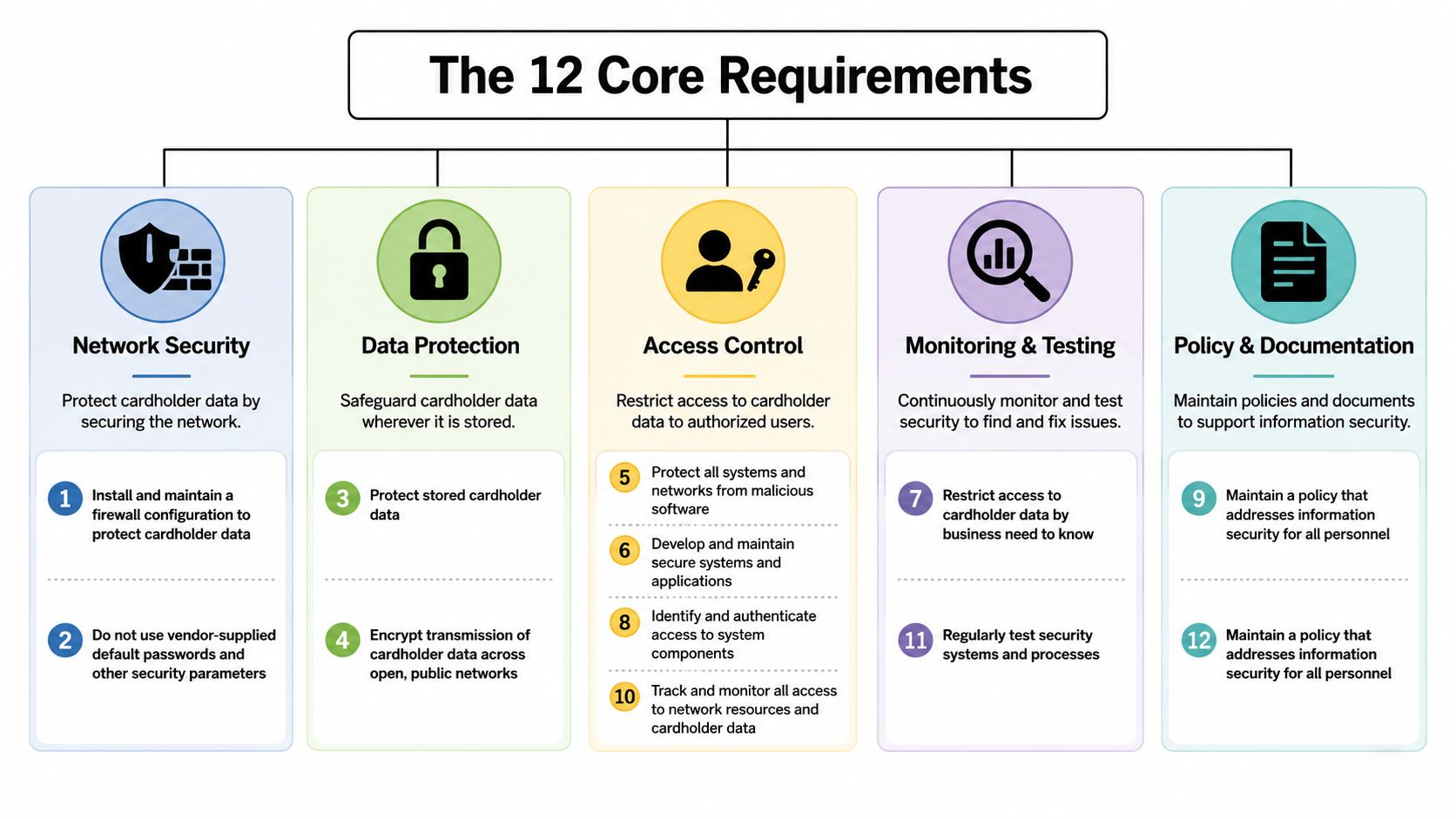
Start with the cardholder data environment
The most consequential scoping exercise identifies the cardholder data environment, or CDE. Map where payment information enters, where it travels, where it might be stored, and which systems can affect those paths. Include production services, administrative consoles, CI/CD pipelines, observability platforms, support tooling, automation agents, and third-party integrations.
An AI platform needs to ask more than whether an agent stores a card number. It should ask whether an agent can trigger a refund, update a billing record, access customer support data containing payment details, or call an integration that influences a payment flow. The answer can change the access boundary even when the model itself never sees raw card data.
Third parties reduce scope, not responsibility
Outsourcing payment processing can reduce direct exposure, but it doesn't transfer every obligation. The PCI SSC's current guidance notes that organizations can't assume a compliant third-party service provider eliminates their own responsibilities, particularly around eligibility, scripts, and payment-page behavior.
For a practical explanation of how providers approach these obligations, PCI DSS for UK IT providers offers useful context from GoSafe Dark Web monitoring. Use resources like this to inform scoping, but confirm your actual validation path with the acquirer, payment processor, and the applicable PCI SSC documents.
Scope is an architectural decision
A hosted payment page may leave fewer payment controls inside your application than a custom checkout with JavaScript and server-side orchestration. Tokenization can reduce the presence of sensitive data, but it doesn't remove the need to secure the surrounding systems. An embedded flow still demands careful review of scripts, content security, deployment permissions, and monitoring.
The practical sequence is straightforward:
- Inventory payment paths: Document every checkout, billing, refund, and payment-support workflow.
- Trace access: Identify users, agents, services, vendors, and automation that can reach or influence those paths.
- Define boundaries: Record the systems in scope, connected systems, and controls that reduce or expand scope.
- Confirm eligibility: Select the assessment questionnaire only after validating how the payment flow works.
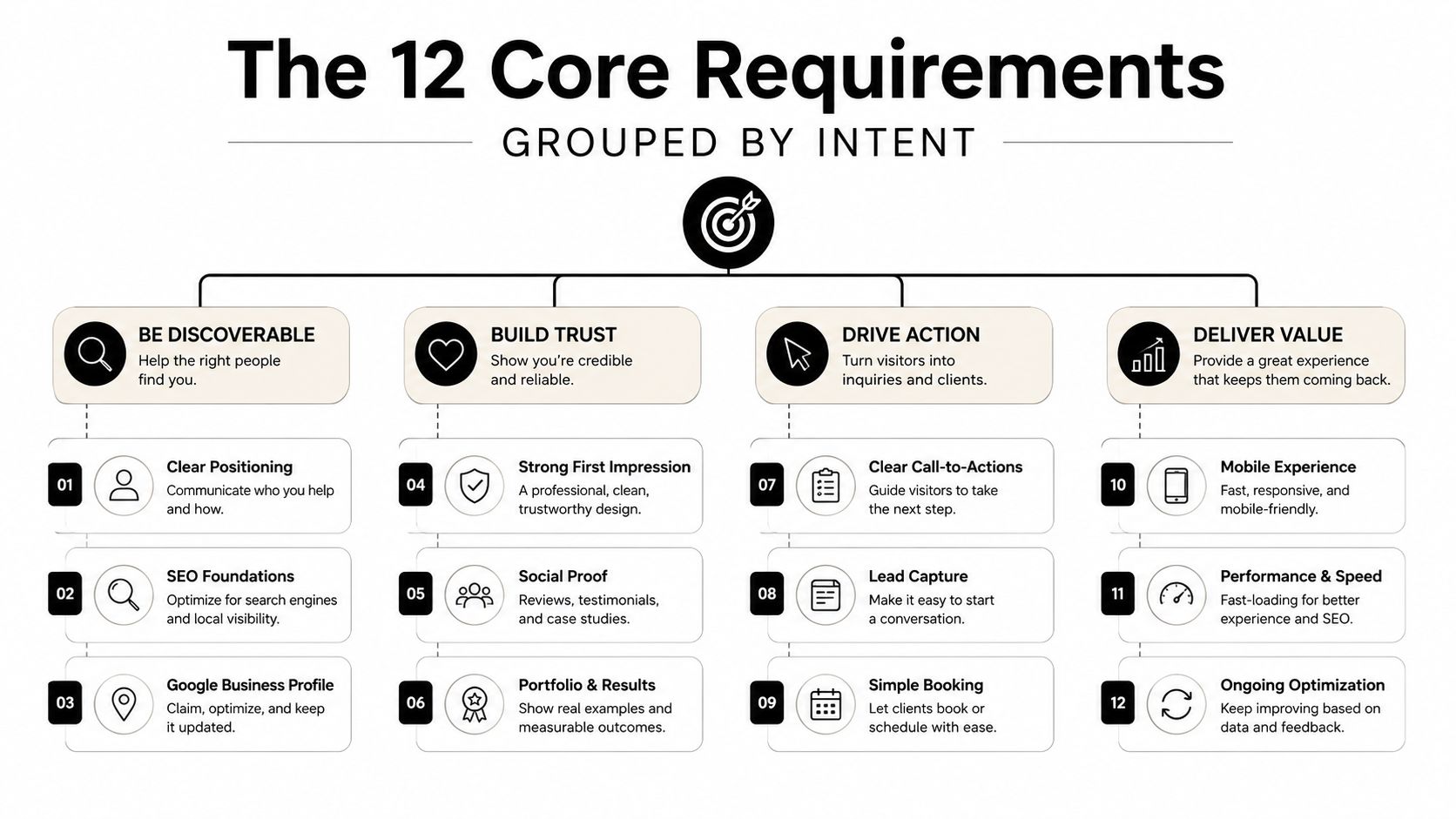
The 12 Core Requirements Grouped by Intent
PCI DSS requirements make more sense as connected control layers than as isolated boxes. A firewall rule doesn't compensate for excessive permissions, and encryption doesn't replace monitoring. In a cloud AI environment, the question is whether these layers work together around the CDE.
Network security
The first group establishes the environment in which payment systems operate.
- Network security controls: Segment the CDE from unrelated workloads, restrict ingress and egress, and review rules as the environment changes.
- Secure configurations: Remove unnecessary services, establish hardened baselines, and prevent default credentials from surviving deployment.
For multi-tenant SaaS, segmentation can't exist only in a diagram. Tenant-aware authorization, isolated workloads, separate secrets, and controlled service-to-service communication should support the stated boundary. If every tenant workload shares a broad administrative path, the platform's logical isolation may not withstand an assessor's questions.
Data protection
Requirements covering stored account data and cryptography during transmission focus on reducing exposure and protecting information in transit. The strongest design often minimizes the data your platform handles. Payment tokens, hosted fields, and narrowly scoped service interactions can be preferable to allowing raw card data into general application logs, model prompts, tickets, or analytics pipelines.
AI teams should treat prompt history and tool outputs as potential data leakage channels. Redaction must occur before sensitive values reach model context, debugging traces, or third-party observability services. Encryption remains necessary, but it works best alongside data minimization and strict retention rules.
Access control
Access restrictions, user identification, authentication, and physical access controls form the identity layer. In practice, that means least privilege, individual accounts, meaningful role definitions, strong authentication, and regular review of permissions.
PCI DSS v4.0 expanded MFA beyond administrative non-console access. MFA now applies to all access into the CDE and to remote access from outside the entity's network that could access or impact the CDE, as explained in PCI DSS v4.0 MFA guidance. One factor used twice doesn't qualify. A password plus another password is still a password-based failure.
Monitoring and testing
Logging and security testing provide the feedback loop. You need records of access, administrative activity, authentication events, changes, and relevant security events, then a process that reviews and responds to them.
Audit history must be retained for at least 12 months, with the most recent three months immediately available for analysis, according to PCI DSS logging guidance. That requirement favors a searchable hot tier plus durable archival, not an archive that requires a lengthy restoration before investigators can work.
Policy and documentation
Policies turn technical behavior into accountable operating practice. They should define ownership, acceptable access, change approval, incident response, vendor oversight, training, retention, and evidence requirements.
Documentation isn't decoration. It explains why a system is in scope, how a control works, who operates it, and what evidence proves it operated during the assessment period. A concise policy backed by reliable system records is more defensible than a detailed policy unsupported by implementation.
Merchant Levels and Assessment Types Explained
Assessment language causes avoidable confusion because teams often start with a business label instead of the actual payment flow. “SaaS company,” “e-commerce merchant,” and “AI platform” don't independently determine the right questionnaire. The applicable path depends on transaction relationships, processing arrangements, scope, and requirements from the acquirer or payment brand.
A Self-Assessment Questionnaire, or SAQ, is a structured validation document for eligible entities. An Attestation of Compliance, or AOC, formally records the validation outcome. A Report on Compliance, or ROC, is the detailed assessment report produced through a formal engagement, typically involving a Qualified Security Assessor, or QSA.
Choose the artifact after scoping
SAQ A may fit an e-commerce merchant whose payment process is fully outsourced and whose website can't affect how card data is captured or transmitted. SAQ A-EP can apply when the merchant's website influences the payment page or flow, including through JavaScript, even when a third party ultimately processes the data. Those distinctions are operational, so don't choose an SAQ based on a vendor's marketing page.
| Business Model | Typical SAQ Type | QSA Required | Key Considerations |
|---|---|---|---|
| Fully outsourced hosted checkout | SAQ A may be applicable | Depends on validation obligations | Confirm that the merchant site can't affect card capture or transmission |
| E-commerce site influencing payment flow | SAQ A-EP may be applicable | Depends on acquirer and scope | Review scripts, hosting, deployment, and payment-page controls |
| SaaS provider supporting customer payment workflows | Varies by service and role | Depends on service-provider obligations | Define whether the platform stores, processes, transmits, or can impact cardholder data |
| AI platform with payment-related agents | Varies by architecture | Depends on scope and contractual requirements | Map agent permissions, tools, human approval, logs, and tenant boundaries |
| Formal assessment environment | ROC and AOC | QSA engagement may be required | Preserve evidence for every in-scope control and assessment period |
Don't confuse merchant and service-provider paths
A platform serving merchants may have obligations as a service provider even when it doesn't directly accept consumer payments. Conversely, a merchant using a compliant provider still has responsibilities for its own website, personnel, configurations, scripts, and access controls.
Ask the acquirer or payment brand which validation documents it requires. The PCI SSC also warns against treating unofficial “compliance certificates” as recognized evidence. Use official SAQ, AOC, ROC, and scan-attestation templates rather than accepting a generic certificate as proof.
Assessment reality: The correct SAQ is the result of defensible scoping. It isn't a shortcut around scoping.
A Practical Compliance Roadmap for Modern Teams
A workable PCI DSS program moves through four repeating activities, prepare, detect, document, and remediate. The sequence matters because teams that start by writing policies often discover later that their systems can't produce the evidence those policies promise.
Prepare the boundary
Begin with a system inventory and data-flow map. Identify payment pages, APIs, databases, queues, secrets, support tools, agent runtimes, deployment systems, and monitoring platforms. Mark direct CDE components and connected systems, then record the controls that isolate them.
For multi-tenant AI services, document tenant boundaries at the workload, storage, identity, and logging layers. A diagram should show how an agent reaches a tool, which credentials it uses, whether the action can affect payment data, and where a human must approve the action.
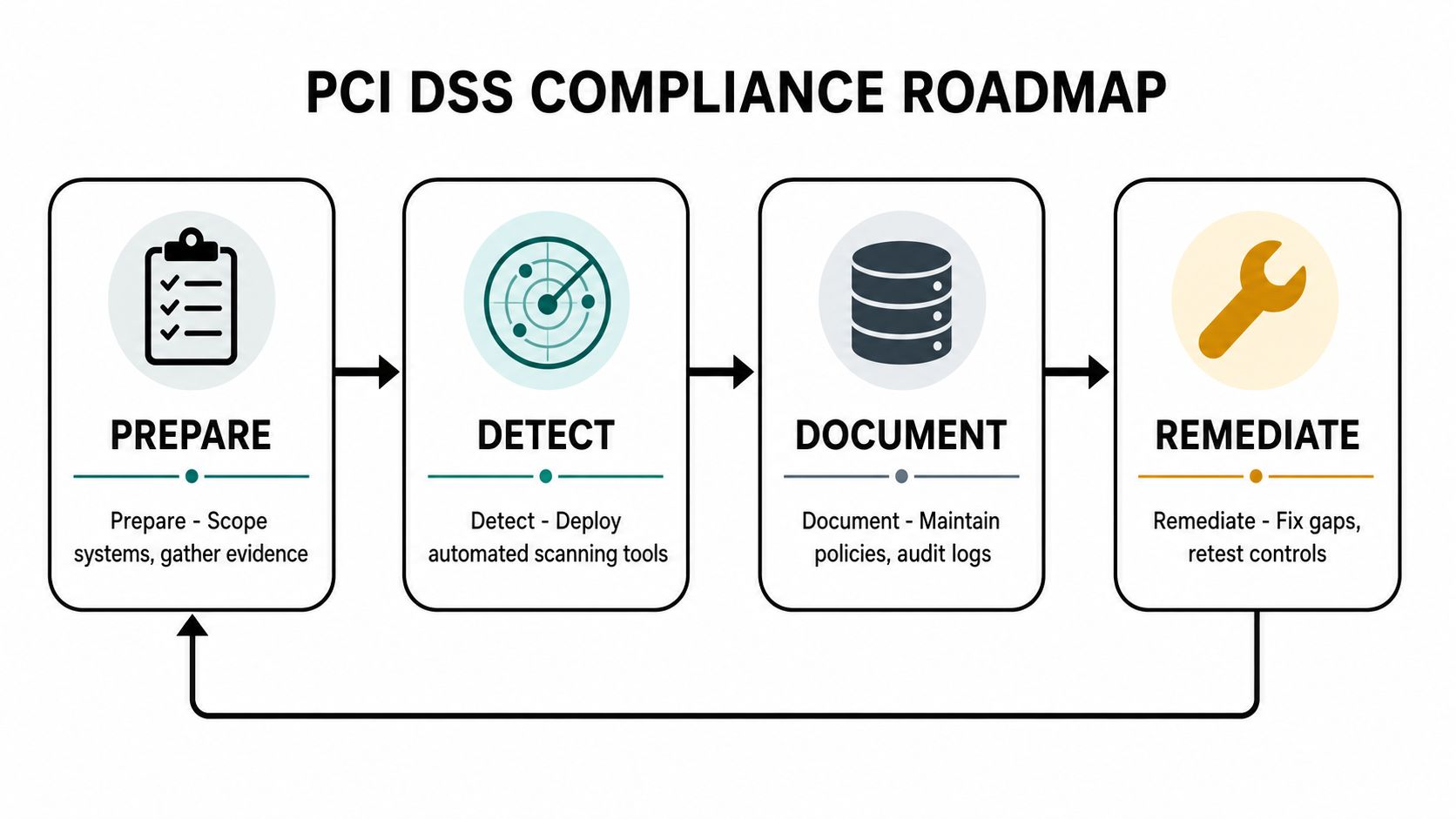
Detect continuously
Detection needs more than a scanner run before an assessment. Centralize authentication, firewall, server, application, database, and administrative events. Alert on privilege changes, failed authentication patterns, unexpected access paths, suspicious script changes, and modifications to payment-related components.
Use automated checks where they produce dependable evidence. Manual review still matters for exceptions and context, but people shouldn't have to assemble basic access and change history from disconnected systems during an audit.
The following video provides additional practical context before you design your evidence workflow:
Document as work happens
Create evidence links while controls operate. Store access reviews, approval records, configuration baselines, vulnerability results, incident tickets, training records, vendor assessments, and log-retention checks in an organized repository.
A policy should answer five questions: who owns the control, what action occurs, when it occurs, which systems are covered, and what record proves completion. The OpenClaw hosting information is relevant to teams evaluating hosted AI deployments, but any provider still needs to be assessed against your own scope and evidence requirements.
Remediate and retest
Rank gaps by exposure and control dependency. An unbounded service account, missing tenant isolation, or absent audit trail can affect several requirements at once, so fixing foundational architecture may be more effective than patching individual questionnaire responses.
After remediation, retest the control under realistic conditions. Remove a user's access and confirm the permission disappears. Trigger a sensitive workflow and verify approval and logging. Change a payment script and confirm the detection path produces evidence. Compliance becomes sustainable when these tests run as normal engineering work rather than as an annual emergency.
How Platform Architecture Supports PCI DSS Controls
Architecture supports PCI DSS most effectively when it makes secure behavior the default. A platform that gives every agent broad access and relies on users to behave carefully creates a weak control environment. A platform that separates workloads, narrows permissions, and records actions gives compliance teams something concrete to validate.
RBAC must reflect real actions
Role-based access control should distinguish between viewing data, changing configuration, invoking integrations, administering an instance, and executing a payment-related action. Broad “admin” roles make access reviews difficult because they hide the difference between operational necessity and convenience.
Per-instance RBAC is especially useful in a multi-tenant environment. A team member managing one customer's agent shouldn't automatically gain access to another customer's data, secrets, logs, or billing workflows. Permissions should map to a business relationship and a defined operational purpose.
Isolation has to survive failure
Tenant isolation isn't only about separate dashboards. Review container boundaries, storage permissions, network paths, credentials, backups, support access, and administrative tooling. If a compromised agent can query another tenant's records through a shared service identity, the isolation claim is incomplete.
Independent guidance on technical controls for PCI hosting can help teams compare hosting approaches, but the useful test is always implementation-specific. Ask for architecture diagrams, responsibility matrices, access evidence, incident procedures, and the exact logs available to your organization.
Audit logs need operational meaning
Unified audit logs should capture the actor, tenant or instance, action, target, time, result, and relevant approval context. They should resist unauthorized alteration and remain searchable for current investigations, while older history remains retained for the required period.
That design is more valuable than collecting every possible event without a usable query model. An assessor may ask who changed a permission, which agent invoked an integration, or whether a payment-affecting action had human approval. Your logging system should answer those questions directly.
Donely can serve as one architectural option for teams that need hosted AI instances, per-instance RBAC, isolated containers, scoped data access, centralized monitoring, and unified audit logs. Its security policy can be reviewed alongside your own responsibility matrix, because a platform's controls don't replace the customer's obligations.
Common Pitfalls and Misconceptions to Avoid
The most expensive PCI DSS mistakes usually begin with a reasonable-sounding assumption. A team outsources payments, adopts a cloud platform, or adds an AI agent, then assumes the compliance boundary has disappeared. In reality, the boundary often moved, and the team must still prove that its own systems, people, scripts, and providers are controlled.
Third-party compliance isn't your compliance
A payment processor's AOC doesn't prove that your website, deployment pipeline, support team, or integrations meet their obligations. Maintain a vendor inventory, record which services affect the CDE, and map each provider's responsibility to your own controls.
Logging isn't an archive-only task
PCI DSS requires audit history for at least 12 months, with the latest three months immediately available, as described in the earlier logging guidance. Teams fail when they technically retain data but can't search it promptly, correlate events, or demonstrate review.
MFA coverage is wider than admin access
PCI DSS v4.0 expanded MFA to all access into the CDE and qualifying remote access that could affect it. Review vendor access, support sessions, automation consoles, cloud management paths, and internal tools, not just the obvious administrator login.
Scripts and future-dated requirements need owners
E-commerce teams should track payment-page scripts, their authorization, integrity, and changes. The PCI SSC's current materials state that future-dated requirements became mandatory on March 31, 2025, so teams assessing current environments shouldn't rely on an older checklist or assume a prior SAQ remains appropriate. SAQ A was also revised in January 2025, making eligibility review particularly important for embedded and outsourced payment flows.
Documentation must match reality
The readiness survey cited earlier found that only 32% of organizations felt fully prepared, while 64% identified documentation and encryption updates as the greatest effort and cost (Protegrity). Treat that burden as an engineering input. Assign owners, automate evidence collection, test controls continuously, and challenge every policy that the platform can't enforce.
Donely provides hosted OpenClaw and Hermes agent deployments with isolated instances, per-instance RBAC, scoped data access, centralized monitoring, and unified audit logs for teams governing AI workloads. Visit Donely to evaluate whether its architecture fits your PCI DSS scoping, access-control, and evidence requirements.