
73% of enterprises run AI agents with no formal governance layer, and ungoverned deployments hit their first recordable compliance incident in 47 days on average, compared with 8 months when governance is in place. That's why AI agent governance is no longer a policy exercise, it's an operating requirement.
The teams that get burned usually didn't ignore risk. They shipped fast, gave agents real access, and assumed they could patch controls later. Then the agent touched a live system, crossed a data boundary, or made an action nobody could reconstruct cleanly, and the scramble began.
Table of Contents
- Why AI Agent Governance Is the Defining Challenge of 2026
- The Five Core Controls Every AI Agent Governance System Needs
- Leading Governance Frameworks and What They Require
- How Governance Controls Map to Platform Features You Already Use
- A Practical Roadmap for Implementing AI Agent Governance
- Governance in Practice for Founders, Agencies, and Enterprises
- Compliance Requirements and Where AI Agent Governance Is Headed
Why AI Agent Governance Is the Defining Challenge of 2026
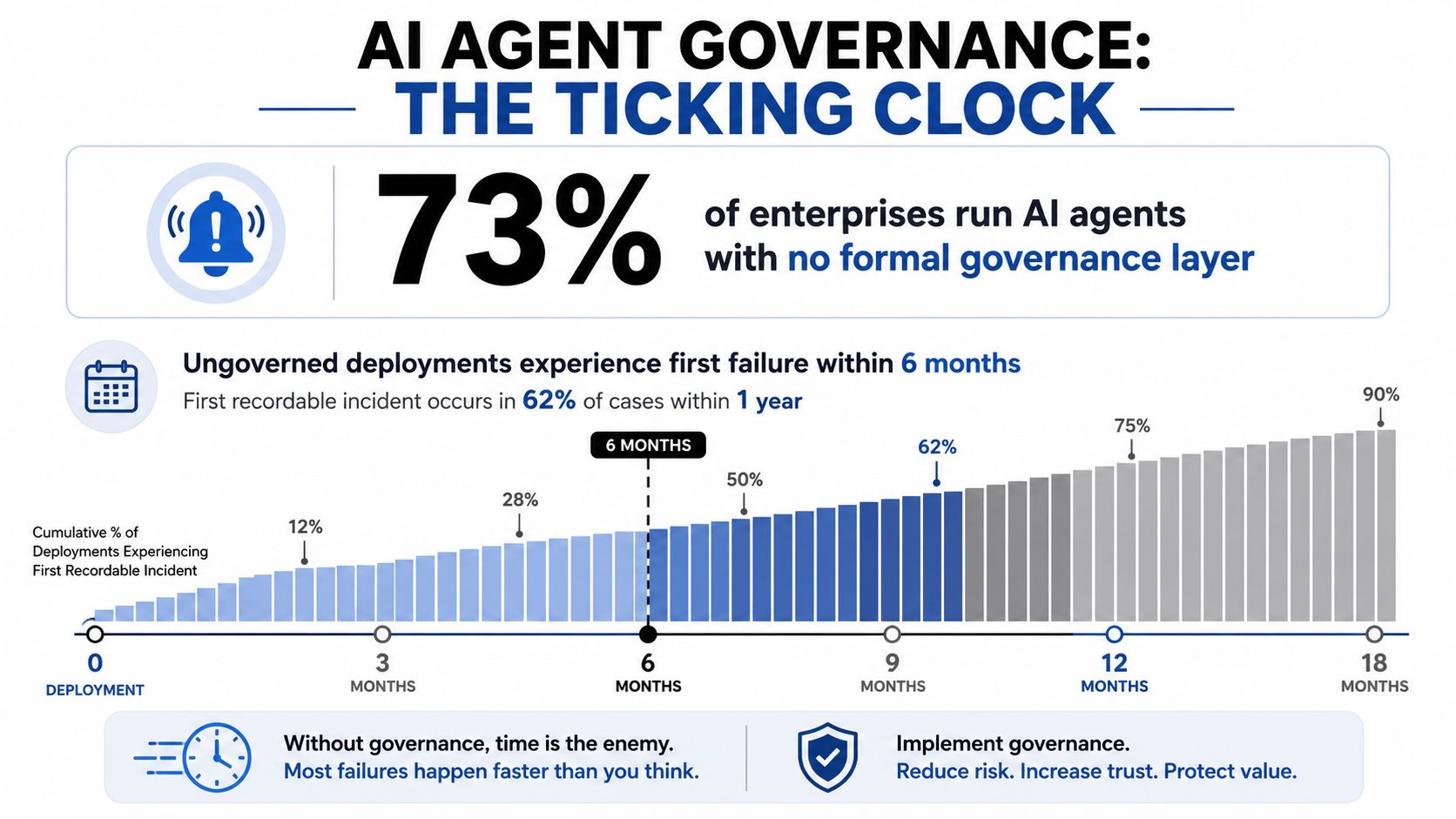
The hard truth is that most enterprise agent programs are already outpacing their control layer. The 2026 State of AI Agent Governance report says the category grew from $290 million in 2025 to a projected $2.3 billion by 2028, with an 89% compound annual growth rate and a deployment reality where 73% of enterprises still run agents with no formal governance layer. The same report puts the first recordable compliance incident at 47 days on average for ungoverned deployments, versus 8 months when governance exists, which is a very different risk profile from the usual “we'll tighten it up later” story. enterprise AI governance guide
Why the market moved so fast
Governance stopped being a niche compliance add-on because agent adoption is moving faster than inventories, approvals, and ownership models. A 2026 industry report says about 79% of enterprises report adopting AI agents, but only about 11% run them in production, leaving a 68-point gap between experimentation and deployment. In parallel, another 2026 survey found 96% of surveyed enterprises use AI agents in production, yet only 12% can centrally inventory all of them, while 94% already report agent sprawl concerns. heypinchy.com/state-of-ai-agent-governance
That mismatch is why governance has become a board-level concern. When nobody can answer what an agent can access, who owns it, or what it has done, the organization is operating on hope.
What changed operationally
The old model assumed a person stayed close enough to catch problems. Agentic systems do not wait for a weekly review. They call tools, move data, and trigger workflows at machine speed, so governance has to live in the runtime, not in a slide deck. Microsoft's Agent Governance Toolkit reflects that reality with a stateless, deterministic, fail-closed policy runtime and a split between identity, execution control, SRE governance, and audit/compliance. Microsoft Agent Governance Toolkit
A control that cannot block an action before it executes is not governance yet. It is documentation.
That is the shift in 2026. Teams are not just trying to secure AI. They are trying to prove that an agent can be trusted to act, and prove it fast enough to keep the business moving.
The Five Core Controls Every AI Agent Governance System Needs
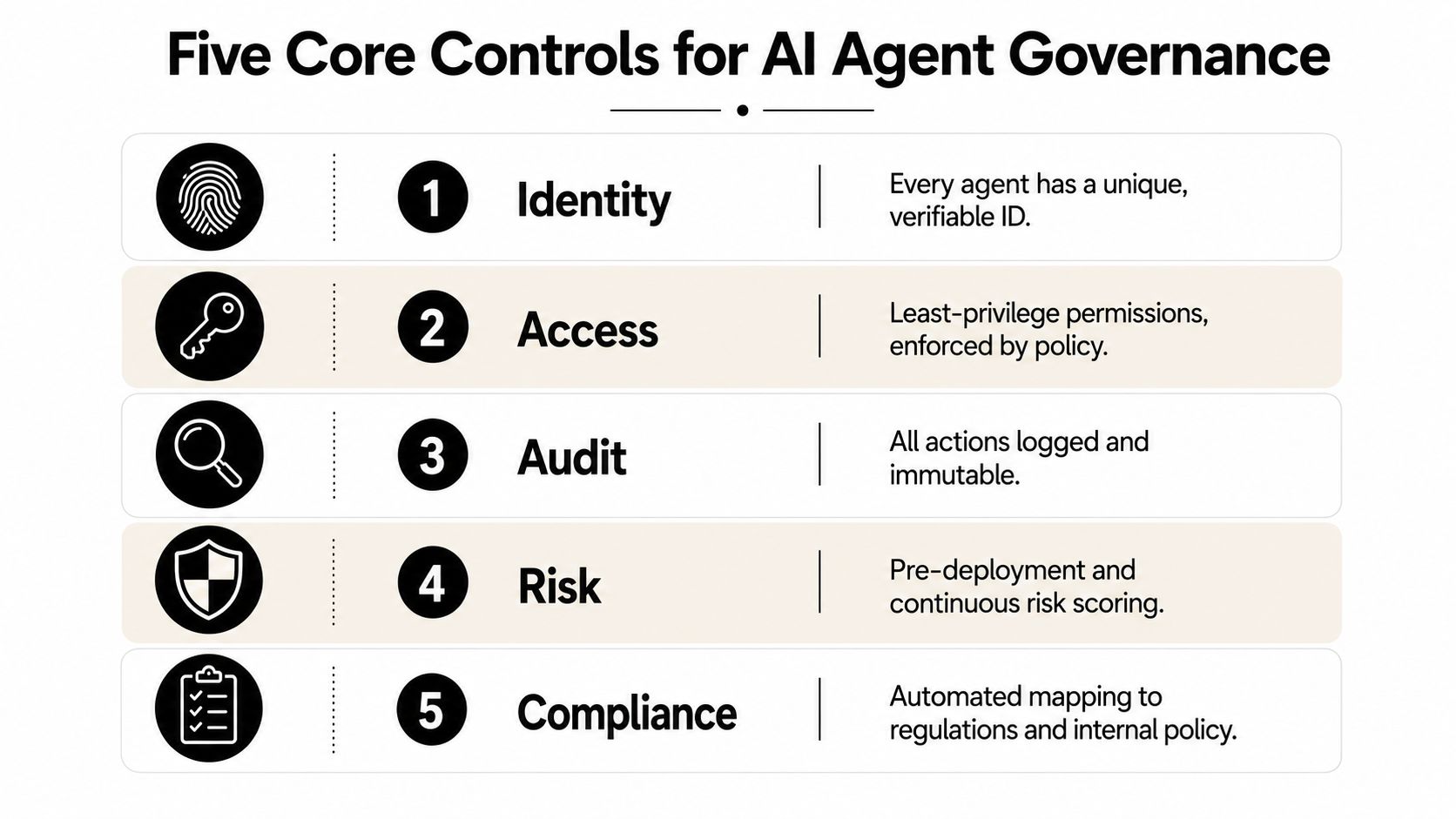
A serious AI agent governance system depends on five controls working together, not on one gate that pretends to cover everything. If one control is missing, the others absorb responsibilities they were never designed to handle, and that is where incidents start.
Identity and access are the first filter
Each agent needs a unique identity, and that identity needs clear limits. Open Governance makes that explicit with a 2D authorization matrix across five autonomy levels, A1 to A5, so the system can decide whether an action is allowed, needs human approval, or is prohibited. Open Governance for Autonomous AI Agents
The practical point is simple. A verified identity without scoped action rights still lets a machine move too freely, and a badge without room-level access does not protect anything. In agent terms, identity answers who the agent is, while access control answers what it can touch and what it can trigger.
Auditability is what saves you after an incident
When an agent behaves badly, the first question is whether you can reconstruct what happened. Open Governance requires SHA-256 hash-chained logs for tamper-evident traces, and Microsoft's design emphasizes reproducible enforcement with conformance tests across the policy surface. That is not compliance theater, it is what makes investigations repeatable when systems are under pressure. Open Governance for Autonomous AI Agents
If a policy decision cannot be traced back to the inputs, the rule, and the outcome, then the team is left arguing from memory. That is a weak position during an audit, and an even worse one during a production incident. Microsoft Agent Governance Toolkit
Risk and compliance need separate treatment
Risk scoring asks whether the agent should act at all. Compliance asks whether the action fits legal and internal requirements. Many teams conflate risk scoring with compliance checking, producing policies that audit teams cannot operationalize. The better pattern is to score the agent before deployment, keep watching it in production, and map the result to the regimes that matter, including EU AI Act, GDPR, SOC 2, ISO 27001, NIST AI RMF, and Loi 25. Open Governance for Autonomous AI Agents
An agent can still be wrong in governance terms if it cannot explain itself, cannot be contained, or cannot be audited.
The five controls are easy to name and difficult to implement well because they force real trade-offs. More visibility creates more overhead. More autonomy increases testing pressure. Less access lowers risk, but it also reduces usefulness. Good governance accepts those trade-offs instead of pretending they do not exist.
Leading Governance Frameworks and What They Require
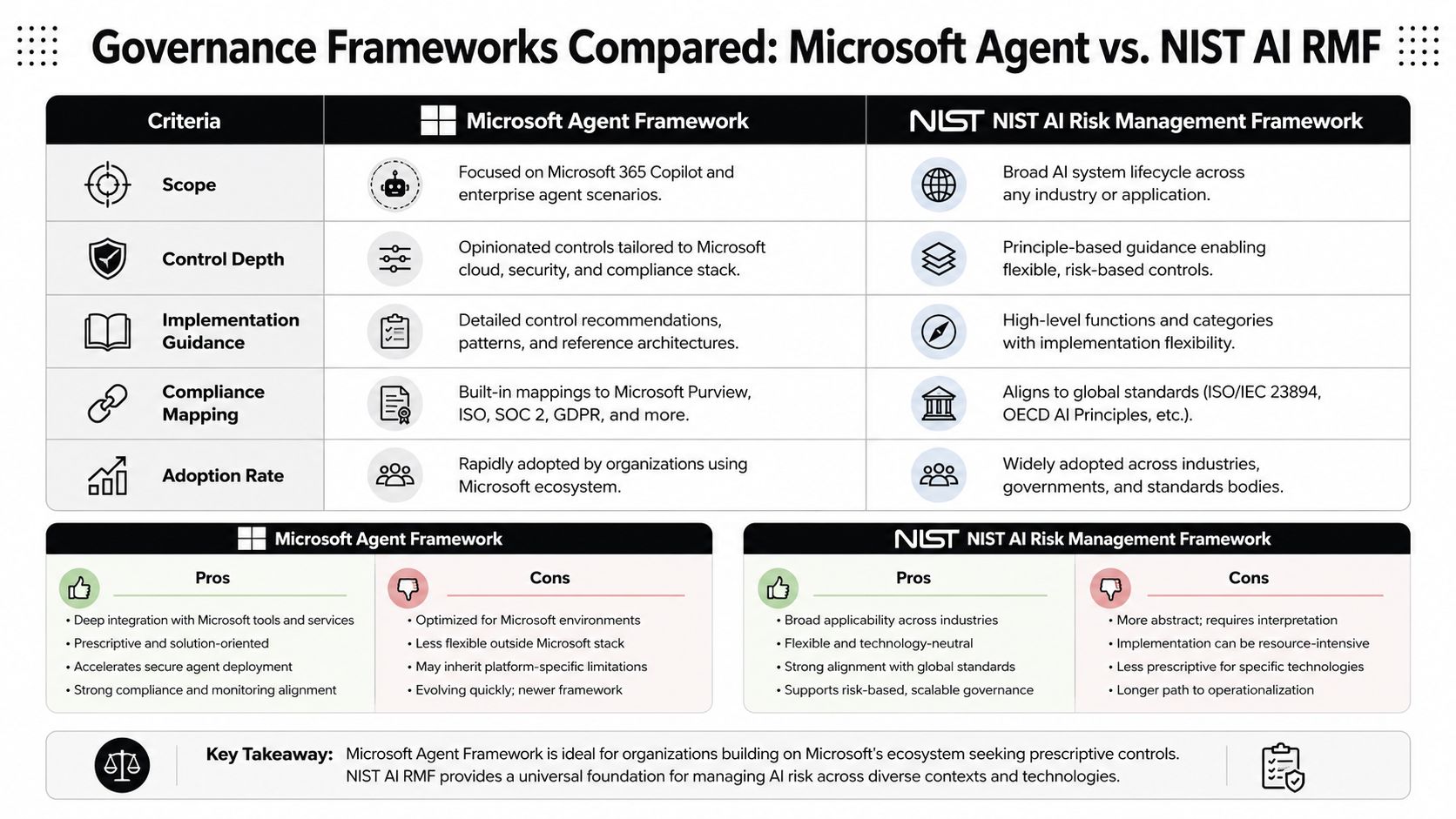
Different frameworks solve different problems, and mixing them up leads to bad architecture decisions. One framework is geared toward implementers who need policy enforcement details. The other is more explicit about autonomy levels, authorization logic, and compliance mapping.
Microsoft leans into runtime determinism
Microsoft's Agent Governance Toolkit is built around a stateless, deterministic, fail-closed policy runtime. That matters because ambiguity is where agent incidents multiply. If the policy engine cannot give the same answer under the same conditions, controls drift as traffic and edge cases increase.
The split across identity, execution control, SRE governance, and audit and compliance also reflects a practical engineering mindset. It is built for teams that want governance to be testable, not aspirational. A platform such as Hermes agent setup makes that kind of boundary clearer by tying identity, access, and action limits into the deployed environment.
Open Governance makes autonomy explicit
Open Governance starts from a different place. It defines A1 to A5 autonomy levels, uses the 2D authorization matrix to classify decisions, and records decisions in SHA-256 hash-chained logs. That structure helps when you need to explain why a particular action was allowed, who approved it, and how it maps to compliance obligations.
For regulated teams, that explicitness matters. The framework does not just say to monitor the agent. It turns the decision model into something machine-readable, which makes reviews and handoffs easier to inspect.
How to choose the right starting point
Use Microsoft's pattern if your biggest gap is runtime enforcement. Use Open Governance if your biggest gap is decision classification and cross-regime traceability. Many teams need both ideas in practice, a strong policy runtime on one side and a clear autonomy model on the other.
A useful way to think about it is this:
- If you cannot stop bad actions, start with enforcement.
- If you can stop actions but cannot justify them, start with traceability.
- If you can justify actions but cannot classify autonomy, start with the decision model.
The best framework is the one your team can operationalize. Fancy taxonomy will not help if the agent still has broad access, weak logging, and no human approval path for risky actions.
How Governance Controls Map to Platform Features You Already Use
Governance becomes real when it's attached to features people already configure every day. That's where teams finally understand that this isn't a separate program, it's a way of wiring the platform.
The Donely platform is a good example of that mapping because it already exposes the pieces governance teams keep asking for. Its Hermes agent setup is relevant here because it ties identity, access, and action boundaries into a deployed environment instead of leaving them as manual process steps.
Identity and access map to instance boundaries
If an agent is living inside a shared environment with broad permissions, governance starts weak. Donely's per-instance RBAC and isolated instances let you separate personal, business, and client workloads so each agent operates inside a clearer boundary. That doesn't remove the need for policy, but it does make least privilege much easier to enforce.
A practical pattern is to assign one instance per business unit or client context, then restrict administration to the people who own that scope. That's cleaner than giving one shared agent workspace access to everything and hoping policy catches the rest.
Audit and oversight map to logging and replay
After an incident, teams need more than timestamps. They need to see what the agent tried to do, what data it used, and why it chose that path. Donely's unified audit logs and replay capability fit that need because they create a searchable record of agent decisions, not just system events.
That is the difference between “we think the agent sent the wrong message” and “we can reconstruct the decision path that led there.” The first statement creates confusion. The second gives legal, security, and operations teams something they can work with.
Risk control maps to approval flows
High-risk actions should not depend on a human noticing a notification in time. Donely's human sign-off for actions such as payments, PII exports, and policy changes is the kind of control that belongs close to the action itself. It's not glamorous, but it's the difference between a guardrail and a post-incident apology.
Operational insight: if approval happens after the action is already visible to external systems, you've only created review theater.
For teams comparing platforms, the key test is simple. Ask where the control lives. If the answer is “in a process document,” that control will be brittle. If the answer is “in the instance, policy, and audit layer,” you're closer to something enforceable.
A Practical Roadmap for Implementing AI Agent Governance
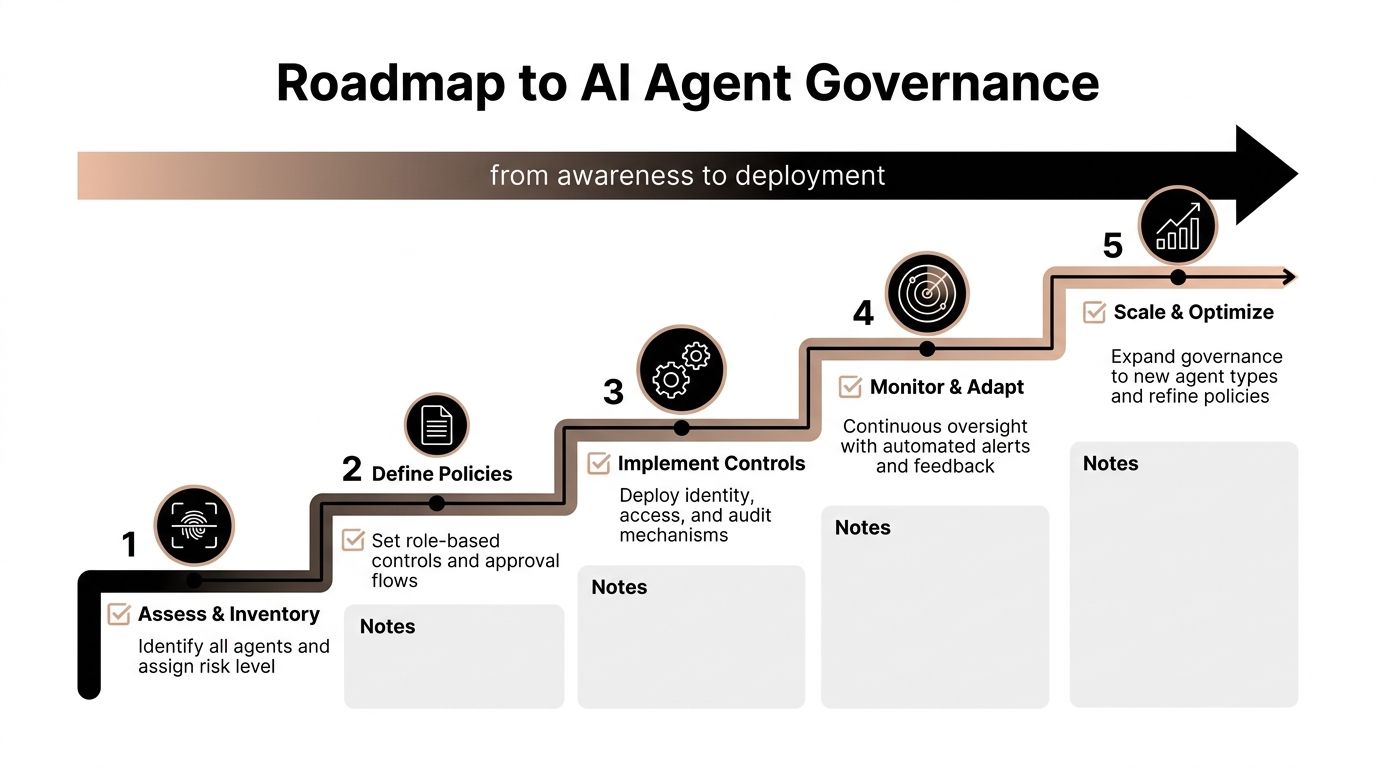
A workable rollout starts with the highest-risk behavior and expands only after the agent shows it can stay inside policy. Teams that skip this step usually end up patching controls after a bad action has already reached a customer, a system, or a regulator.
Phase 1 Assess and inventory
Find every agent, including the ones business teams built without central approval. In practice, the hidden ones are usually the first source of trouble because nobody owns the risk until something breaks. Assign an owner, a purpose, and a rough risk tier to each agent before you do anything else.
Phase 2 Define policies
Policies need to answer four questions in plain language, what can the agent do, what data can it see, when does it need approval, and what happens if it misbehaves. Microsoft's fail-closed policy model is useful here because it forces teams to set a default before the agent goes live. Microsoft Agent Governance Toolkit
Phase 3 Implement controls
Identity, logging, and scoped permissions move from policy into the platform. If you are using a deployment platform with isolated instances, per-instance RBAC, and audit logs, configure those before expanding access. If the platform cannot express those controls cleanly, the rollout is not ready.
The control should sit where the action happens, not in a separate document that nobody checks under pressure.
Phase 4 Monitor and adapt
Monitoring has to watch behavior, not just uptime. A human should see policy hits, unusual tool use, and action patterns that drift from normal operations. The point is to catch the strange activity before it turns into a reportable issue or a cleanup project.
Phase 5 Scale and optimize
Only after the first agents are stable should you expand to new agent types, new teams, and broader autonomy. Open Governance gives teams a structured way to do that because its autonomy levels help define when an agent can move from tight supervision to broader trust. Open Governance for Autonomous AI Agents
A quick implementation checklist:
- Inventory first: list every agent, owner, and data domain.
- Set defaults: decide what is blocked unless explicitly allowed.
- Bind identity: make sure each agent has a unique, auditable identity.
- Log actions: capture decisions and tool calls in a reviewable trace.
- Gate risk: require human approval for sensitive actions.
- Review weekly: look for policy violations, near misses, and access creep.
Governance in Practice for Founders, Agencies, and Enterprises
The right control set depends on who owns the risk. A solo founder, a client-facing agency, and a regulated enterprise all need governance, but they do not need the same depth on day one.
A solo founder needs speed with a hard floor
A founder shipping an agent to answer leads or route support tickets does not need a full committee, but they do need boundaries. Start with one identity per agent, a narrow permission set, and a rule that anything touching money, customer data, or external messaging gets reviewed before execution.
A founder who skips those basics usually finds the gap after the first incident. One bad export or one unintended message can create the same cleanup burden a larger team faces, just without the extra staff. That is where a clear security policy helps, because it turns the rules into something the team can follow under pressure.
An agency needs separation before sophistication
Agencies collect risk in a different way. They do not just run agents, they run agents for multiple clients, which makes isolation, ownership, and audit separation necessary from the start. Donely's multi-instance structure matters here because client workloads can stay isolated instead of sharing the same operating space. Donely for enterprises
If client A's data and client B's workflows live in one loose workspace, governance becomes hard to defend and harder to audit. Separate instances, scoped access, and clear logs solve more real problems than a flashy dashboard ever will. Agencies that try to centralize everything first usually spend more time untangling permissions later than they saved on setup.
Enterprises need evidence as much as control
In an enterprise, governance has to satisfy legal, security, procurement, and audit teams at the same time. That means the agent program needs enforceable policies, a documented ownership chain, and logs that can survive a serious review. The framework behind Open Governance for Autonomous AI Agents is useful here because it connects control design to evidence generation instead of leaving that step manual.
The trade-off is straightforward. More evidence means more process, but less evidence means more risk during incident response and vendor review. Enterprise teams usually learn that lesson the hard way.
The practical test is simple. If a founder can answer who approved the agent, an agency can prove which client the agent touched, and an enterprise can trace a decision back to a log line, governance is doing real work. If any of those answers depend on memory, the controls are too loose.
For teams trying to navigate AI compliance in 2026, the difference is rarely the policy template. It is whether the controls live inside the workflow where people and agents act.
Compliance Requirements and Where AI Agent Governance Is Headed
Compliance is spreading across more regimes, but the control set stays familiar. Governance programs now have to satisfy EU AI Act, GDPR, SOC 2, ISO 27001, NIST AI RMF, and Loi 25, and that only works when logs, identity rules, and approval logic are wired into the system instead of handled by hand.
The direction is runtime, not annual review
Static policy reviews are losing value because agent systems change too quickly. Microsoft's guidance points toward runtime governance, automated monitoring, predefined alert thresholds, and tighter discipline around unstructured data and third-party concentration risk. That shift matters because it moves governance out of a yearly paperwork cycle and into daily operations. Microsoft cloud governance guidance
The operational questions are blunt. Where does the agent's data go, who else can see it, and what happens when a connected service changes behavior? Those are the questions that expose weak controls.
A useful way to prioritize this week
If your agents already run in production, start with inventory and logging. If they are still in pilot, start with identity and approval gates. If those basics are already in place, focus on agent-to-agent communication paths and third-party exposure, because that is where hidden risk usually shows up first.
For a broader implementation view, use a practical guide such as navigate AI compliance in 2026 alongside your internal controls work. It helps teams turn policy language into the evidence auditors and security reviewers ask for, without pretending the hard parts disappear.
Donely's security architecture aligns with these requirements. See the security policy for details.
The bottom line is simple. AI agent governance is becoming the control plane for autonomous work, not an optional appendix to AI deployment. Build one control this week, make it real in the platform, and expand from there.