
By 2026, 66% of customer service organizations were using AI agents, up from 39% in 2025, a 1.7× year-over-year increase. The shift marks a change in operating design, not just a surge in chatbot experiments. Teams are using customer support AI agents to triage requests, retrieve answers, take approved actions, and hand complex conversations to people across web chat, voice, and messaging channels. Industry adoption data
The hard part starts after the demo. Production agents fail when they can access too much data, act without clear permissions, lose context during escalation, or remain “healthy” at the infrastructure level while giving customers wrong answers. A reliable rollout therefore needs more than a language model and a help center. It needs controlled scope, curated knowledge, explicit action boundaries, role-based access control, isolated workloads, traceable handoffs, and an operating rhythm for reviewing failures.
Table of Contents
- Why Customer Support AI Agents Are Now Standard Operations
- Designing Your Agent Scope Knowledge and Resolution Goals
- Launching Your Agent With Integrations and Channels
- Building Hybrid Escalation That Protects CSAT
- Securing and Scaling With RBAC Data Isolation and Multi Instance Control
- Monitoring Metrics and Cost Control for Long Term Performance
Why Customer Support AI Agents Are Now Standard Operations
About 85% of customer service organizations use at least one form of AI, a sign that automation has moved into the frontline operating layer. The practical question is no longer whether to run a pilot. Support leaders must decide which workflows are safe to automate, which permissions an agent receives, and where a person remains accountable.
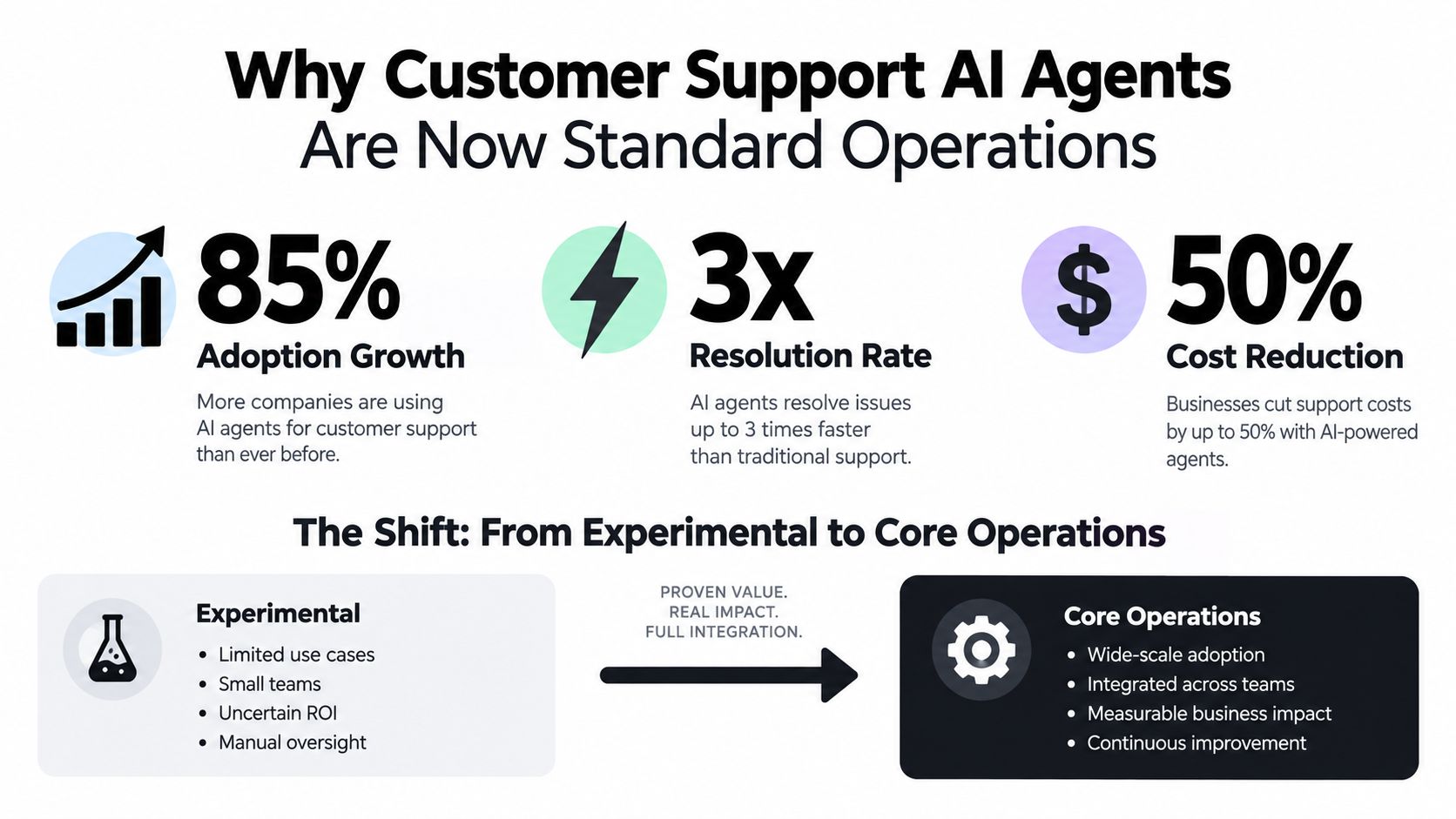
A conventional chatbot answers questions from a narrow script. A customer support AI agent coordinates a workflow. It can identify intent, retrieve an approved policy, check an order system, update a subscription, confirm the result, or route the case to a human. Support work includes classification, authentication, system lookups, policy application, transaction execution, documentation, and escalation. Conversation is only one part of the job.
Routine work is the natural starting point
Requests with a clear intent and predictable resolution path provide the safest starting point. Order status, password resets, refund status, cancellations, subscription edits, and policy questions can run against constrained knowledge and a small set of approved tools. The agent should not improvise across every business system.
The operating model changes once the agent becomes a front door instead of a standalone widget. It can collect relevant details, apply routing rules, identify missing information, and preserve conversation history before a human takes over. That reduces repetitive triage while keeping sensitive decisions inside a governed workflow.
Practical rule: Treat the agent as a controlled service layer, not as an employee with unrestricted access to every system.
The scale of autonomous resolution is also pushing teams to formalize controls. Gartner projects that agentic AI will autonomously resolve 80% of common customer service issues by 2029, including order tracking, refunds, cancellations, and subscription changes. The Gartner forecast and resolution benchmarks describe early deployments resolving 30% to 50% of tickets end to end, with mature workflows reaching 50% to 70% autonomous resolution.
Those benchmarks support a selective rollout, not blanket automation. Emotional complaints, ambiguous requests, fraud concerns, policy exceptions, and cases involving vulnerable customers need stronger safeguards. Separate predictable work from high-risk work, then define the exact conditions that move a conversation to a person.
Governance must cover more than answer quality. Configure role-based access control so an agent can read only the data required for its assigned workflow and can perform only approved actions. Isolate customer data and workloads by tenant or environment, log tool calls and handoffs, and monitor failures that infrastructure checks will miss, such as unsupported claims or incorrect routing.
Teams evaluating platforms should examine deployment controls, auditability, escalation behavior, and channel coverage alongside conversation quality. A guide to customer service AI can frame the wider automation context, but implementation decisions remain operational: what can the agent read, what can it change, who approves those changes, and how will the team detect behavioral drift?
Designing Your Agent Scope Knowledge and Resolution Goals
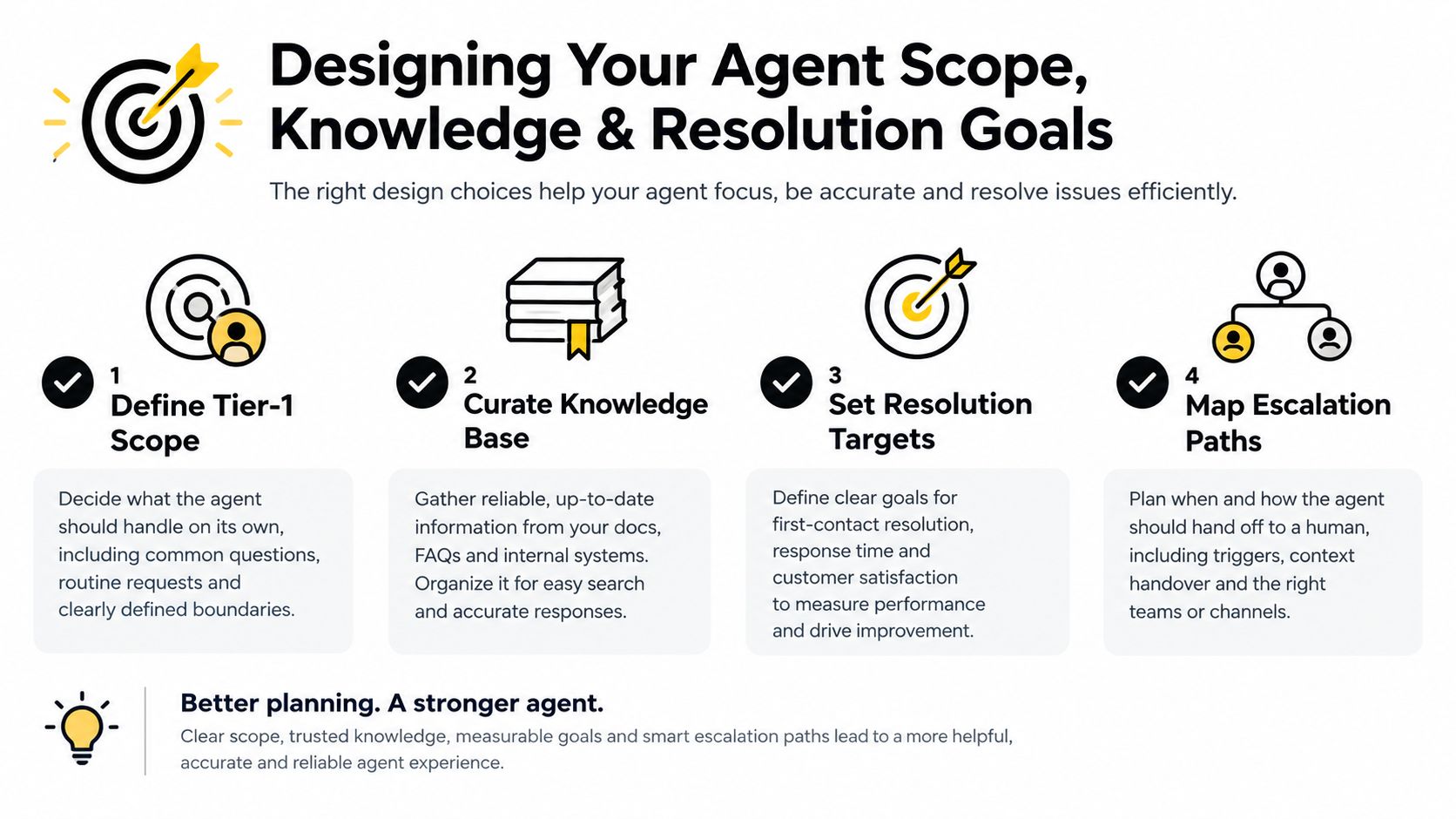
The first launch should be deliberately narrow. Broad instructions such as “handle customer support” create ambiguous behavior, unclear ownership, and difficult testing. A better design names the intent family, the data required, the permitted actions, the refusal conditions, and the exact handoff destination.
Start by baselining the existing workflow. Record current deflection, first-contact resolution, CSAT, and escalation rate for the intents you're considering. These measurements establish what “resolved” means before the agent changes the counting method. A conversation that ends with a helpful article but still requires a human follow-up is not an end-to-end resolution.
Constrain the first release
Choose the highest-volume intents with the clearest resolution rules. Good candidates include:
- Order status: Retrieve current fulfillment information and explain the next available step.
- Password reset: Verify the customer through the approved identity flow and initiate the reset.
- Refund status: Read the transaction state and explain whether the refund is pending, completed, or blocked.
- Subscription edits: Apply only the changes explicitly supported by the billing system.
- Policy questions: Answer from a maintained source, then escalate when the customer asks for an exception.
Give each intent its own test set and escalation rule. A single global success score hides uneven performance. An agent can answer shipping questions reliably while mishandling billing disputes, so the team needs intent-level accuracy, containment, escalation, and customer feedback.
Knowledge quality determines how safely the agent can answer. Remove contradictory articles, assign owners to policy documents, mark expired guidance, and write procedures in a form that maps directly to customer questions. Retrieval should prioritize a curated knowledge base rather than every historical ticket, because old conversations often contain exceptions, outdated policies, or informal workarounds.
Set targets that reflect operating maturity
Independent benchmark syntheses place launch resolution around 40% to 50% end to end, with tuned workflows reaching about 55% to 67%. Strong deployments can reach roughly 70% to 80% or more on well-scoped Tier-1 tasks, while reports above 90% generally apply to narrow, highly structured ticket types. The independent benchmark synthesis also warns that vendors may count partial deflection or chatbot interactions as resolution when human follow-up still occurs.
Use those ranges as planning context, not promises. Your baseline, intent mix, system integration quality, and escalation policy will determine the actual result. Set a launch target that protects customer experience, then raise it only when transcript reviews show that the agent is resolving the complete workflow.
Action permissions should follow the same discipline. Reading an order status is lower risk than issuing a refund. Drafting a response is lower risk than changing a subscription. Require confirmation or human approval for irreversible actions until the agent has demonstrated consistent behavior under realistic tests.
For channel-specific work, a restrained WhatsApp chatbot design offers a useful reminder: personality should support clarity and trust, not compensate for weak routing or unclear boundaries. Keep the tone natural, but make the rules explicit. The agent should say when it lacks enough information, explain what happens next, and avoid inventing a resolution to keep the conversation moving.
A shared company knowledge layer can help centralize approved procedures, but it still needs ownership, access boundaries, and review dates. Teams considering that model can examine Donely's company brain as one example of how organizational knowledge might be structured for agent access.
Launching Your Agent With Integrations and Channels
A production launch connects three layers: the knowledge layer, the action layer, and the customer channel. If any layer is missing, the result is either a passive FAQ bot or an overpowered system that can make changes without enough control.
Begin with retrieval. Connect the agent to the approved help center, policy documents, product references, and internal procedures. Keep the source set intentionally small during the pilot. When a customer asks about a refund, the agent should retrieve the current refund policy and transaction information, not search an unfiltered archive for a plausible-sounding answer.
Connect tools with action boundaries
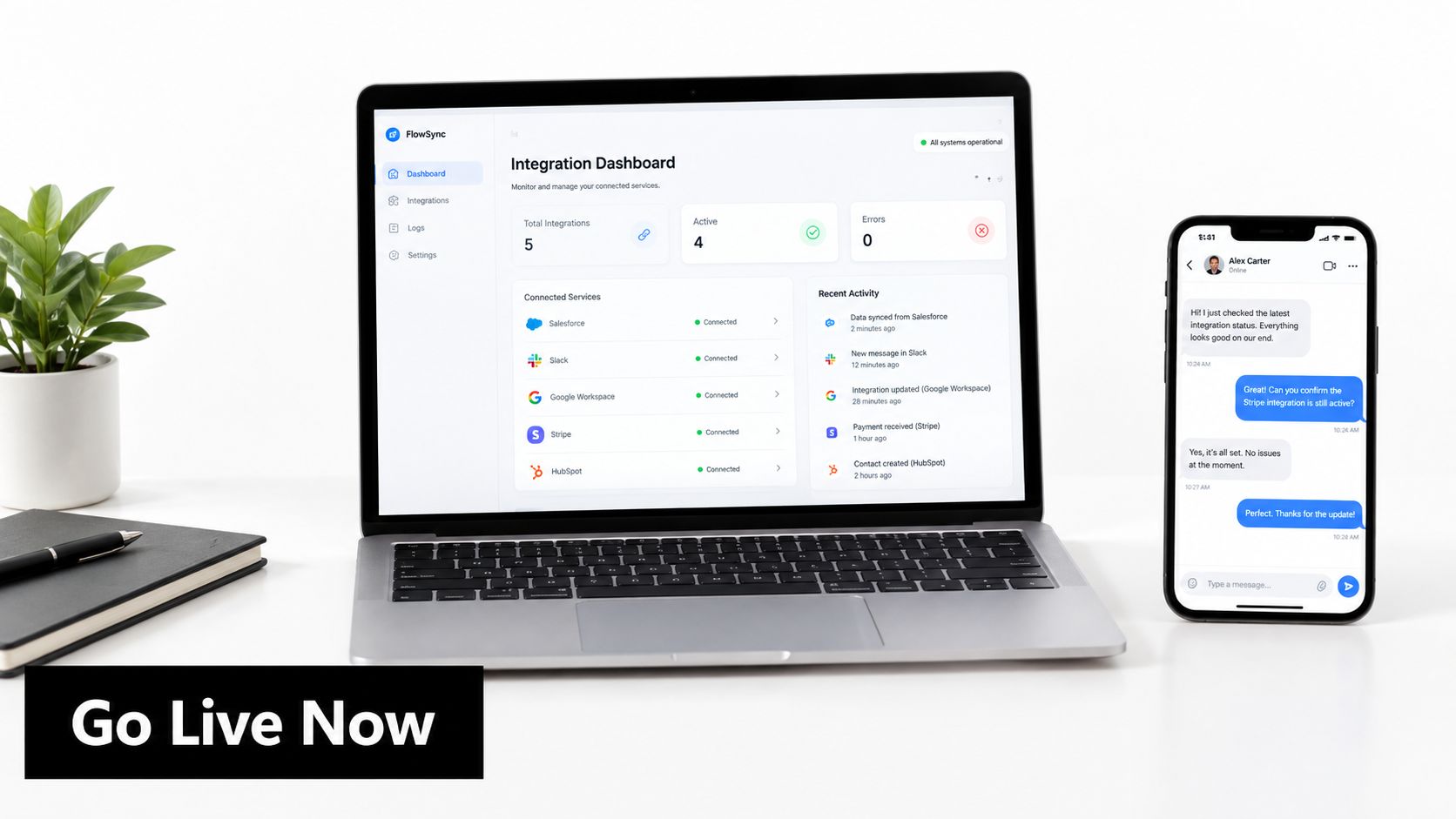
The next step is wiring business systems. A support agent may need Zendesk for tickets, Salesforce for customer context, HubSpot for lifecycle data, Gmail for email workflows, and Slack for internal escalation. Donely describes built-in integrations with 850+ tools, including those systems, as well as channels such as WhatsApp, Telegram, Discord, and Slack. Its integrations directory provides the relevant surface to evaluate when comparing deployment approaches.
Each tool needs a permission design. Separate read operations from write operations, and give the agent only the fields and actions required for its assigned intents. For example, an order-status workflow might read fulfillment data and add an internal note, while a refund workflow may create a review request instead of directly issuing money.
Use a sandbox or test workspace before enabling customer traffic. Create cases for successful lookups, missing records, stale data, failed API calls, duplicate requests, and partial tool completion. Confirm that the agent reports failure clearly and that the resulting ticket contains enough detail for a human to continue.
Publish channels only after the handoff works
Channel expansion should follow workflow readiness. Web chat may be easiest to test, while WhatsApp or voice introduces different expectations around message length, interruptions, identity, and context. Telegram, Discord, and Slack can also serve different audiences, so don't assume one prompt works equally well everywhere.
A practical launch sequence looks like this:
- Prepare the intent contract: Define accepted inputs, allowed tools, refusal behavior, and escalation ownership.
- Test retrieval: Check that answers cite or reflect current approved content.
- Test actions: Run tool calls with controlled records and verify every resulting update.
- Test failure paths: Disable a dependency and observe whether the agent retries, stops, or escalates correctly.
- Release gradually: Start with a defined audience or intent family, then review transcripts before widening access.
The most common production mistake is expanding scope because the first demo looks fluent. Fluency doesn't prove that the agent understands permissions, recognizes uncertainty, or completed the requested action. A customer support AI agent should earn broader authority through observed reliability, not receive it at deployment.
Building Hybrid Escalation That Protects CSAT
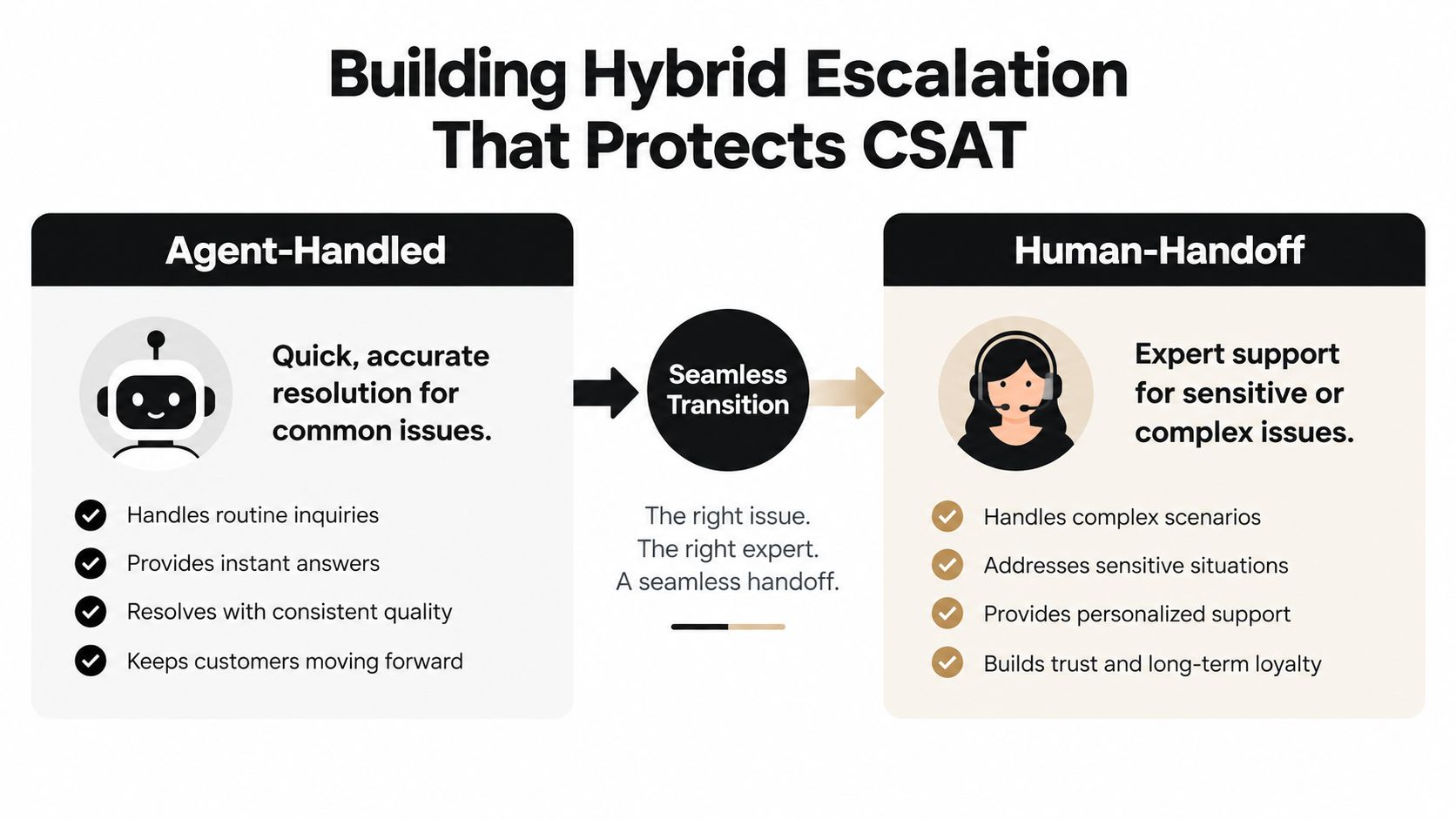
A support agent earns trust partly through the way it exits. Customers don't expect automation to solve every exception, but they do expect a clean handoff when automation stops being appropriate. The agent should transfer the conversation without forcing the customer to repeat the issue, re-upload information, or explain which steps already failed.
Benchmark data from 220M+ live chat interactions reports 75.3% AI chat handling, a 37.5% wait-time reduction for large teams, a 9.1% increase in chatbot satisfaction, and 92.6% handoff CSAT. The live chat benchmark report points to a practical model: use AI as a front-door triage layer, then combine routing, confidence thresholds, and human intervention.
The CSAT comparison makes the design choice sharper. Pure-AI handling reaches 4.1/5 CSAT, compared with 4.3/5 for humans, while hybrid escalation narrows the gap to 0.05 points. The customer service AI agent data on hybrid escalation supports the conclusion that handoff quality matters as much as autonomous answer quality.
Use a decision matrix, not a single fallback rule
| Situation | Agent role | Required control |
|---|---|---|
| Clear intent, approved answer, no account change | Automate | Retrieval and confidence threshold |
| Clear workflow, reversible action | Assist or automate | Scoped tool permission and confirmation |
| Emotional language or repeated failure | Escalate | Priority routing and full transcript |
| Policy exception or financial dispute | Human-led | Approval and audit trail |
| Missing or conflicting system data | Escalate | Explain the missing dependency |
Confidence shouldn't be the only signal. Combine it with sentiment, customer history, repeated attempts, policy sensitivity, tool failure, and the consequences of an incorrect answer. A confident response based on stale order data is still unsafe.
The handoff payload should include the customer's original request, extracted intent, identity state, retrieved sources, tool calls, completed actions, failed actions, and the reason for escalation. The human agent should see a concise summary and the full transcript, not a blank ticket containing only “customer needs help.”
Handoff standard: The human should inherit the case, not inherit the investigation.
Measure containment and escalation by topic. Track which intents trigger handoff, whether the human resolves them, how often customers repeat information, and whether the handoff improves or harms satisfaction. A global CSAT number can conceal a serious failure in refunds or account access, especially when routine requests dominate the sample.
Use the agent to assist humans when automation isn't suitable. It can summarize a long thread, retrieve policy text, recommend the next diagnostic step, and draft a response for review. That model keeps judgment with the person while reducing the mechanical work surrounding the decision.
Securing and Scaling With RBAC Data Isolation and Multi Instance Control
Security failures rarely come from the visible reply alone. They happen when an agent retrieves a client's data in the wrong workspace, exposes internal notes in a customer channel, uses a credential outside its intended scope, or leaves no record of who approved an action.
A scalable governance model treats every agent deployment as an isolated instance with its own data boundary, tools, roles, logs, and billing context. That model works for a founder separating personal and business operations, an agency managing multiple clients, or an enterprise dividing business units with different policies.
Apply least privilege at the instance level
Role-based access control should answer four separate questions:
- Who can configure the agent? Prompt, model, knowledge, and workflow changes should be limited to authorized operators.
- Who can connect tools? Integration credentials and action permissions need a narrower group than general support access.
- Who can inspect conversations? Transcript visibility should follow customer, team, and compliance boundaries.
- Who can approve sensitive actions? Refunds, account changes, exports, and policy exceptions may require human approval.
Per-instance permissions are more practical than a single organization-wide role when teams serve different customers or business lines. An agency shouldn't have to mix client knowledge bases, logs, and invoices to run several deployments. Likewise, an enterprise team shouldn't give every support administrator access to every regional or product dataset.
Isolate data and preserve auditability
Use isolated containers or equivalent workload boundaries, scoped data access, and unified audit logs. The system should record authentication events, configuration changes, retrieval activity, tool calls, approvals, escalations, and failures. Logging only the final customer message leaves out the evidence needed to investigate a bad outcome.
Multi-instance control also prevents a common scaling trap: creating separate accounts for every workload and later attempting a painful migration. A central control plane can provide consistent policy while keeping each instance operationally separate. Teams assessing managed hosting can review Hermes agent hosting for an example of this deployment model.
Compliance requirements should influence architecture from the first workflow, not appear as a procurement checkbox at the end. SSO, auditability, data residency expectations, retention rules, and approval paths need owners and documented controls. Donely describes SOC 2 as in progress, a HIPAA-ready architecture, and a 99.9% uptime SLA as part of its Enterprise offering. Those are product claims to validate during vendor due diligence, not substitutes for your own security review.
The strongest control model makes the safe path the easy path. Operators should be able to create a client instance, assign roles, connect only approved tools, inspect activity, and revoke access without rebuilding the agent. Scaling then becomes a governance exercise rather than an uncontrolled multiplication of credentials and exceptions.
Monitoring Metrics and Cost Control for Long Term Performance
An agent can be available, responsive, and wrong. Infrastructure monitoring catches outages, but it won't necessarily catch a stale policy, a bad retrieval result, a failed tool action, or a handoff that strips away customer context. Long-term operations require product, quality, security, and cost signals in the same review loop.
Track performance at the intent level. Handling rate and wait time show whether the front door is absorbing demand, while containment and escalation reveal where the workflow succeeds or breaks. Pair those measures with CSAT, first-contact resolution, tool failure, refusal, and repeat-contact signals.
Build a review loop around real conversations
A weekly transcript review is one of the highest-value operating rituals. Sample successful conversations and escalations, then classify each issue as a knowledge gap, routing problem, permission problem, tool failure, unclear policy, or model behavior. Add representative failures to the test set before changing the prompt, otherwise the same regression can return later.
Use a dashboard that shows:
- Availability: Instance status, channel status, dependency health, and failed jobs.
- Quality: Intent-level accuracy, containment, escalation reason, CSAT, and repeat contact.
- Operations: Wait-time reduction, handling rate, first-contact resolution, and tool completion.
- Governance: Permission changes, approval events, data-access anomalies, and audit-log activity.
- Economics: Usage by instance, workflow, channel, and tool, plus the cost of human follow-up.
A single automation percentage can mislead. If the agent deflects a customer into a delayed human queue, the interaction may look automated while the actual resolution remains manual. Define resolution as a completed customer outcome, then keep partial deflection as a separate measure.
Control cost without weakening safeguards
Don't optimize cost by removing escalation or shrinking review coverage blindly. Route simple retrieval tasks to an economical model, reserve more capable reasoning for ambiguous cases, and keep human approval for high-consequence actions. Consolidated billing can help agencies and enterprises understand usage across instances and apply volume pricing as deployments grow.
Scope expansion should follow evidence. Add a new intent only after its knowledge sources are owned, its tools are permissioned, its failure paths are tested, and its escalation destination is staffed. Review changes against the previous production baseline before release, and roll back when quality drops even if infrastructure dashboards remain green.
A practical continuous-improvement checklist is:
- Review escalations: Identify the topics and failure reasons that consumed human time.
- Fix the source: Update knowledge, routing, permissions, or integrations rather than only rewriting tone.
- Re-test edge cases: Include ambiguous, emotional, incomplete, and dependency-failure scenarios.
- Compare outcomes: Check intent-level containment, CSAT, resolution, latency, and cost together.
- Expand carefully: Increase scope only when the complete workflow, including handoff, performs reliably.
Customer support AI agents scale when governance scales with them. Start with narrow authority, preserve human judgment where it matters, isolate every workload, and make monitoring part of the product rather than an afterthought.
Donely provides a managed platform for hosting, deploying, and monitoring AI employees across customer support workflows, with integrations, messaging channels, isolated instances, per-instance RBAC, audit logs, and centralized usage controls. Visit Donely to evaluate whether its deployment model fits your next support agent rollout and governance requirements.