
You're probably at the point where AI agents have moved from “interesting demo” to “we should deploy this.” That's when the OpenClaw vs Manus decision stops being theoretical.
One path gives you ownership, local execution, and room to customize almost everything. The other gives you a managed environment that gets out of your way fast. Both can be the right call. Both can also become the wrong call once your team has to support real workloads, real users, and real governance.
I've seen this fork show up most often in founder-led teams, agencies, and internal ops groups. The first question sounds technical. Which platform should we use? The core question is operational. Who is going to own setup, security, access boundaries, failure handling, and scale six months from now?
That's also why this isn't just a product comparison. It's a delivery model comparison. If you're building an AI roadmap, hiring around it, or trying to find US artificial intelligence investors who understand infrastructure-heavy AI businesses, this distinction matters early. Investors, clients, and internal stakeholders all eventually ask the same thing. Can this be deployed cleanly, governed predictably, and scaled without becoming an ops burden?
Table of Contents
- The AI Agent Dilemma Choosing Your Path
- Understanding the Core Philosophies
- Feature and Architecture Deep Dive
- Security Governance and Scaling Challenges
- Analyzing Pricing and Total Cost of Ownership
- Ideal Use Cases and Buyer Personas
- Your Decision Checklist Which Platform Fits Best
The AI Agent Dilemma Choosing Your Path
A common scenario looks like this. A team has proven that AI agents can handle browser work, internal workflows, lead routing, research, or support triage. The pilot works. Then the team has to pick a foundation.
OpenClaw usually wins the room first when engineers care about control. It's open-source, runs locally or on your own servers, and gives technical teams more say over how data moves and how the agent behaves. Manus usually wins attention from operators and non-technical stakeholders because it removes the burden of server maintenance and gets people into production faster.
That sounds like a clean split. It rarely stays clean.
The OpenClaw vs Manus debate often gets framed as flexibility versus convenience. That's true, but incomplete. The harder trade-off is between building an agent system and consuming an agent service. One model asks your team to own deployment and lifecycle management. The other asks your team to accept the boundaries of a vendor-managed platform.
Use OpenClaw if infrastructure ownership is part of the strategy. Use Manus if infrastructure ownership would distract from the strategy.
The catch is that many teams don't want either extreme. They want OpenClaw's control model without inheriting a DevOps project. Or they want Manus-level simplicity without giving up instance isolation, scoped access, or deeper customization later.
That third path matters more than most comparison articles admit. Once you move from one personal agent to many production agents across departments or client accounts, the decision isn't just OpenClaw or Manus. It becomes self-hosted open source, managed SaaS, or a managed OpenClaw layer that handles the operational mess in between.
Understanding the Core Philosophies
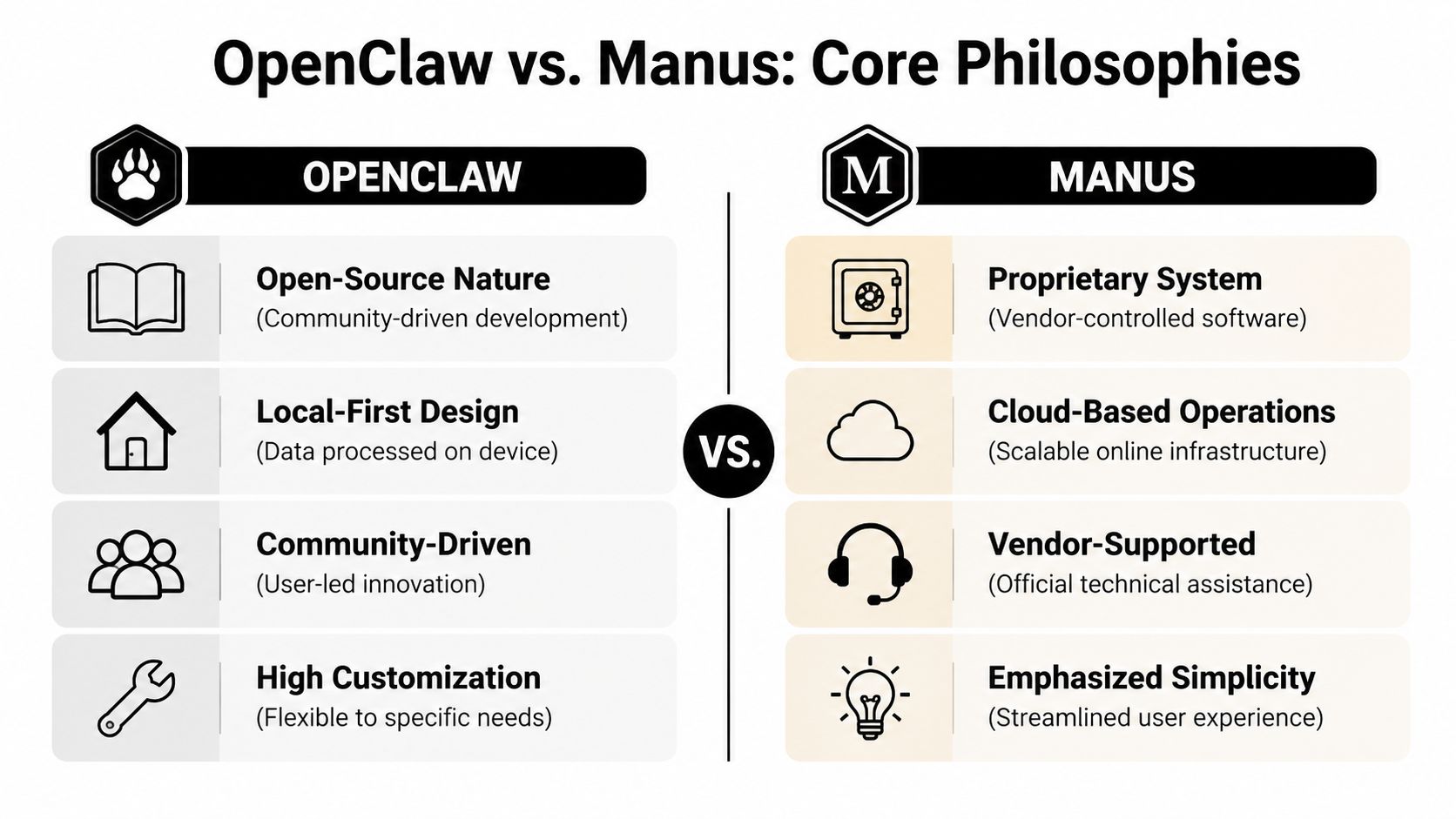
The cleanest way to think about OpenClaw vs Manus is this. OpenClaw is a self-hosted engine. Manus is a managed service.
That distinction is explicit in comparative coverage. OpenClaw is described as an open-source, local-first agent you run on your own infrastructure, while Manus is described as a cloud-based managed platform optimized for rapid setup with no server maintenance, according to Thunderbit's OpenClaw and Manus comparison.
OpenClaw as a build-it-yourself system
OpenClaw fits teams that want to decide where the agent runs, how it's configured, what gets logged, and how workflows are extended. Another comparison describes OpenClaw as an open-source, local-first autonomous agent that runs on a user's own machine or server, while Manus is described as cloud-hosted, closed-source, which means OpenClaw exposes code and data flow for local execution and auditability while Manus routes execution through vendor infrastructure, as noted by Get AI Perks in its OpenClaw vs Manus overview.
That's the custom car model. You get the chassis, the parts, and the freedom to rework the system. You also own maintenance.
Manus as a consume-it-now platform
Manus follows the opposite philosophy. It gives you a managed environment and abstracts away the underlying platform decisions. If the main goal is getting an agent running quickly, this is attractive.
You're not designing the vehicle. You're leasing one that's already assembled, supported, and maintained by someone else. That's often the right call for teams that value speed over deep environment control.
Why philosophy becomes an operations question
This architectural split drives everything that happens later:
- Data handling changes because OpenClaw can stay on your own infrastructure, while Manus runs through vendor-managed systems.
- Customization scope changes because open-source software can be modified more directly than a closed platform.
- Support burden changes because someone still has to own updates, failures, and environment drift.
Practical rule: Don't choose based on the demo experience. Choose based on who will own the system after launch.
The OpenClaw vs Manus decision starts as a tooling conversation. It ends as an operating model decision.
Feature and Architecture Deep Dive
Here's the fast view before the deeper breakdown.
| Feature | OpenClaw (Self-Hosted) | Manus |
|---|---|---|
| Core model | Open-source, local-first | Cloud-hosted, managed platform |
| Hosting responsibility | Your team | Vendor-managed |
| Customization | Broad, code-level flexibility | More productized experience |
| Data path | Runs on your machine or server | Routed through vendor infrastructure |
| Setup style | Manual deployment and configuration | Faster managed onboarding |
| Best fit | Teams wanting control | Teams wanting convenience |
| Long-running workflows | Positioned as browser and system-control agent with persistent memory | Reported to support workflows that can run for hours without interruption |
| Governance maturity in public comparisons | Less clearly documented at scale | Less clearly documented at scale |
If you want a managed layer built around OpenClaw rather than running it yourself, managed OpenClaw deployment options are part of the market now, and they change this comparison more than most side-by-side articles acknowledge.
Architecture
OpenClaw and Manus differ first at the execution layer.
OpenClaw is built around local or self-managed execution. That matters if your team wants visibility into code paths, tighter control over environment design, or stronger ownership of how the agent interacts with systems. It also means the burden of runtime stability sits with your team.
Manus abstracts that layer away. You consume the platform rather than assembling it. That reduces friction for teams that don't want to operate agent infrastructure directly.
Deployment Models
Here, many teams underestimate the gap.
With OpenClaw, deployment isn't just “install and go.” You still need to think about where instances run, how secrets are managed, how updates are applied, and who gets paged when something fails. For a developer or a small technical team, that's manageable. For a business unit that just wants working automation, it often becomes a bottleneck.
Manus is simpler to stand up because the vendor owns the service layer. That's the core value proposition. You trade some platform control for less operational work.
Integrations
Open-source systems usually give broader room for extension. That's one of OpenClaw's biggest strengths. If your team wants to wire custom tools, internal APIs, or unusual workflows into the agent, self-hosted software generally gives more room to do that.
Managed platforms usually present integrations in a more curated, productized way. That lowers complexity for common use cases and raises friction for edge cases.
A good rule here is simple. If your workflow is standard, Manus-style abstraction is helpful. If your workflow is odd, regulated, or closely tied to internal systems, OpenClaw is usually easier to bend.
Performance
Performance discussions around OpenClaw vs Manus often drift into claims that aren't well supported. The most useful verified distinction is narrower.
For long-running automation, Manus is reported to support workflows that can run for hours without interruption, which makes it better suited for multi-step background operations and large-scale data aggregation, according to AI for Creative Collective's comparison guide. The same comparison positions OpenClaw more as a browser and system-control agent with persistent memory and local execution, but it does not provide comparable benchmark timings or throughput numbers for either system.
So the practical takeaway isn't “Manus is faster” or “OpenClaw performs better.” The practical takeaway is workload fit:
- Shorter, convenience-first task execution: Manus often maps better.
- Local control and system interaction: OpenClaw remains attractive.
- Claims about raw benchmarks: Treat them cautiously unless a vendor publishes real measurement detail.
Security Governance and Scaling Challenges
The OpenClaw vs Manus conversation gets much more serious when one agent becomes many. That's where hobby-grade comparisons stop being useful.
A recurring gap in public coverage is scale governance. One comparison points out that the more important question isn't just which platform is better, but which one is safer to operationalize at scale when teams manage multiple clients or business units. It also notes that available comparisons don't provide strong evidence on multi-tenant operations, role-based access control, or audit-log depth, even though those are the features that matter most in production governance, according to MyClaw's analysis of OpenClaw and Manus.
What Breaks at Scale
A single founder running one agent can live without strict controls for a while. An agency with client accounts can't. A revenue team deploying agents across sales, support, and operations can't either.
The pressure points show up fast:
- Access boundaries: Who can view prompts, logs, credentials, and workflow outputs?
- Instance isolation: Can one client or department be separated cleanly from another?
- Auditability: Can you reconstruct who changed what and when?
- Repeatability: Can you roll out the same governed setup across multiple deployments?
Self-hosted OpenClaw gives you freedom, but freedom means your team has to design these guardrails. That can be a benefit if you already have security and platform engineering depth. If you don't, it becomes backlog.
What Teams Usually End Up Building
Teams often don't start by saying, “Let's build governance.” They start by trying to get an agent into production. Governance work appears later as a pile of requirements.
That pile often includes:
- Per-team or per-client separation so workflows and data don't bleed together.
- Scoped permissions so non-admin users can operate agents without full system access.
- Logging and change visibility so compliance and operations teams can review what happened.
- Deployment consistency so new instances don't become handcrafted snowflakes.
Governance isn't a premium feature. It's the cost of moving from one experimental agent to a fleet of business-critical agents.
Manus reduces some of this burden because it's managed, but public comparisons still leave open questions about depth in multi-instance governance and audit behavior. OpenClaw gives you the ability to implement what you need, but your team carries the integration and maintenance work.
The Middle Path
This is the under-discussed third option. Use OpenClaw as the underlying engine, but don't self-host it in the raw.
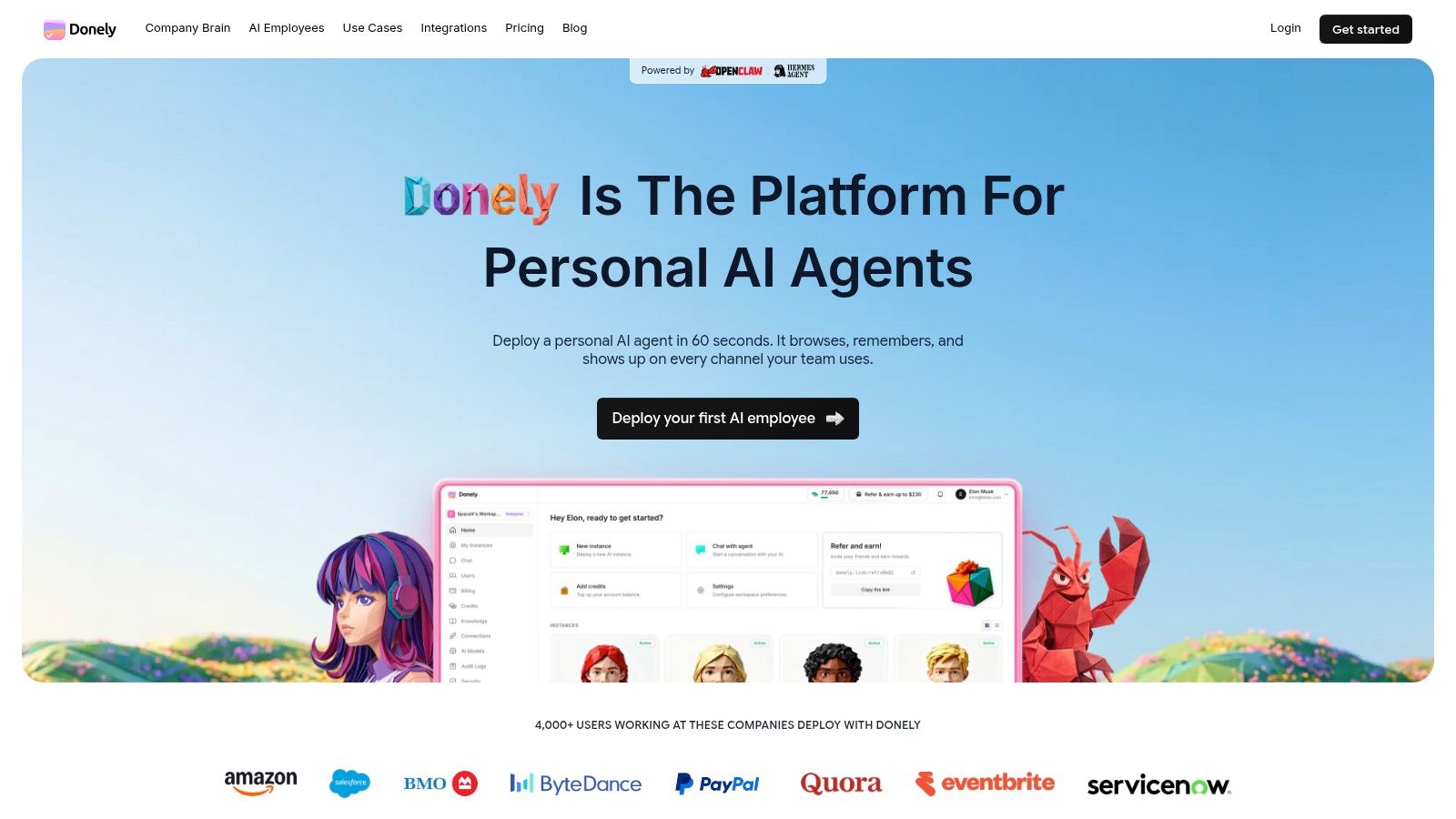
A managed OpenClaw platform can sit in the middle. The model is straightforward: keep the flexibility and ecosystem direction of OpenClaw, but move hosting, instance lifecycle, access control, monitoring, and operational management into a platform layer. One example is Donely, which provides multi-instance OpenClaw management with isolated instances, per-instance RBAC, unified audit logs, centralized monitoring, and hosted deployment.
That middle path changes the decision criteria. You no longer have to choose only between full DIY control and pure vendor abstraction. For agencies, internal ops teams, and compliance-sensitive deployments, that's often the more realistic production answer.
Analyzing Pricing and Total Cost of Ownership
Pricing pages don't settle the OpenClaw vs Manus question. They rarely even capture the full cost.
Why Open Source Is Not the Same as Low Cost
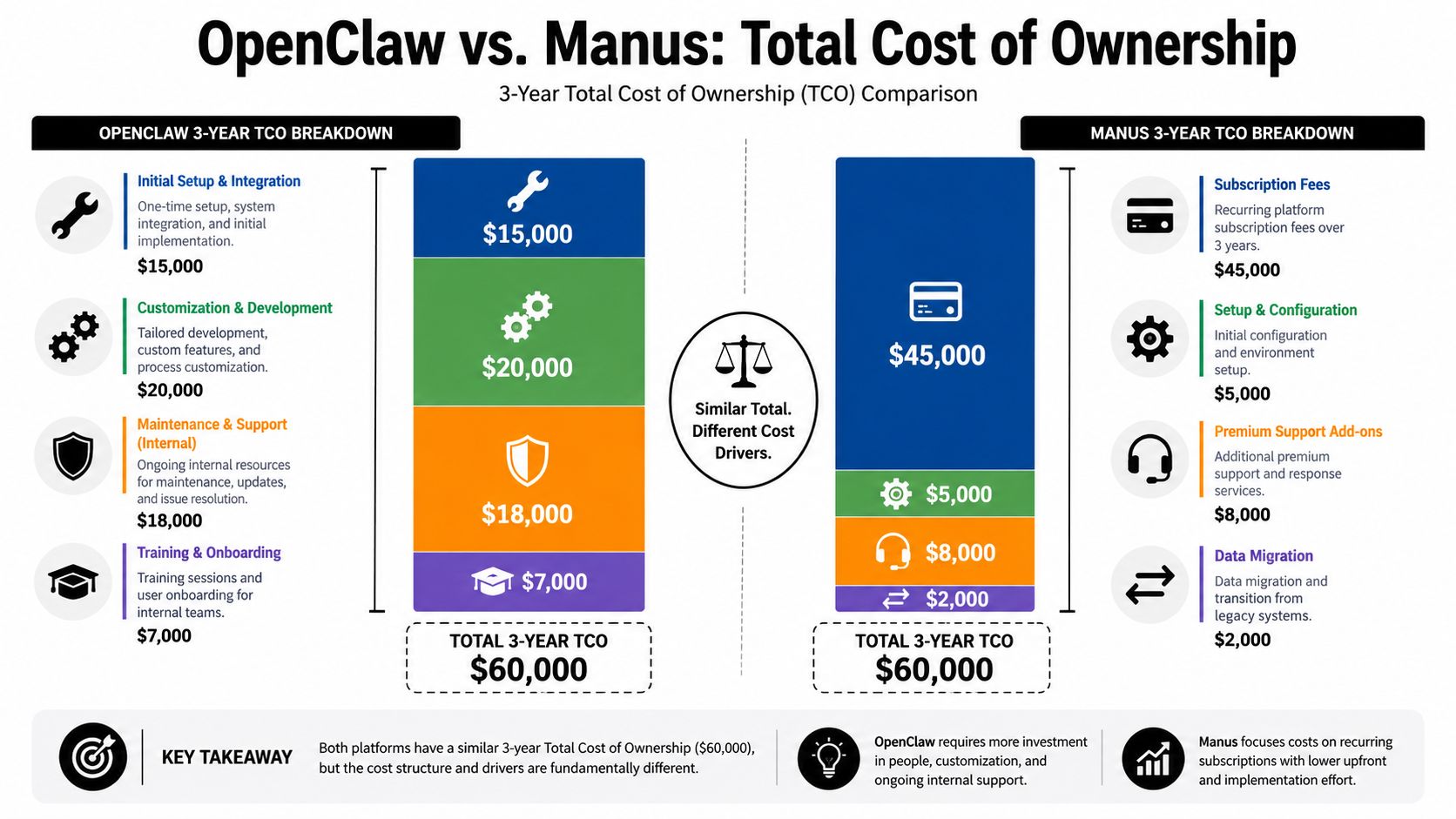
OpenClaw can look inexpensive at first because the software model gives you more control over infrastructure and API choices. But “software is open-source” doesn't mean “operations are free.”
The cost shows up in labor and ownership:
- Deployment work still has to happen.
- Maintenance still has to happen.
- Incident handling still belongs to someone.
- Security controls don't materialize on their own.
Those costs are manageable when self-hosting is aligned with your team's strengths. They become expensive when the agent stack is a side project your engineers reluctantly support.
To compare models usefully, look at platform pricing and infrastructure cost together. If you're evaluating managed OpenClaw options, review the Donely pricing model alongside your expected internal ownership burden.
A quick visual can help frame the trade-offs before a budgeting discussion.
Where Managed SaaS Looks Better
Manus usually wins the first-month cost conversation because setup friction is lower. Teams can start faster, and there's less infrastructure to own directly. That's a real advantage.
The trade-off is that managed SaaS can be easier to start than to fully model over time. Cost visibility, operational constraints, and data handling details can matter more once usage expands.
The Cost Question Most Teams Skip
One of the better observations in recent coverage is that the actual gap isn't license price. It's the cost and reliability profile over time. Existing comparisons often say OpenClaw offers predictable costs because users can bring their own API keys, while Manus is easier to start and may be opaque on pricing or data handling. But those same comparisons usually stop short of quantifying total cost of ownership, downtime risk, or workflow failure rates, as discussed by The Tool Nerd in its analysis of Manus and OpenClaw.
That's the practical lens I'd use. Ask which model creates the lowest total burden for your team's actual operating shape, not which one looks cheaper on day one.
Ideal Use Cases and Buyer Personas
The right answer in OpenClaw vs Manus depends less on features and more on who has to live with the tool every day.
Who Should Choose Self-Hosted OpenClaw
Self-hosted OpenClaw makes sense for teams that treat control as a requirement, not a preference.
That usually includes:
- Developers and technical operators who want direct control over runtime behavior, integrations, and deployment shape.
- Research or internal tooling teams that need flexibility more than polished UX.
- Organizations with strict data handling rules that prefer local-first execution and tighter infrastructure ownership.
This path works best when your team already knows how to operate software, not just configure it.
Who Should Choose Manus
Manus fits buyers who want a managed path to working automation and don't want to staff around infrastructure.
That often includes:
- Solo builders who need to execute tasks quickly.
- Marketing, ops, or business teams that care more about outcomes than environment design.
- Organizations testing agent adoption before committing internal engineering time.
If the main job is getting useful work done without running a platform, Manus is the simpler fit.
Buy Manus when the agent is a tool your team uses. Buy self-hosted OpenClaw when the agent stack is something your team intends to shape.
Who Needs the Managed OpenClaw Option
This is the buyer most comparisons overlook. They want OpenClaw's model, but they don't want to become OpenClaw operators.
That group includes agencies managing multiple client agents, startups moving from one internal agent to many business workflows, and organizations that need separation, oversight, and easier administration. They also tend to care about integration breadth, because agents don't live in isolation. They touch CRM, support, messaging, project management, and document systems. If that's your reality, a managed OpenClaw platform with broad agent integration support is usually easier to operationalize than raw self-hosting.
This middle path is often the most durable one. It avoids the rigidity of pure SaaS and the operational drag of pure DIY.
Your Decision Checklist Which Platform Fits Best
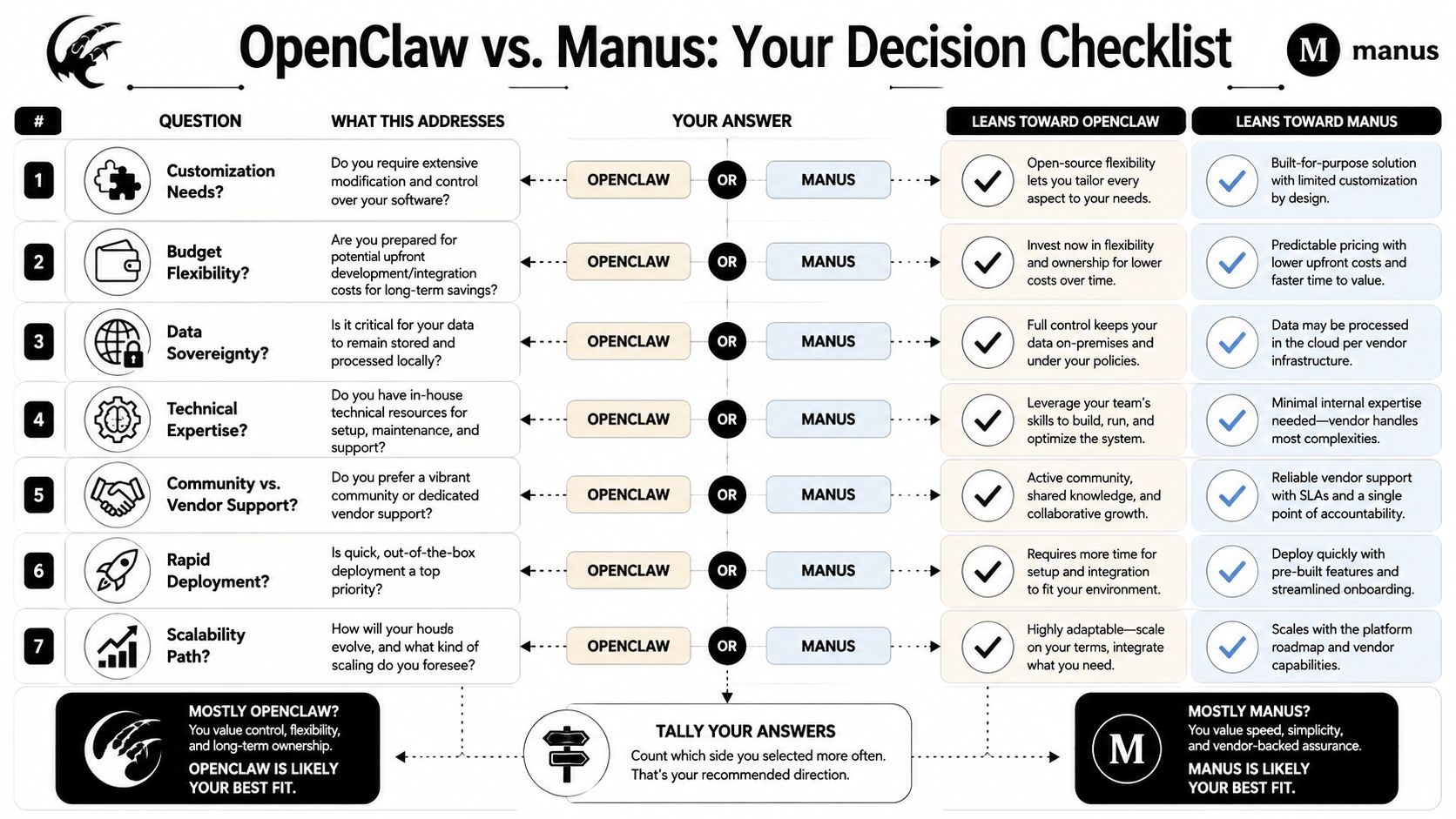
Pick based on operating fit. These questions usually make the answer obvious.
Ask these before you commit
Do you have people who can own deployment and maintenance?
If yes, self-hosted OpenClaw stays viable. If not, move toward Manus or a managed OpenClaw platform.Is local execution or infrastructure ownership a hard requirement?
If yes, OpenClaw is the stronger direction. Manus is built around vendor-managed infrastructure.Do you need fast launch with minimal setup?
If yes, Manus is the cleaner fit.Will you run separate agents for multiple clients, teams, or business units?
If yes, don't stop at feature lists. Evaluate instance isolation, scoped permissions, and auditability early.Do you expect heavy customization later?
If yes, OpenClaw gives you more room to shape the system over time.Would your team benefit from OpenClaw without wanting to self-host it?
If yes, the managed OpenClaw path is likely the right compromise.
The short version
Use self-hosted OpenClaw when control, local execution, and customization matter enough to justify operational ownership.
Use Manus when speed, simplicity, and managed infrastructure matter more than deep platform control.
Use a managed OpenClaw platform when neither extreme fits. That's often the best answer for growing teams that need governance, isolated instances, and lower DevOps load without giving up the OpenClaw model.
The mistake is treating OpenClaw vs Manus like a simple product shootout. It isn't. It's a decision about who owns the platform, who governs it, and how much operational complexity your team can absorb without slowing down.
If you want the OpenClaw model without running the infrastructure yourself, Donely is one option to evaluate. It's built to host, deploy, and manage OpenClaw-based agents with isolated instances, RBAC, audit logs, and centralized operations, which makes it relevant for teams that have outgrown both hobby self-hosting and one-size-fits-all SaaS.