
You're probably in one of two places right now. Either your team has bought a serious stack of controls, firewalls, EDR, SSO, MFA, cloud logging, awareness training, and a policy library, and you still can't answer whether an attacker could reach something that matters. Or you've received a pen test report, fixed the obvious findings, and you're still uneasy because the report never showed how small weaknesses combine into a real breach path.
That's where red team assessment services become useful. Not because they look impressive in a board update, but because they test whether your security program works against an adversary who thinks in sequences, not checklists. The difference matters. Attackers don't care that one control is “in place.” They care whether several imperfect controls can be chained, bypassed, or exhausted.
Table of Contents
- Why Your Security Controls Might Not Be Enough
- What Are Red Team Assessment Services
- Red Team vs Penetration Testing vs Purple Team
- The Anatomy of a Red Team Operation
- Choosing a Vendor and Scoping Your Assessment
- The Red Team Playbook From Commissioning to Remediation
- Integrating Red Team Insights into Your Security Automation
Why Your Security Controls Might Not Be Enough
A common pattern looks like this. The company has Microsoft Defender, Okta, a managed SOC, email filtering, endpoint controls, and documented policies. Leadership assumes the basics are covered. Then someone with patience finds exposed employee details, crafts a believable pretext, gets one foothold, abuses weak privilege boundaries, and reaches a business system no one thought was part of the path.
That doesn't happen because the team bought “bad” tools. It happens because tools are purchased and operated in silos, while attackers work across silos. A phishing-resistant identity rollout can still be undermined by over-permissioned service accounts. Strong endpoint telemetry can still miss the business impact if the attacker moves through SaaS, shared mailboxes, or cloud IAM misconfigurations. Security programs often measure coverage. Adversaries measure outcomes.
Practical rule: If your program can't show how controls behave together under pressure, you don't yet know your real exposure.
This is why teams that already invest in audits and policy work still benefit from adversarial testing. A disciplined audit is essential for governance, and resources on effective cybersecurity auditing can help tighten controls and evidence collection. But an audit asks whether controls exist and are documented. Red teaming asks whether those controls stop a determined operator.
A lot of buyers are waking up to that distinction. The AI Red Teaming Services Market was valued at USD 2.26 billion in 2026 and is projected to reach USD 6.17 billion by 2030, growing at a CAGR of 28.5%, driven by the rise of enterprise AI deployments and an increasingly complex threat environment according to Research and Markets.
That growth makes sense. Organizations aren't just defending laptops and servers anymore. They're defending cloud permissions, APIs, internal automation, and AI-assisted workflows. Policy matters, especially when teams are formalizing ownership and exceptions through a security policy framework, but policy alone won't tell you whether a realistic attack path exists.
The real failure mode
The biggest security surprises rarely come from a single critical bug. They come from combinations:
- A trusted workflow abused: an internal tool accepts actions from a user who should only view.
- A human shortcut: a helpdesk process resets access too easily.
- A monitoring gap: logs exist, but no one correlates them.
- An overly broad role: a service account can touch systems it never needed.
Red team assessment services are valuable because they expose those combinations in a way checklists usually can't.
What Are Red Team Assessment Services
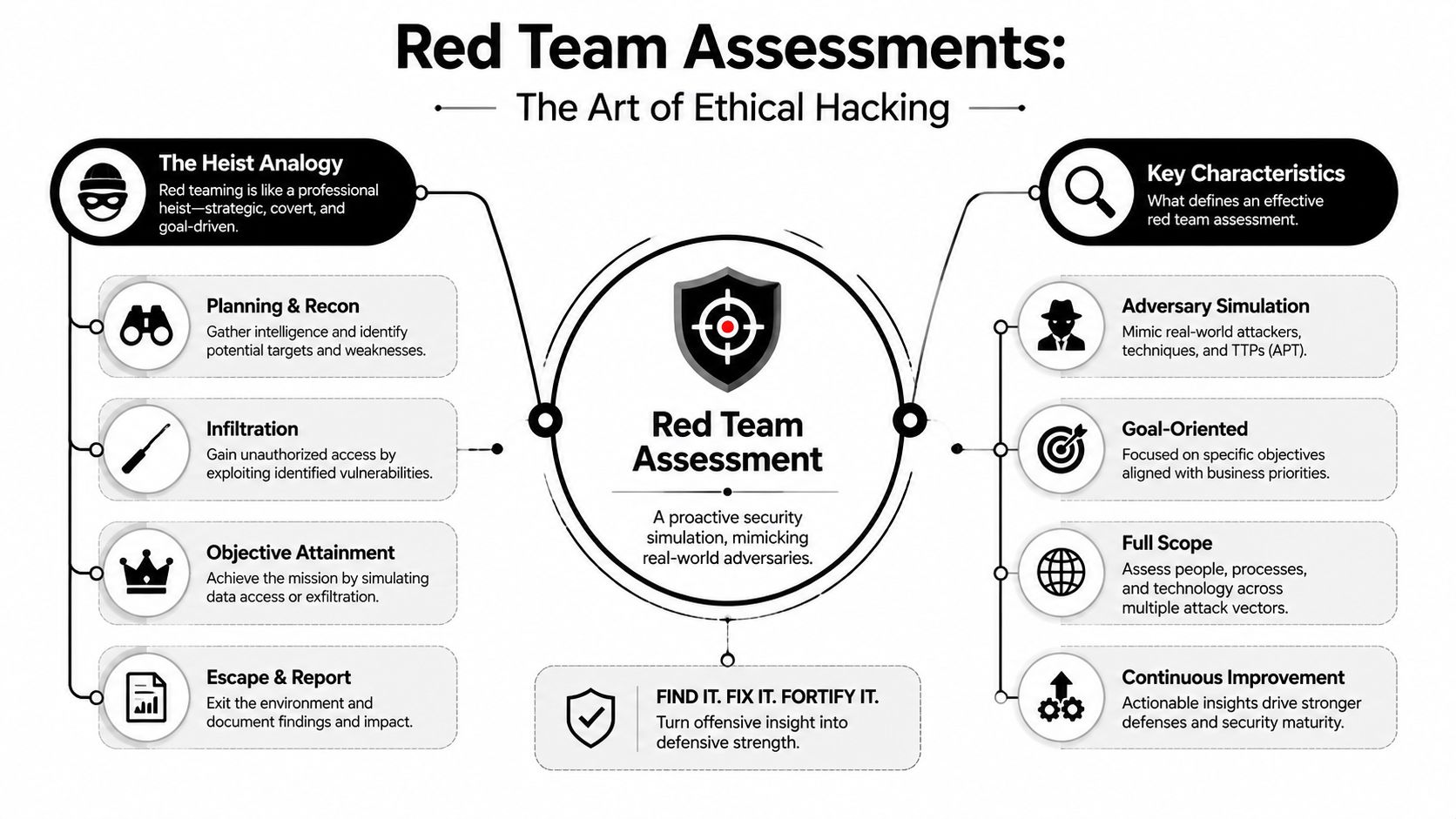
The bank heist analogy is useful for a reason
The easiest way to explain red team assessment services is to compare them to hiring a professional heist crew to test a bank. You don't hire them to tell you the vault door exists. You hire them to see whether reconnaissance, timing, social engineering, physical access, credential theft, and process abuse could be combined to reach the vault without the guards stopping them.
That's much closer to what an actual attacker does.
Formally, red team assessments are goal-driven engagements where the primary objective is to validate an organization's ability to prevent, detect, and respond to advanced attacks, rather than solely identifying isolated vulnerabilities. They also require a pre-launch meeting to establish the Rules of Engagement (ROE), defining scope, duration, and critical functions to be targeted, as described by Evalian's overview of red team testing.
The ROE matters more than many buyers realize. Without it, the engagement turns into theater or chaos. With it, everyone knows the objectives, the off-limits systems, the legal boundaries, the escalation path, and the safety constraints.
Here's a useful primer before going further:
What you are actually buying
You are not buying “ethical hacking” in the generic sense. You are buying a controlled simulation of an adversary campaign against your people, processes, and technology.
A sound engagement usually includes:
- A defined objective: reach a crown-jewel dataset, compromise a privileged identity, or test whether an attacker can move from internet exposure to a regulated system.
- An agreed operating model: stealth level, communication cadence, safety controls, and emergency stop conditions.
- A threat-informed plan: scenarios based on realistic attacker behavior, not a random bag of exploits.
- A decision-ready readout: evidence of what worked, what failed, and where defenders detected or missed activity.
A red team isn't paid to impress you with clever tradecraft. It's paid to answer whether your defenses work against a plausible attack path.
The heist analogy also helps explain what red teaming is not. It isn't a broad inventory exercise. It isn't a compliance audit. It isn't a vulnerability scanner with a different logo. If a vendor talks mostly about “running tools” and not about objectives, control validation, and response testing, they're probably selling something narrower than true red team assessment services.
Red Team vs Penetration Testing vs Purple Team
Quick comparison
The confusion usually starts because all three involve offensive security work. The intent and output are different.
| Attribute | Red Team Assessment | Penetration Test | Purple Team Exercise |
|---|---|---|---|
| Primary objective | Validate prevention, detection, and response against a realistic attack path | Find and exploit vulnerabilities within a defined scope | Improve detection and defensive coordination through collaboration |
| Scope | Broad, business-outcome focused | Narrower, asset or application focused | Focused on specific scenarios and defender learning |
| Adversary emulation | High | Limited to moderate | Moderate, with defender visibility |
| Stealth | Important | Usually less important | Low, because collaboration is the point |
| Typical output | Attack narrative, control failures, detection gaps, remediation priorities | Vulnerability findings and exploit evidence | Updated detections, playbooks, and analyst learning |
| Best use case | Test overall security posture and SOC readiness | Test a web app, API, or environment for exploitable flaws | Tune blue team capability in near real time |
When each option makes sense
If you need to know whether a specific application can be broken, buy a penetration test. If the target is a customer-facing product, focused services like web application testing are often the right starting point because they concentrate on application logic, auth flows, and exploitability within that surface.
If you need to know whether an attacker can cross boundaries, stay hidden, and reach a business objective, buy red team assessment services. This is the right choice when the question is larger than any one app or subnet.
Purple teaming fits between the two. It's collaborative by design. The red side shares timing, TTPs, or indicators so defenders can learn while the exercise is running. That makes it strong for maturing detections and analyst workflows, but weaker as a clean test of whether your current operations would have caught a quiet intrusion.
A lot of disappointment comes from buying the wrong service for the wrong question.
- Choose a pen test when you need exploit depth on a defined target.
- Choose a red team when you need realism, stealth, and business-impact validation.
- Choose purple teaming when your main goal is operational learning and rule tuning.
Buy for the decision you need to make next. Don't buy a red team when you really need application assurance, and don't buy a pen test when you need to validate your SOC.
The Anatomy of a Red Team Operation
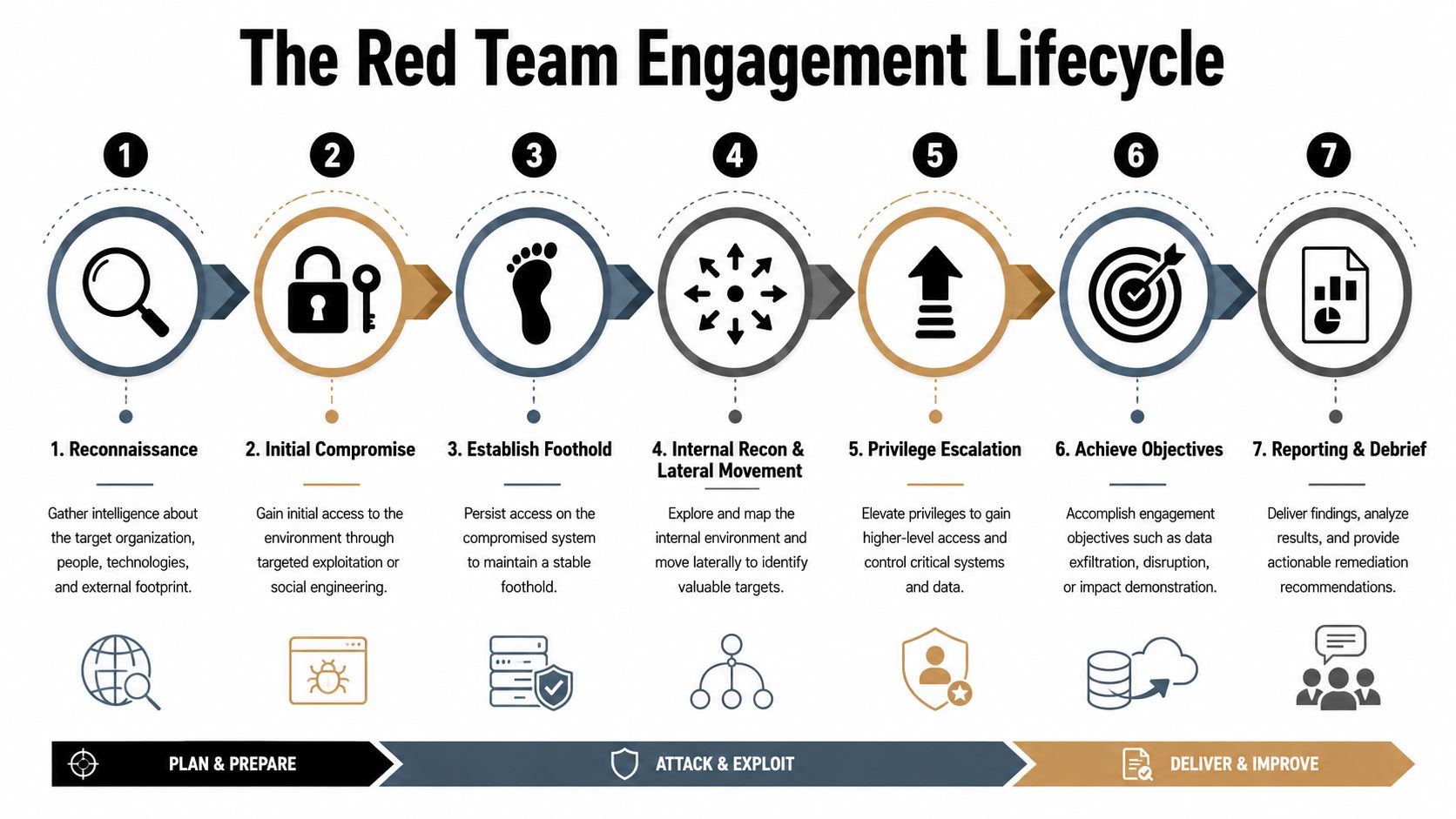
How the attack path unfolds
A serious engagement follows a method, not improvisation. According to Schellman's red team methodology overview, the technical execution follows a six-stage lifecycle: Reconnaissance, Vulnerability Discovery, Exploitation, Credential Access and Lateral Movement, and Reporting tied to the MITRE ATT&CK Framework.
In practice, that begins with reconnaissance. The team gathers open-source intelligence, maps exposed services, profiles staff, and looks for operational clues. Sometimes the most useful lead comes from nontechnical behavior, such as badge habits, exposed metadata, or social engineering vectors. Even basic awareness issues like social engineering shoulder surfing can become part of a larger chain when physical and digital signals overlap.
From there, the team validates possible entry points. They may test exposed applications, identity workflows, cloud roles, remote access paths, or user behavior. The point isn't to enumerate every flaw. It's to find the few weaknesses that can be combined into a viable path.
A typical flow looks like this:
Reconnaissance
OSINT, organizational mapping, external surface review.Vulnerability discovery
Targeted testing to confirm which weaknesses are practical.Exploitation
Safe use of those weaknesses to gain a foothold.Credential access
Collection or abuse of credentials, tokens, or trust relationships.Lateral movement
Expansion through the environment toward the agreed objective.Reporting
Documentation mapped to MITRE ATT&CK so defenders can act on it.
Why the blue team report matters
The most useful deliverable is often not the flashy attack narrative. It's the record of what defenders saw. Schellman notes that a critical deliverable is a separate 'Blue Team Report' that quantifies which actions the defensive team detected, providing a benchmark for the SOC's capabilities in that same methodology piece.
That report changes the conversation. Instead of debating whether a control “should have” alerted, you can see what happened in reality:
- Which actions triggered telemetry
- Which alerts were ignored or misclassified
- Where analysts lacked context
- Which control gaps enabled progression
That's what turns red team assessment services from spectacle into measurable operational learning.
Choosing a Vendor and Scoping Your Assessment

The wrong vendor can waste budget even if they're technically competent. The biggest buying mistake is focusing on brand, daily rate, or offensive certifications before checking whether the team can scope well and report clearly.
That matters because the upside is material. Bluefire's red teaming statistics page says implementing AI Red Teaming services can reduce security incidents by approximately 67% and help organizations report breach cost reductions exceeding 40%, with average savings approaching $2.4 million per significant incident. Those figures only matter if the engagement is well targeted and the findings are usable.
What to ask before you sign
Ask for a sample report. Not a marketing deck. Not a sanitized screenshot. A real sample that shows attack narrative, evidence, detection analysis, business impact, and remediation logic. If the report reads like a vulnerability scanner export, move on.
Ask how they define success. Good answers sound like outcomes: “Could we reach regulated data?” “Could we bypass a segmentation boundary?” “Could we operate long enough to test response?” Weak answers sound like activity volume.
A short buyer checklist helps:
- Methodology clarity: Do they explain how scenarios are chosen and validated?
- ROE discipline: Can they walk you through safety controls, escalation contacts, and off-limits systems?
- Detection focus: Will they evaluate what your SOC saw, not just what they compromised?
- Remediation quality: Do they prioritize attack paths and control failures, not only individual flaws?
A vendor's sample report tells you more than their certification list. Strong operators can still be weak communicators, and weak reporting kills remediation.
What good scoping looks like
The best scopes are narrow in objective and broad in path. For example, “determine whether an external attacker can reach finance approvals” is better than “test the network.” It gives the team a clear end state while preserving realism in how they get there.
Poor scoping usually fails in one of two ways:
- Too broad: everything is in scope, so the exercise becomes shallow.
- Too safe: the objective is trivial, so the findings don't challenge the program.
You should also align internal ownership before the kickoff. Legal, IT operations, identity owners, SOC leadership, and the business owner of the target function should all know the purpose and boundaries. If nobody owns remediation before the engagement starts, the findings will stall after the readout.
The Red Team Playbook From Commissioning to Remediation
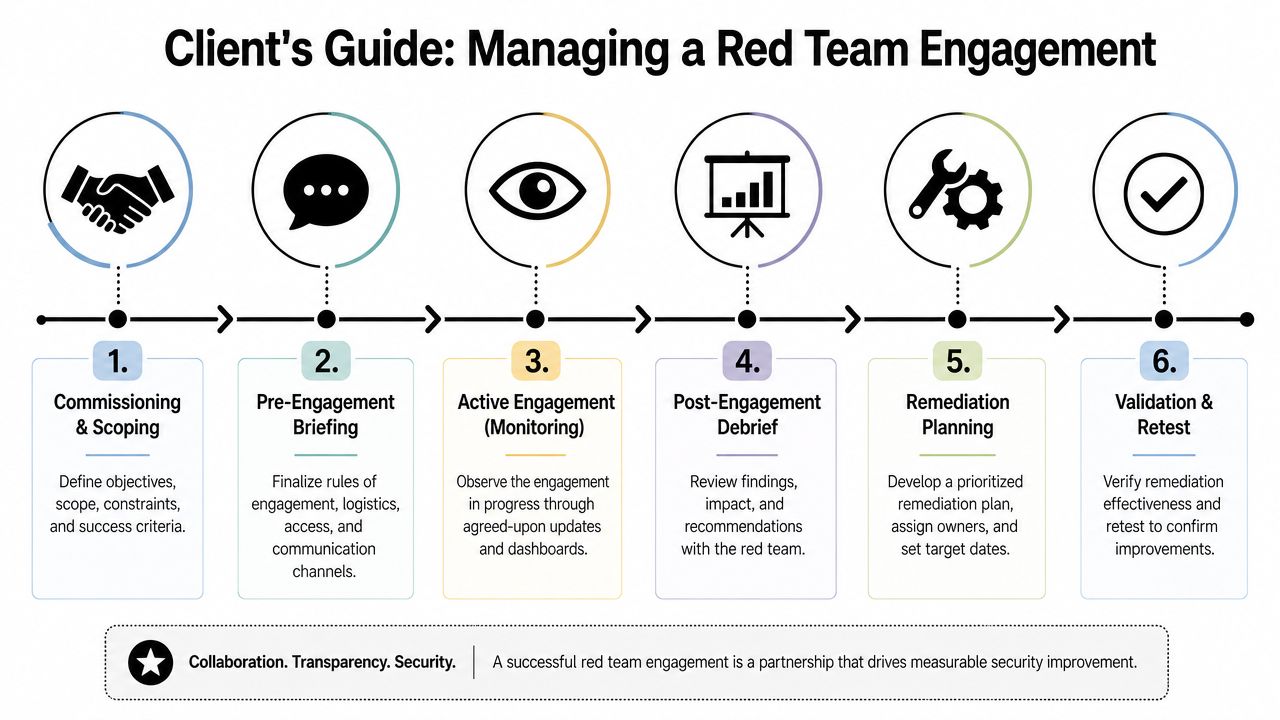
Phase one through three
1. Commissioning and scoping
Start with one or two business-critical objectives. Name the systems, identities, or functions that matter. Define what success looks like for the red team and what would make the test unsafe.
2. Pre-engagement briefing
During this briefing, the control group, vendor lead, and executive sponsor lock the ROE. Confirm communications, emergency contacts, blackout periods, evidence handling, and the approval model for any sensitive action. If you're involving an internal AI-enabled operations layer, make sure its monitoring boundaries are documented through the Hermes agent deployment model so responsibilities are explicit.
3. Active engagement monitoring
During the exercise, keep the control group small. Too many insiders distort the result. The client's job isn't to micromanage the operators. It's to preserve safety, track major milestones, and avoid accidental interference.
A practical operating pattern is:
- Control team owns approvals
- SOC operates normally unless safety is at risk
- Executive sponsor gets milestone updates, not live play-by-play
- IT operations stays on standby for emergency rollback only
Phase four through six
4. Post-engagement debrief
This is the most important meeting. The red team reconstructs the timeline, shows the path from initial access to objective, and compares that activity against what defenders observed. Ask them to separate exploitable issues from merely present issues. Those are not the same.
5. Remediation planning
Don't assign fixes by CVSS alone. Prioritize by demonstrated attack path. If three medium-severity weaknesses created the path to your objective, those three deserve faster action than an isolated high-severity flaw with no practical route.
Use a remediation worksheet that captures:
- The failed control
- The exact abuse path
- Who owns the fix
- How success will be validated
- What temporary mitigation applies now
6. Validation and retest
Don't stop at ticket closure. Validate that the path is broken. Sometimes the individual findings are remediated and the broader route still exists because trust relationships or process weaknesses remain.
The goal isn't to produce a cleaner report next quarter. The goal is to make the demonstrated attack path impossible, noisy, or slow enough that your defenders can win.
This client-side discipline is where many red team assessment services deliver or disappoint. Good operators can uncover real weaknesses. Only an organized client turns that into a stronger security posture.
Integrating Red Team Insights into Your Security Automation
Monday morning, the report is delivered. By Friday, an admin role has changed, a new SaaS app is connected, and one of the conditions behind the original attack path is back in place. That is the problem with treating a red team engagement as a point-in-time exercise.
A red team report should become operating input. The attack chain, abused identities, lateral movement steps, and missed detections belong in the systems your team uses every day. Detection engineering can turn them into rules and correlation logic. Incident response can build triage around the exact sequence that led to impact. Security operations can watch for the same preconditions returning through drift, exceptions, or rushed changes.
From static report to living validation
Picus explains autonomous red teaming as a shift from periodic exercises to continuous adversarial simulation focused on whether a specific outcome is still achievable. That is a useful framing because it forces a better question: can the same breach path still work today?
That question changes how teams use red team findings. Instead of filing the report and waiting for the next engagement, they can build a repeatable validation program around demonstrated attacker behavior:
- Continuous checks against the original attack path and its dependencies
- Automated triage for the event sequences that mattered during the engagement
- Remediation logging tied to a tested scenario, not just a generic ticket
- Containment workflows for high-confidence repeats of known techniques
AI can help here, but only if the scope is tight and the evidence trail is clear. Tools built for autonomous security agents can rerun validation steps, collect telemetry, open or update cases, and record what changed after a fix. They still need guardrails. A weak prompt wrapped around broad production access is not automation maturity. It is just a faster way to make a bad decision.
What good operationalization looks like
The strongest programs map each finding to three things. A control to validate. An owner to fix it. A workflow that proves whether the attack path is broken.
That usually means connecting report findings to the places where work happens through security integrations and workflow connectors. For example, if the red team reached a sensitive system by chaining an overprivileged service account, weak alerting, and an approval gap, the follow-up should not stop at three tickets. The better pattern is to log the service account change, trigger validation of the risky permission set, route the alert sequence into analyst triage, and keep remediation evidence attached to the original scenario.
AI agents are useful in practice. They can continuously validate known paths, triage repeat signals against prior red team evidence, and keep remediation records current enough for audits, retests, and leadership review. That closes the gap between a well-written report and a stronger security posture.
Human operators still decide risk, approve disruptive actions, and judge whether a control failure is isolated or systemic. Automation keeps the findings alive long after the red team leaves.