
You've probably already done the obvious things. Your cloud accounts have MFA. Production access is restricted. The app went through security review. Maybe your team even runs regular vulnerability scans and books a penetration test before major releases.
Then the operating model changes.
You deploy autonomous agents into support, sales ops, internal knowledge workflows, or finance tasks. Those agents connect to Slack, Gmail, Notion, Jira, HubSpot, Salesforce, and other systems. They can read, write, trigger actions, and pass data across tools. The security question changes from “Is the perimeter protected?” to “What happens when a capable system starts making chained decisions inside the business?”
That's where red teaming services stop being a nice-to-have. They become the fastest way to learn whether your defenses hold up against an adaptive attacker, or against unsafe agent behavior that behaves like one. If your team is already thinking seriously about governance and access boundaries, the right place to start is your platform's own security policy, then pressure-testing whether those controls work under realistic attack conditions.
Table of Contents
- Your Defenses Are Good But Are They Battle-Tested
- What Red Teaming Is and How It Differs from Pen Testing
- The Three Main Types of Red Teaming Services
- Inside a Typical Red Team Engagement Lifecycle
- How to Select the Right Red Teaming Vendor
- The New Frontier Red Teaming for AI Employee Platforms
- Conclusion From Simulation to True Security Resilience
Your Defenses Are Good But Are They Battle-Tested
A lot of fast-moving tech companies hit the same point. The stack looks secure on paper, but no one has tested how the whole thing behaves when a determined operator starts chaining small weaknesses together.
That problem gets sharper when AI agents enter production. A support agent can access customer context. A sales ops agent can update records. An internal research agent can search documents, summarize them, and send results elsewhere. Each permission may look reasonable by itself. The issue is the path between them.
I've seen teams assume their biggest risk is a known software flaw. In practice, the nastier failures often come from interaction effects. A prompt slips through. An agent uses the wrong tool. A low-privilege foothold reaches a high-value system because no one tested the full route end to end.
Red teaming is what you use when controls look fine individually, but you need to know whether they still hold under pressure.
That's why mature teams use red teaming services as a sparring partner, not as a branding exercise. The point isn't to generate a dramatic breach story. The point is to force your detection, access control, logging, and response process to operate against someone trying to win.
The risk isn't only technical
Security failures in modern environments rarely stay inside one layer. An operator may start with public information, pivot into a cloud app, abuse identity relationships, then move through workflow tools that no one originally classified as critical.
For companies deploying autonomous systems, the same principle applies. The danger isn't just “Can someone break the model?” It's “Can unsafe behavior or adversarial input cause an agent to reveal data, misuse tools, or overstep role boundaries?”
Why this matters now
Traditional reviews catch important issues, but they don't answer the hardest question. If a creative adversary targets your environment the way a real one would, will your team detect it early enough to matter?
That's the difference between a secure-looking posture and a tested one.
What Red Teaming Is and How It Differs from Pen Testing
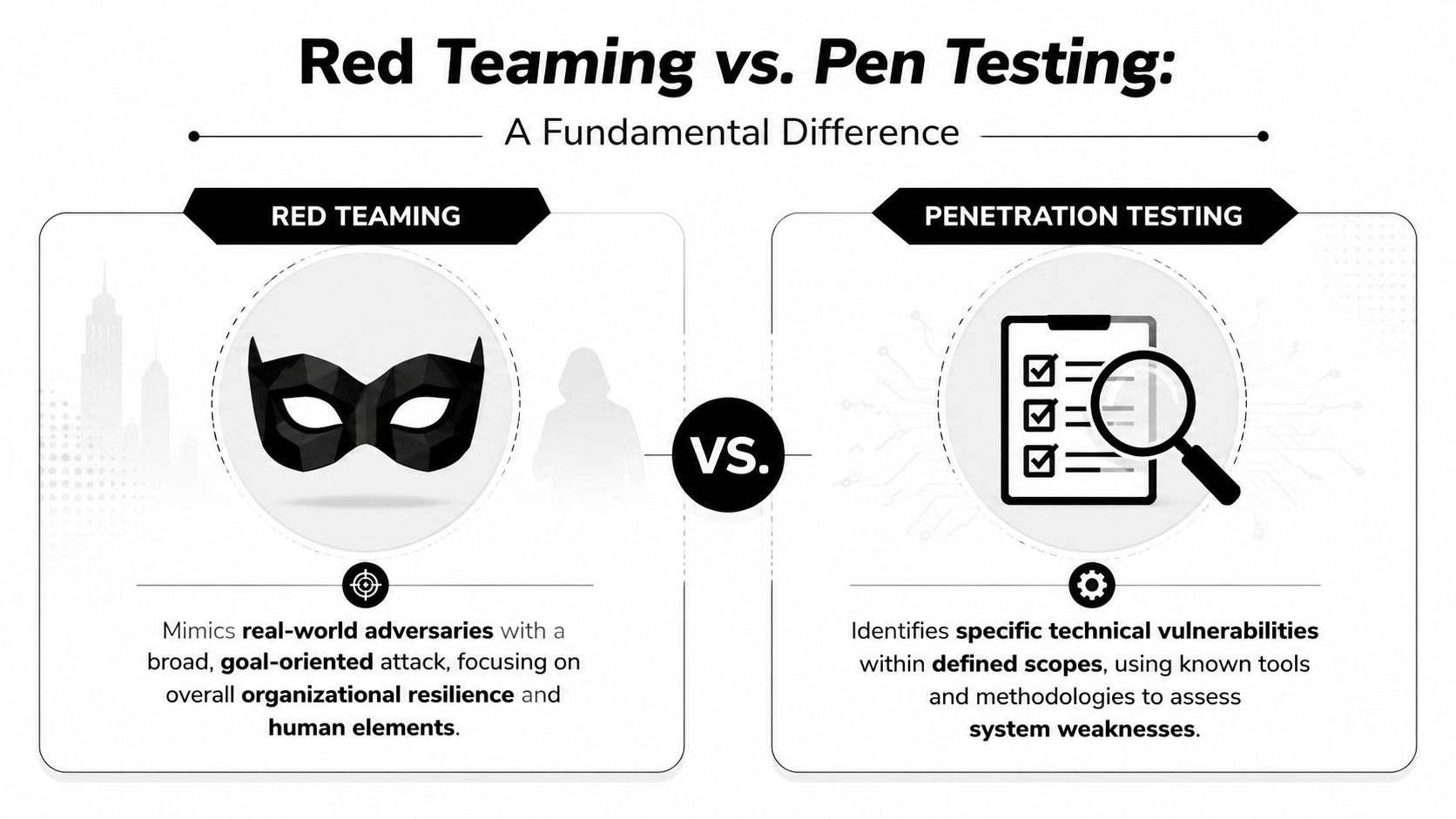
A penetration test is like hiring a building inspector. You want someone to check the doors, locks, windows, alarm wiring, and structural weak points against known standards.
A red team is closer to hiring ethical robbers and asking them to get to the vault without being stopped.
That analogy matters because buyers often use the terms interchangeably. They shouldn't. The difference isn't branding. It's the operating philosophy.
Why the attacker mindset matters
Red teaming differs from traditional penetration testing by adopting an attacker mentality where the team's sole objective is to attack the network, emulating advanced persistent threats by chaining multiple techniques like spear phishing into lateral movement. A critical outcome is the generation of a Blue Team Report that provides a direct comparison of defensive effectiveness against the red team's attack execution model, as outlined by Rapid7's explanation of red teaming.
That “chaining” point is where many leaders finally see the value.
A pen test may flag separate issues: an exposed service, weak permissions in one app, a misconfiguration in identity, and a sensitive workflow that lacks approval checks. Useful findings, absolutely. But red teaming asks a tougher question. Can those small cracks be combined into one realistic attack path that reaches an objective that matters to the business?
The answer is often yes.
Red team operators use toolsets that support that style of work. The verified material references Cobalt Strike, Metasploit, and BloodHound as examples of tooling used to map relationships, test vulnerabilities, pivot through hosts, and support post-exploitation activity. The specific tools matter less than the operating model behind them. Skilled teams don't just run scans. They adapt.
Practical rule: If the engagement is designed mainly to enumerate flaws, you're buying a penetration test. If it's designed to validate whether defenders can detect and stop a realistic campaign, you're buying red teaming services.
What a pen test gives you instead
A good pen test is still valuable. It's often the right choice when you need focused validation of a defined asset, such as a web app, API surface, cloud deployment, or new release. It's efficient. It's narrower. It helps engineers remediate concrete weaknesses quickly.
Red teaming is broader and less tidy. It tests people, process, technology, and response quality under conditions that resemble an adversary operation. That usually means more ambiguity, more time, and more internal coordination.
Here's the cleanest way to separate them:
- Pen testing checks exposure. It tells you where a skilled tester can identify and exploit defined weaknesses.
- Red teaming checks resilience. It shows whether an attacker can pursue a meaningful objective without your organization detecting and stopping them in time.
- Pen testing supports remediation planning. Engineering teams often use it to prioritize fixes in a known environment.
- Red teaming supports operational learning. Security leaders use it to evaluate monitoring, escalation, containment, and decision-making.
What doesn't work is buying one and expecting the other. If leadership wants a realistic adversary simulation, a standard pentest won't satisfy that need. If the team still needs to fix foundational issues, a full red team may be premature.
The Three Main Types of Red Teaming Services
Buying “red teaming services” without defining the attack path you want tested usually leads to a mismatch. A vendor runs a technically solid exercise, leadership gets a report, and the core question still goes unanswered. Can an attacker reach what matters most to the business, and can your team stop it in time?
The three service types below solve different problems. Strong programs often use more than one, but they should not be scoped the same way.

Cybersecurity red teaming
This is the standard form of red teaming. It tests whether an attacker can move through your digital environment to reach a defined objective such as production data, privileged access, source code, payment systems, or an administrative control plane.
The work usually spans identity, cloud infrastructure, endpoints, internal applications, and the trust relationships between them. Good operators do not waste your budget proving that a low-risk bug exists. They chain weaknesses together and show how exposure becomes impact.
Common areas of focus include:
- Identity abuse: Excessive privileges, weak role design, service account misuse, and directory trust issues
- Cloud and application attack paths: Misconfigurations, exposed management interfaces, insecure secret storage, and risky system-to-system permissions
- Detection and response: Whether your SOC, EDR, SIEM, and incident leads can identify suspicious behavior before business objectives are reached
This is usually the right choice when leadership wants an answer to a practical question. If a capable adversary targeted us, how far would they get?
AI and adversarial agent red teaming
This is the category many companies still treat too narrowly. They test the model prompt, maybe the chatbot UI, and assume the job is done. That misses the actual failure path in autonomous systems.
An AI employee platform or agentic workflow can have valid credentials, approved tool access, and legitimate business context, then still cause material harm. The issue is not just unauthorized entry. The issue is unsafe action after access is granted.
That changes the scope of the engagement. Testing has to cover the model, the orchestration layer, memory, retrieval, tool permissions, approval logic, and the business process the agent is meant to execute. On platforms like Donely, where agents can coordinate tasks across systems, the red team should be trying to trigger wrong actions, data exposure, and control failures that would never appear in a traditional network exercise.
A useful AI red team will probe questions like these:
- Prompt injection: Can external content override instructions or redirect the agent's goal?
- Tool misuse: Can the agent call the wrong integration, take an unsafe action, or send data to an unintended destination?
- Data leakage: Can sensitive context spill through summaries, retrieval results, logs, chat outputs, or multi-step tasks?
- Role confusion: Can one agent exceed its intended function because memory, permissions, or orchestration rules are too loose?
- Autonomy limits: Does the system require the right approvals before high-risk actions, or can it act too freely under routine conditions?
This work sits between application security, identity architecture, and operational governance. Teams that skip it often discover problems only after the platform is in production and connected to live systems.
To ground the broader discussion, this short overview is useful:
Physical red teaming
Physical red teaming tests the controls that never show up in a vulnerability scan. Building access, badge checks, tailgating, unattended devices, printed materials, shipping procedures, and front-desk verification all create openings if they are handled casually.
A mature engagement might involve attempts to enter a facility, access a workstation, place rogue hardware, or use social engineering against staff who handle sensitive workflows. For hybrid teams, the scope can also include executive travel, home office practices, and equipment delivery.
This type of testing matters more than many software-first companies expect. A single physical lapse can bypass expensive technical controls and hand an attacker the foothold they need.
The right mix depends on what your business is exposed to. A cloud-heavy SaaS company may start with cyber red teaming. A company deploying autonomous AI agents into finance, support, or operations may need AI red teaming first. Organizations with regulated facilities, executive risk, or sensitive on-site workflows often need physical testing in the same program.
Inside a Typical Red Team Engagement Lifecycle
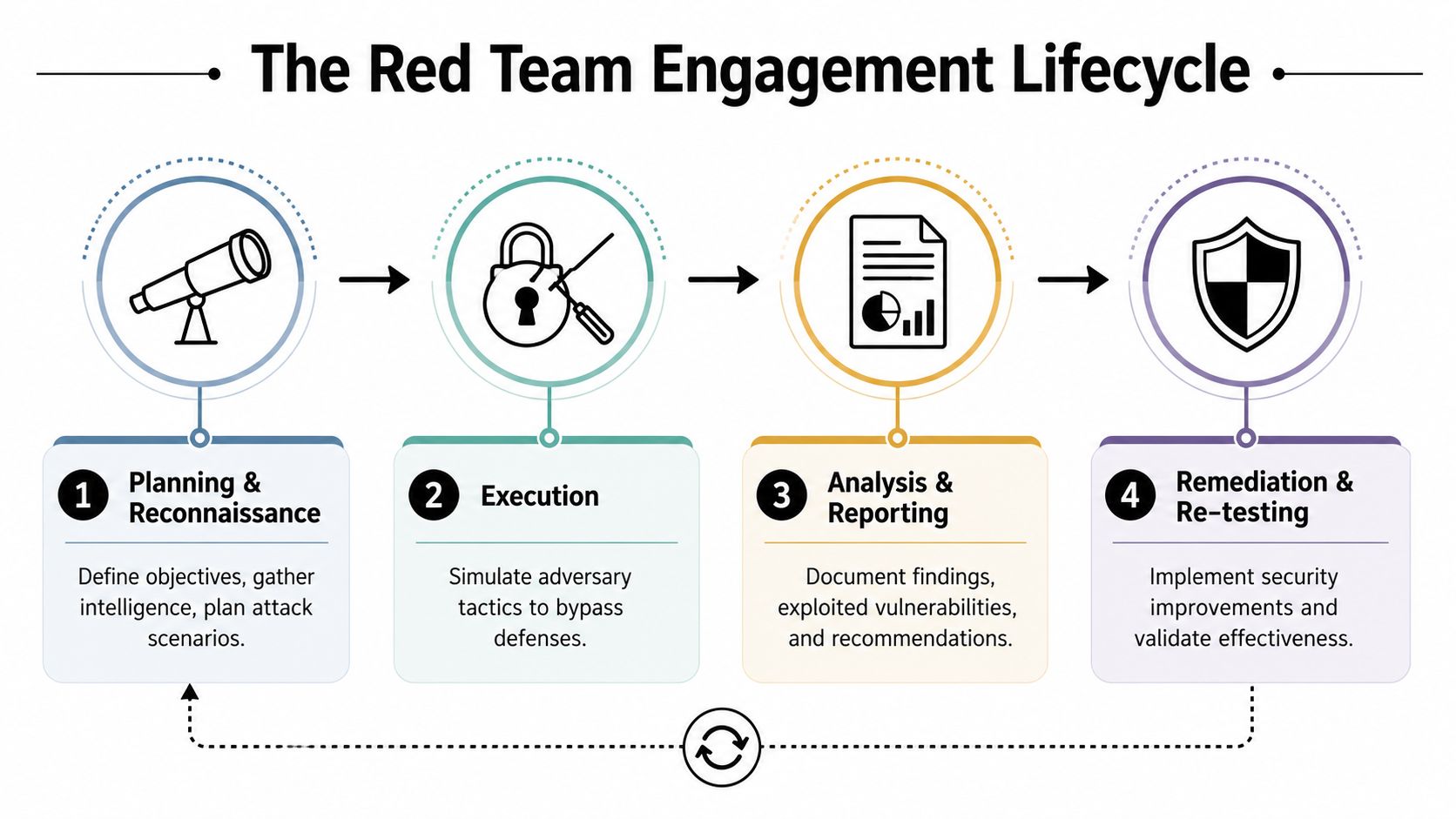
A professional red team engagement should feel controlled from the client side, even if the attack simulation feels unpredictable from the defender side. If the process looks improvised, that's usually a warning sign.
The lifecycle follows a practical sequence from planning to remediation. The exact details vary by vendor, but the shape of the work is consistent.
Scoping and rules of engagement
Before anyone touches production, the client and vendor define objectives, constraints, escalation paths, and safety controls.
A critical distinction between serious buyers and casual ones emerges. “Test us like a real attacker” sounds bold, but it's incomplete. You need named objectives. You need clear boundaries. You need agreement on what happens if the red team reaches sensitive systems, impacts a critical workflow, or uncovers an immediate risk that can't wait until the report.
A strong scope usually defines:
- Business objectives: What the red team is trying to achieve, such as access to a critical data set or privileged control plane.
- Operational limits: Systems, time windows, personnel boundaries, and safety constraints.
- Communication protocols: Who gets called, when, and under what conditions.
- Success evidence: What proof is enough to demonstrate impact without causing unnecessary harm.
Reconnaissance and initial foothold
According to Redscan's red team operations overview, a red team operation is an extended engagement conducted over several weeks to achieve a specific objective such as data exfiltration. It begins with thorough reconnaissance where operators gather technical, organizational, and human intelligence to build a roadmap of potential attack vectors using open-source intelligence and active probing.
This stage often looks quiet from the outside, which is exactly why it matters. Good operators learn the environment before they force it. They map people, systems, naming patterns, exposed surfaces, trust relationships, and weak assumptions.
Initial access can come from several directions depending on the scope. It may involve external exposure, phishing, social engineering, credential paths, or an assumed foothold agreed during planning. The method matters less than what the team does after entry.
The most useful red team evidence usually appears after initial access, when the exercise shows how far an attacker can move before defenders react.
Persistence movement and objectives
Once inside the network, the same Redscan source notes that red teamers establish persistence using mechanisms like backdoors or new user accounts to maintain long-term access even if the initial entry point is discovered and shut down. They then escalate privileges by exploiting local vulnerabilities and move laterally across the environment toward critical assets such as domain controllers.
That sequence is where many organizations get surprised.
A company may detect phishing reasonably well but fail to spot privilege escalation. Another may monitor endpoints but miss identity abuse. Another may log cloud events but not correlate them fast enough to stop lateral movement. Red teaming exposes those handoff failures.
A mature engagement usually aims at a predefined end state, not open-ended chaos. Examples include:
- Administrative control: Demonstrate that privileged access could be obtained.
- Sensitive data access: Show that important information was reachable.
- Operational disruption path: Prove that a critical workflow could be influenced or interrupted.
- Undetected dwell path: Measure how defensive controls perform while the operator maintains footholds and pivots.
Debrief remediation and re-test
The engagement doesn't end when the red team “wins.” It ends when the organization understands why the attack path worked and what to change.
The same verified Redscan material states that the operation concludes with completion of predefined goals, followed by a detailed debrief that documents attack paths and missed detection opportunities to improve resilience. In practice, that means two outputs matter most: an executive narrative that ties findings to business impact, and a technical record that engineers and defenders can use immediately.
A useful debrief should answer questions like these:
- Where did detection fail first?
- Which privilege relationships made the path possible?
- What evidence should defenders have seen?
- Which fixes reduce the whole path rather than one symptom?
If the vendor hands over a dramatic slide deck but no practical remediation path, the engagement wasn't complete.
How to Select the Right Red Teaming Vendor
Most vendor selection mistakes happen because buyers compare on price and presentation quality before they compare on operating fit. Red teaming services are easy to market and hard to deliver well.
A polished website doesn't tell you whether the team can build a realistic attack path through your stack, exercise your defenders without unnecessary drama, and leave behind reporting your engineers can effectively use.
Buy for outcomes not theatre
Start with the engagement outcome you care about. Are you validating SOC performance? Testing identity boundaries? Stress-testing cloud trust relationships? Evaluating agent behavior under adversarial conditions? Different vendors are strong in different areas.
The second filter is methodology. Ask how the team scopes objectives, how it handles safety, how it balances stealth with evidence collection, and what artifacts you'll receive at the end. If the answer is vague, assume the delivery will be vague too.
What usually works well:
- Objective-led scoping: The vendor frames the engagement around business-critical outcomes rather than generic “testing.”
- Clear reporting samples: They can show sanitized examples of attack narratives, timelines, detection gaps, and remediation guidance.
- Operator depth: The team can discuss trade-offs in identity, cloud, endpoint, application, and human attack surfaces without sounding rehearsed.
- Strong client handling: They know how to coordinate with legal, engineering, security, and executive stakeholders without confusion.
What usually disappoints:
- Checklist language dressed up as red teaming
- Overemphasis on tools instead of attack logic
- Reports that read like scanner exports
- No credible plan for validating AI-agent behavior if your environment depends on it
If your environment relies heavily on integrations and workflow automation, it's smart to review the shape of your connected surface before scoping an engagement. A platform's available integrations often reveal where attackers and unsafe automation could traverse between systems.
Questions that expose weak vendors fast
Ask direct questions. Good operators tend to answer plainly.
“Show me how you tie technical findings to a business objective. Then show me what the blue team receives.”
Also ask how they'll handle an environment where software, people, and autonomous workflows all interact. A vendor that only thinks in terms of external exploitation may miss your highest-risk paths.
Here's a practical shortlist to use during procurement.
| Evaluation Criteria | What to Look For | Red Flag |
|---|---|---|
| Methodology clarity | A defined approach to scoping, execution, evidence capture, debriefing, and remediation | Buzzwords with no explanation of how the work is actually run |
| Business alignment | Objectives tied to critical systems, sensitive workflows, or meaningful attack outcomes | A generic promise to “test everything” |
| Reporting quality | Attack-path narrative, timeline, detection analysis, and actionable remediation guidance | A finding list with little context |
| Communication discipline | Named escalation contacts, safety procedures, and clean executive updates | Unclear communication during active testing |
| Technical breadth | Ability to discuss identity, cloud, application, endpoint, and workflow abuse in one engagement | Deep skill in only one narrow area |
| AI-specific capability | Evidence they can test prompt injection, tool misuse, data leakage, and agent authorization boundaries | They treat AI risks as standard web-app issues |
| Operational maturity | Professional handling of logs, artifacts, containment, and cleanup | No clear answer on how they avoid lingering risk |
| Retest philosophy | A practical plan to validate fixes after remediation | “We deliver the report and move on” |
A strong vendor should make you more confident before the engagement starts, not less.
The New Frontier Red Teaming for AI Employee Platforms
The biggest shift in red teaming right now isn't another endpoint tactic or cloud exploit path. It's the move from testing static systems to testing autonomous systems that can perceive, decide, and act.
That requires a different mindset. Traditional red teaming asks, “Can an attacker get in and move?” AI-focused red teaming also asks, “What happens when the system already has legitimate access and makes the wrong move for the wrong reason?”
Why AI agents change the attack surface
The verified data is blunt here. There's a critical gap between generalized red teaming and AI-specific adversarial testing. While 90% of content covers traditional red teaming, only 12% of reports address AI systems. This is a significant blind spot, as 78% of AI security breaches stem from untested agent behaviors like prompt injection or data leakage, based on the Bishop Fox analysis referenced for this gap.
That matches what practitioners see on the ground. AI agents aren't just another app feature. They often sit at the center of workflows, with access to messages, documents, tickets, CRM records, and action tools.
The risk profile changes in four ways:
- Instruction fragility: The agent may follow malicious or misleading input embedded in content it was supposed to process.
- Action chaining: A harmless-looking task can turn risky when the agent can query one system, interpret the result, then act in another.
- Boundary confusion: Weak role design can let one agent or workflow overreach into another context.
- Audit complexity: When the system produces intermediate reasoning, retrieval, tool calls, and outputs across platforms, reconstructing cause and effect gets harder.
For teams evaluating use cases such as AI agents for customer support, the security model has to extend beyond model quality and response speed. You need to know whether the agent can be manipulated into exposing information, bypassing policy, or escalating action scope.
How to scope an agent red team exercise
For AI employee platforms, scope the test around workflows, permissions, and evidence. Don't scope it around “the model” in isolation unless your real deployment is isolated too.
A good exercise usually includes the following:
Role-based scenarios
Define separate agent roles and ask the red team to test whether those roles stay contained. Sales shouldn't drift into finance. Support shouldn't retrieve internal strategy docs. A research assistant shouldn't gain action privileges by proxy.
Tool abuse scenarios
Test what happens when an agent is coaxed into using the wrong integration, invoking the wrong function, or returning sensitive context from one connected system into another channel.
Cross-instance isolation checks
In multi-tenant or multi-instance environments, verify whether context, credentials, memory, outputs, or logs can cross boundaries accidentally.
Adversarial content injection
Feed the system realistic hostile inputs through the same channels it uses in production. That might include tickets, documents, chat threads, email content, or linked knowledge sources.
Don't ask only whether an agent can answer unsafely. Ask whether it can act unsafely.
Teams deploying AI workers should also examine the platform-level controls around instance isolation, role enforcement, and governance. For context on how these environments are structured operationally, it helps to review AI employee platform architecture before defining red team objectives.
What good evidence looks like
A useful AI red team report shouldn't stop at “the agent failed this prompt.” That's too shallow for production programs.
You want evidence such as:
- Exact trigger conditions: What input pattern, source, or workflow caused the failure.
- Permission path: Which identity, connector, or role allowed the unsafe step.
- Observable artifacts: Logs, tool calls, audit events, outputs, and timing evidence.
- Control recommendation: Whether the fix belongs in prompting, orchestration, RBAC, tool policy, data scoping, or monitoring.
That level of evidence is what lets engineering, security, and operations fix the actual problem instead of debating symptoms.
Conclusion From Simulation to True Security Resilience
The wrong way to think about red teaming is as a final exam. Attackers don't care whether your organization “passed.” They care whether they can reach something valuable before someone stops them.
The right way to think about red teaming services is as applied training for your security program. They reveal where assumptions break, where detection trails go cold, where access boundaries are too generous, and where teams struggle to respond under pressure.
Why the lesson matters more than the breach
A successful red team engagement may produce a breach path. That's uncomfortable, but it's not the main value.
The value sits in what follows. Your defenders refine detections. Engineers remove weak trust relationships. Platform owners tighten permissions. Leaders learn whether response processes work in real time or only in policy documents.
That's especially important in AI-heavy environments. Static controls won't cover every failure mode when agents interact with tools, documents, and users across live workflows. Teams need repeated testing, sharper governance, and better evidence capture.
For organizations building safeguards into prompts and orchestration layers, practical resources on preventing unsafe AI responses can help frame one part of the control stack. But guardrails alone aren't enough. You still need adversarial validation to see how the system behaves when real pressure hits production logic.
Make it part of operating discipline
The strongest companies don't treat red teaming as an annual spectacle. They use it as part of a cycle.
They test. They learn. They remediate. They re-test. Then they update detection logic, access models, and operating procedures before the next major change lands.
That cycle matters even more as AI platforms become operational infrastructure instead of side experiments. Once agents can read, decide, and act across business systems, the line between application security and operational security gets thin fast.
If you're advising a tech company today, the practical recommendation is simple. Keep pen testing for focused technical validation. Use red teaming when you need to know whether your organization can withstand realistic attack behavior. And if autonomous agents are in the environment, make sure the exercise includes them directly. Anything less leaves the newest part of your stack under-tested.
If you're deploying AI workers and want a platform built for operational control, Donely gives teams a practical foundation with isolated instances, granular RBAC, unified audit logs, and centralized management for AI employees at scale.