
Most advice about an AI governance platform starts with policies, committees, and compliance checklists. That advice is incomplete in production. A policy can say an agent must use only approved data, request approval before a sensitive action, and stop when its identity is revoked. It can't enforce any of those rules unless the platform knows which agent is acting, what that agent is authorized to access, and how to contain it while a workflow is running.
Autonomous agents have changed the operational problem. A model that only returns text creates one set of risks. An agent that calls tools, changes records, sends messages, and delegates work creates another. The practical question isn't whether your organization has written responsible-AI principles. It's whether you can inventory every agent, constrain every action, reconstruct every decision, and revoke access without relying on an engineer to hunt through application settings.
Table of Contents
- Why Most AI Governance Strategies Fail in Production
- What an AI Governance Platform Does
- Essential Architecture and Core Features
- Compliance Frameworks and Security Requirements
- Vendor Evaluation Checklist and Red Flags
- Real-World Implementation Scenarios
- Your Implementation Roadmap and Next Steps
Why Most AI Governance Strategies Fail in Production
The popular assumption is that governance begins with a policy document and ends with employee training. In real deployments, the failure usually happens later. An agent inherits a broad service account, a connector exposes more customer data than intended, or a prompt and tool configuration changes without a reviewable record. The organization may have a detailed policy, but the running system still has authority it shouldn't have.
The Cloud Security Alliance describes a significant gap between established governance frameworks and modern tool-calling agents. Those frameworks were created before autonomous agents became common, leaving teams to solve identity, authorization, and containment problems that policy language alone doesn't address. A 2026 survey of 235 large-enterprise CISOs and CIOs found that 92% lacked full visibility into AI agent identities, while 95% doubted they could detect or contain a compromised agent. These figures are reported in the Cloud Security Alliance note on the AI agent governance framework gap.
The production failure pattern
A typical incident doesn't require a malicious model. It can begin with an ordinary operational shortcut:
- Shared credentials: Several agents use one integration identity, so investigators can't reliably attribute an action to a specific workload.
- Broad permissions: An agent created for lead qualification can read more CRM records than its task requires.
- Untracked configuration: A developer adds a tool or changes a system instruction without producing evidence for review.
- Weak termination: Disabling an employee or API key doesn't necessarily stop queued, delegated, or multi-step agent work.
- Fragmented logs: Model calls, tool actions, approvals, and data access events sit in separate systems with no usable timeline.
Practical rule: If you can't answer “which agent did what, with which identity, against which data, and under which approval,” you don't have operational governance.
An ethical-AI resource and a production control system diverge. A business guide to ethical AI can help teams define principles, responsibilities, and acceptable use. Those principles still need technical enforcement at runtime.
Why agents need a different control model
Traditional application governance often assumes a human initiates an action and the software executes it. Agents can plan across multiple steps, select tools dynamically, and continue operating after the original request. Their permissions must therefore be scoped to the task, the data, the tool, and the workflow state.
An effective platform treats each agent as a managed workload with a distinct identity, bounded authorization, observable actions, and a tested containment path. That reframes governance from “did we publish the policy?” to “can we demonstrate control while the agent is operating?” The rest of the evaluation follows from that distinction.
What an AI Governance Platform Does
An AI governance platform is the runtime control plane for autonomous systems. It maintains identity, evaluates authorization, records activity, applies rules, and gives operators a way to intervene while agents are working. The focus is operational: agents, models, tools, data, and human approvals must remain connected as work moves through production.
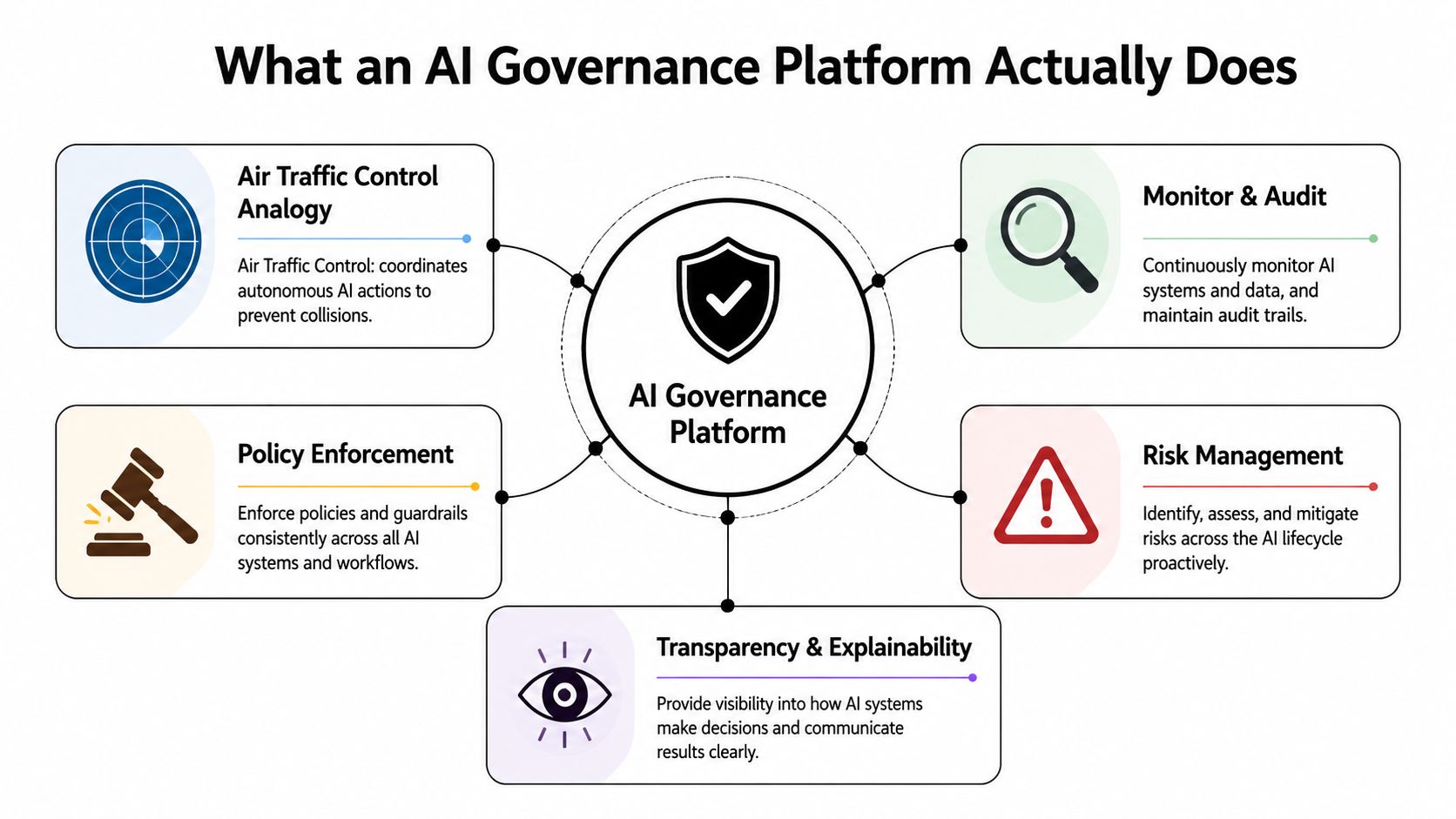
A usable platform connects six operating functions.
Inventory and ownership
Maintain a current register of deployed agents and models, rather than a spreadsheet refreshed before an audit. Each record should show the owner, purpose, environment, model or version, connected tools, data categories, approval requirements, and retirement status. Ownership creates an escalation path when an agent changes behavior or exceeds its intended scope.
Policy enforcement
A policy matters only when it can affect an operation at runtime. The platform should block, allow, require approval, or escalate an action using factors such as agent identity, user identity, data sensitivity, destination, tool type, and workflow context. Authorization must follow the task and its current state, not remain fixed as a broad permission granted at deployment.
Risk management
Assess risk before deployment and continue reviewing it after release. Record the rationale, selected controls, residual risk, exceptions, and review schedule. The platform should flag changes that can invalidate the original assessment, including a new connector, model version, or expansion of data access.
Monitoring and audit
Monitoring shows operators what is happening now. Audit records help investigators reconstruct what happened later. Coverage should include prompts, model calls, tool invocations, approvals, denials, identity changes, configuration changes, and containment actions, with enough context to connect those events into one timeline.
Transparency and explanation
Explainability in agent operations includes the path from request to plan, plan to tool call, and tool call to business outcome. Records should identify where a human approved an action and where an automated rule applied. That evidence is more useful in production than model internals alone.
Incident response
Observation without containment leaves operators unable to stop a harmful workflow. Controls should pause an agent, revoke credentials, disable a tool, isolate an instance, preserve evidence, and support a safe resume after review. Revoking one user or API key is insufficient if queued or delegated work can continue under another identity.
ISO/IEC 42001 frames AI governance as an organization-wide management system built around Plan-Do-Check-Act. A platform should therefore support recurring policy review, assigned accountability, risk reassessment, control testing, and change management instead of treating governance as a completed setup. These practices are outlined in this guide to ISO/IEC 42001 controls.
A practical definition is a control plane connecting identity, authorization, policy, evidence, monitoring, and response across the AI lifecycle. Tools that only measure model quality or scan prompts address narrower observability needs. They do not govern autonomous action without runtime authorization and a tested containment path.
Essential Architecture and Core Features
Production governance starts with architecture, not a dashboard. The platform needs a reliable control plane for identities, configurations, policies, evidence, and operational events, while execution environments remain isolated enough to limit a failure.
The control plane
A centralized inventory should represent every agent as a managed asset. Store its owner, purpose, environment, model and version, tools, data permissions, approval rules, deployment state, and review history. Lifecycle controls should support creation, testing, approval, release, suspension, modification, and retirement.
Identity must be separate at the agent, instance, user, and integration levels. Role-based access control, SSO, and SCIM help organizations assign minimum-necessary permissions and remove access through established identity workflows. Per-instance roles are more useful than one global administrator role because they reduce the blast radius of prompt, tool, and configuration changes.
The audit layer should be append-only and tamper-evident. At minimum, record who accessed what, when the event occurred, which model or version ran, what data category was involved, and which guardrail or approval action applied. Auditors and incident responders need to reconstruct both access control and model decision history, not just download a list of application errors. The relevant ISO/IEC 42001 sample provides the standard context for documented controls and accountability.
The runtime layer
Runtime controls should enforce data boundaries before an agent reaches a tool. Use scoped credentials, isolated containers, allowlisted integrations, and explicit approval gates for high-impact actions. Model version control should tie each execution to the exact version and configuration used, otherwise a later investigation may compare the wrong behavior.
Real-time monitoring should surface unusual tool sequences, repeated denials, unexpected destinations, privilege changes, excessive data access, and failed approvals. Alerting is only useful when connected to response actions. A security operator should be able to pause the relevant workload and preserve the event trail without manually coordinating several disconnected systems.
A platform such as Donely can be evaluated against this pattern when teams need isolated multi-instance deployments, per-instance RBAC, scoped data access, centralized monitoring, billing, and unified audit logs. For teams deploying OpenClaw workloads, the OpenClaw API deployment resource is a relevant implementation reference.
| Feature | Solo Founder | Agency | Enterprise |
|---|---|---|---|
| Agent inventory | Track personal and business agents with clear owners | Separate each client workload and purpose | Maintain lifecycle, risk, and ownership records across departments |
| Instance isolation | Keep personal and business data apart | Isolate clients, credentials, logs, and billing | Separate environments and reduce cross-workload blast radius |
| RBAC | Use a small number of trusted roles | Assign client and operator permissions per instance | Integrate SSO and SCIM with granular review roles |
| Audit logging | Preserve tool and configuration history | Give clients evidence for their workloads | Produce tamper-evident records for audits and incidents |
| Monitoring and response | Watch status and stop misbehaving agents | Centralize health and exception handling | Connect alerts to incident response and control testing |
| Model and policy lifecycle | Review changes before they affect customers | Document client-specific approvals | Enforce release gates, evidence collection, and recurring reviews |
The trade-off is operational complexity. A platform that exposes every possible control can overwhelm a small team, while a simple interface may hide the detail an enterprise auditor needs. Choose the smallest architecture that preserves identity separation, least privilege, evidence integrity, and an immediate containment path.
Compliance Frameworks and Security Requirements
Compliance frameworks answer different questions. No badge proves that an autonomous agent is governed in production. NIST AI RMF structures risk work around Govern, Map, Measure, and Manage. ISO/IEC 42001 defines an auditable AI management system. The EU AI Act introduces risk-based obligations, while SOC 2, GDPR, and HIPAA add requirements for security, privacy, access, and protected data.
ISO/IEC 42001's Annex A is commonly described as containing 38 controls across 9 control areas, covering impact assessment, AI system development, data governance, transparency, and use-of-AI monitoring. Implementation starts by mapping every agent and model to an accountable owner, required evidence, review cadence, and current status. A framework logo in a procurement deck cannot show whether an agent can be identified, authorized, or stopped during a live workflow.
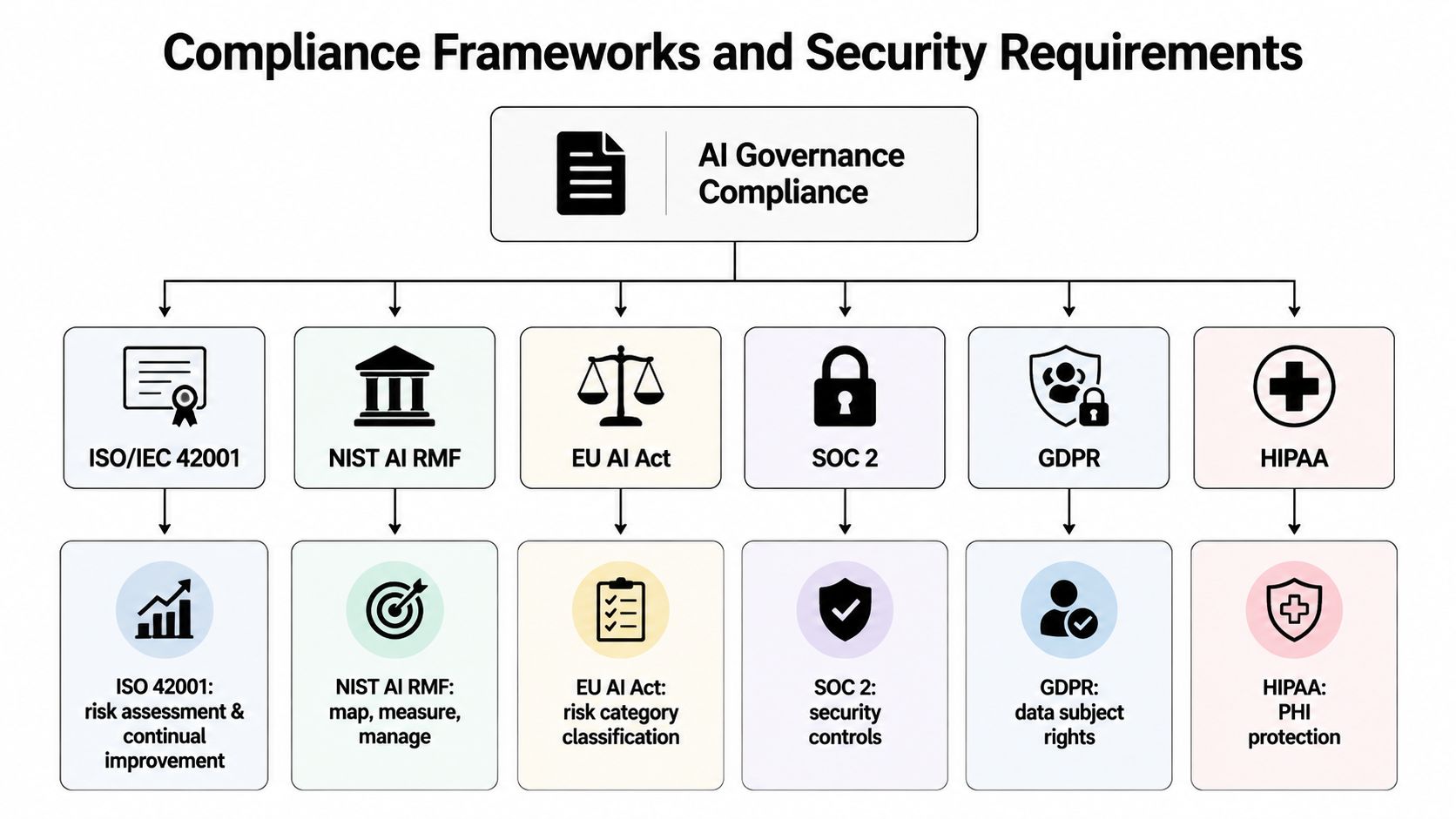
| Framework or requirement | What teams must operationalize | Evidence a platform should preserve |
|---|---|---|
| ISO/IEC 42001 | Management-system ownership, risk review, documented controls, continual improvement | Policies, approvals, assessments, control tests, review history |
| NIST AI RMF | Govern, map, measure, and manage AI risks | Risk records, measurements, mitigations, exceptions |
| EU AI Act | Appropriate classification, documentation, oversight, and monitoring where applicable | System descriptions, assessments, human interventions, post-deployment events |
| SOC 2 | Security, access, change management, and monitoring controls | Identity records, configuration history, access logs, incident evidence |
| GDPR | Lawful data handling, privacy controls, and support for data subject processes | Data access history, purpose records, deletion or restriction actions |
| HIPAA | Protection of protected health information and controlled access | Access events, isolation evidence, approvals, response records |
The operational gap appears at runtime. Isolated containers reduce interference between workloads. Scoped permissions stop an agent from treating an entire repository as available because a connector exists. Centralized logs should join the user request, agent identity, model version, tool action, approval, and response into one investigation trail. Operators also need a live containment path, such as revoking a credential or pausing one agent without disrupting unrelated workloads.
Privacy-heavy environments require traceability beyond the model call. Teams handling product or supply-chain information may boost transparency with passports, provided those records follow the organization's data classifications and access controls.
A written policy has value only when deployment controls enforce it. Review Donely's security policy, then test its described controls against your identity provider, threat model, data classifications, and incident procedures.
A compliance demonstration should answer four questions:
- What exists? Show the complete agent and model inventory.
- Who owns it? Show accountable people, roles, and approval authority.
- What controls apply? Show policy mappings, permissions, isolation, and monitoring.
- Can you prove operation? Show immutable evidence, review records, incidents, and successful revocation tests.
Here is a short visual explanation of how these requirements relate to governance implementation:
Vendor Evaluation Checklist and Red Flags
Evaluate vendors by running failure drills, not by counting policy templates. Ask the vendor to demonstrate what happens when an agent receives a disallowed request, a credential is revoked mid-workflow, a tool is added without approval, or an operator must reconstruct an action from last week. These tests expose whether identity, authorization, and containment work under production conditions.
Questions that reveal operational strength
- Identity: Does every agent, user, instance, and integration have a distinct identity? Can you attribute a tool action without relying on a shared account?
- Authorization: Can permissions be scoped per instance, tool, data category, workflow, and role? Are approvals enforceable rather than merely recorded?
- Containment: Can operators pause an agent, revoke access, disable one connector, and preserve evidence without stopping unrelated workloads?
- Auditability: Are logs append-only and tamper-evident? Do they include access, model or version, data category, guardrail, approval, and configuration events?
- Isolation: Are client and departmental workloads separated through containers or equivalent boundaries? Can one instance access another's secrets or logs?
- Integration: Does the platform connect to your identity provider, ticketing system, SIEM, model gateway, and deployment workflow?
- Economics: Does pricing remain understandable as instances, users, logs, and support requirements expand?
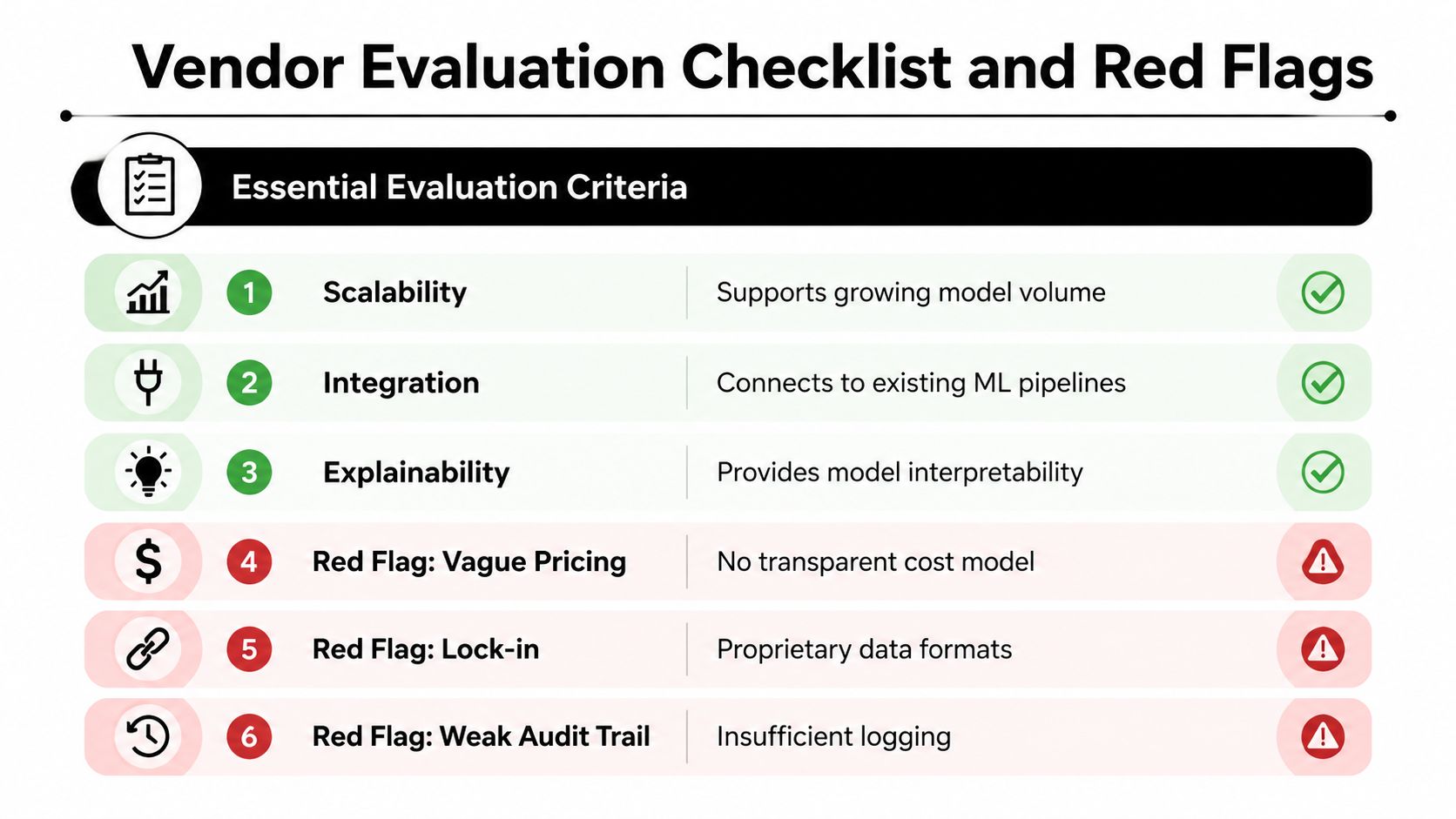
Red flags in demonstrations and contracts
Documentation is not containment. A polished risk dashboard without revocation demos reveals policy, not operational control. Vague answers about log retention, export formats, tenant isolation, or administrator access must stop the evaluation.
Watch for global permissions disguised as granular RBAC, audit events that omit model versions or tool arguments, proprietary evidence formats, and pricing that separates basic monitoring from the controls required for audits. Ask whether “multi-instance” means genuine isolation or merely multiple labels in one shared environment.
Test pricing against the operating model, not only today's deployment. Compare instances, administrators, integrations, storage, support, and compliance features. Then model how those costs change as workloads expand from one team to several clients or departments. Donely's tiered structure, including a free tier, per-instance Personal option, Team, and Enterprise options, provides one reference model. Validate the included controls and service commitments directly.
Evaluation standard: Require a live demonstration of inventory, least-privilege enforcement, mid-workflow containment, and evidence export. If the vendor cannot perform those actions, treat the capability as unavailable for production planning.
Real-World Implementation Scenarios
A solo founder usually starts with one agent and informal trust. The risk appears when that agent begins handling both personal and business information. The practical control is to separate instances, credentials, data scopes, and ownership before the workloads become difficult to untangle. The founder doesn't need an elaborate committee, but they do need a clear record of which agent can access customer systems and how to stop it.
An agency faces a different problem. Each client may require distinct connectors, approval rules, logs, and invoices. Shared infrastructure can reduce administrative work, but shared permissions create unacceptable ambiguity. An agency should give each client workload an isolated instance, assign client-specific operators, and produce an audit trail that doesn't expose another client's activity.
A multi-client operating pattern
Consider an agency running lead-handling and support agents for several customers. The agent may use Gmail, Slack, a CRM, and a ticketing system, but the credentials and data boundaries must remain client-specific. Centralized monitoring helps the agency see health and failures without giving every operator unrestricted access to every customer's content.
The same discipline applies to external data services. Before allowing an agent to collect public information, an engineering team should compare web scraping APIs and document the selected provider, permitted use, rate controls, and data handling path. Vendor selection is part of governance when the agent can call the service autonomously.
A DevOps team deploying OpenClaw agents often prioritizes speed and low maintenance. That doesn't remove governance requirements. The team still needs isolated runtime environments, scoped credentials, deployment history, status monitoring, and a tested shutdown process. A managed platform can reduce infrastructure work, but operators must verify which controls are enforced by the platform and which remain their responsibility.
For a compliance-focused organization, the scenario begins with evidence. The team needs to show ownership, access reviews, data boundaries, approvals, configuration changes, incidents, and response tests. A platform can centralize those records, but it can't invent accountable owners or decide whether a business process needs human approval. Legal, security, engineering, and process owners still have to agree on the control design.
The common pattern across all four environments is separation plus proof. Separate workloads so one failure doesn't spread. Preserve enough context to prove what happened. Test containment before an incident makes the test unavoidable.
Your Implementation Roadmap and Next Steps
Start with an inventory. Record every agent, model, owner, tool, data category, environment, and business purpose, including workloads created outside formal engineering.
Assign distinct identities and least-necessary permissions. Separate instances when personal, client, departmental, or regulated data should not mix. Implement append-only audit logs connecting requests, model versions, tool actions, approvals, denials, and configuration changes.
Define alerts, pause authority, credential revocation, and evidence retention. Run a containment exercise before mapping controls to ISO/IEC 42001, NIST AI RMF, SOC 2, GDPR, or HIPAA requirements. Production governance depends on tested authority to stop an agent, not policy language alone.
Schedule recurring reviews. Governance tracks new agents, changed tools, altered permissions, model updates, exceptions, and incidents through a Plan-Do-Check-Act loop. Measure progress by demonstrable control, not policy volume.
Donely provides isolated AI employee instances, per-instance RBAC, scoped data access, centralized monitoring, billing, and unified audit logs for broader deployments. Visit Donely to assess whether its managed OpenClaw and Hermes environment fits your identity, containment, and evidence requirements.