
Your support agent is handling a queue of customer conversations when a deployment restarts one worker. New requests still arrive, but some customers lose context, tool calls remain uncertain, and a lead-qualification workflow stops halfway through a CRM update. The dashboard may show that the platform is technically online. The business experiences an outage anyway.
That distinction matters for an AI platform high availability setup. An agent isn't just serving a static page. It may be holding conversation state, waiting for a tool response, writing to a system of record, or coordinating several actions in sequence. Resilience therefore means more than adding replicas. It means preserving the work that matters when a process, node, dependency, database, or deployment fails.
Table of Contents
- Why High Availability Matters for AI Agent Platforms
- Choosing the Right Architecture Pattern
- Building the Redundancy Stack Layer by Layer
- Database Clustering and Failover Recovery Procedures
- Monitoring, Chaos Testing, and AI-Assisted Operations
- Security, Cost Trade-offs, and SLA Decision Framework
Why High Availability Matters for AI Agent Platforms
A customer-facing agent can appear online while its business process is already failing. A worker may restart after receiving a request, a tool call may remain unresolved, or a database write may never complete. For founders and operations teams, high availability means keeping the customer action intact through the failure, not merely keeping an endpoint reachable.
NIST defines high availability as a failover capability that keeps a service available during device or component interruptions. NIST's definition of high availability makes redundancy and automated switching foundational design elements. The relevant question is which interruption the platform must survive, and which business outcome must continue.
For an AI agent, that outcome can depend on the conversation record, prompt and policy configuration, queued tool calls, authentication context, idempotency keys, and external systems. A second application instance provides little protection if both instances rely on one unavailable database, an expired credential, or an integration that cannot safely retry. Redundancy must follow the actual dependency chain.
Downtime is a business budget
Availability targets become useful when translated into recovery time. A 99.9% target allows about 8 hours 45 minutes 36 seconds of downtime per year, or roughly 43 minutes 12 seconds per month, according to the calculations at Uptime.is. One incident can consume that monthly allowance, particularly when recovery requires an engineer to diagnose a failed worker and manually replay unfinished tasks.
The step to 99.99% reduces allowable annual downtime to about 52 minutes 36 seconds, removing nearly eight hours from the annual budget. The same availability calculations reinforce why teams cannot treat failover as optional once customer-facing workflows carry a tight service target.
The familiar “nines” model also shaped production engineering. Classic high-availability literature classifies 99.9% as well-managed, 99.99% as fault-tolerant, and 99.999% as high-availability, with 99.999% allowing at most five minutes of interruption per year, as summarized in NIST's high-availability glossary entry. Each additional nine shortens the recovery window, making manual intervention harder to reconcile with the target.
Practical rule: Define availability around the business action that must continue, not around whether a container still answers a health endpoint.
A lead agent might tolerate a delayed response if it can resume without duplicating a CRM update. A support agent may need to preserve an active conversation and expose a clear fallback when a tool is unavailable. An internal research agent may value durable results over immediate interaction. Match the high availability setup to those failure costs, then choose the redundancy pattern and spending level that the business can support.
Choosing the Right Architecture Pattern
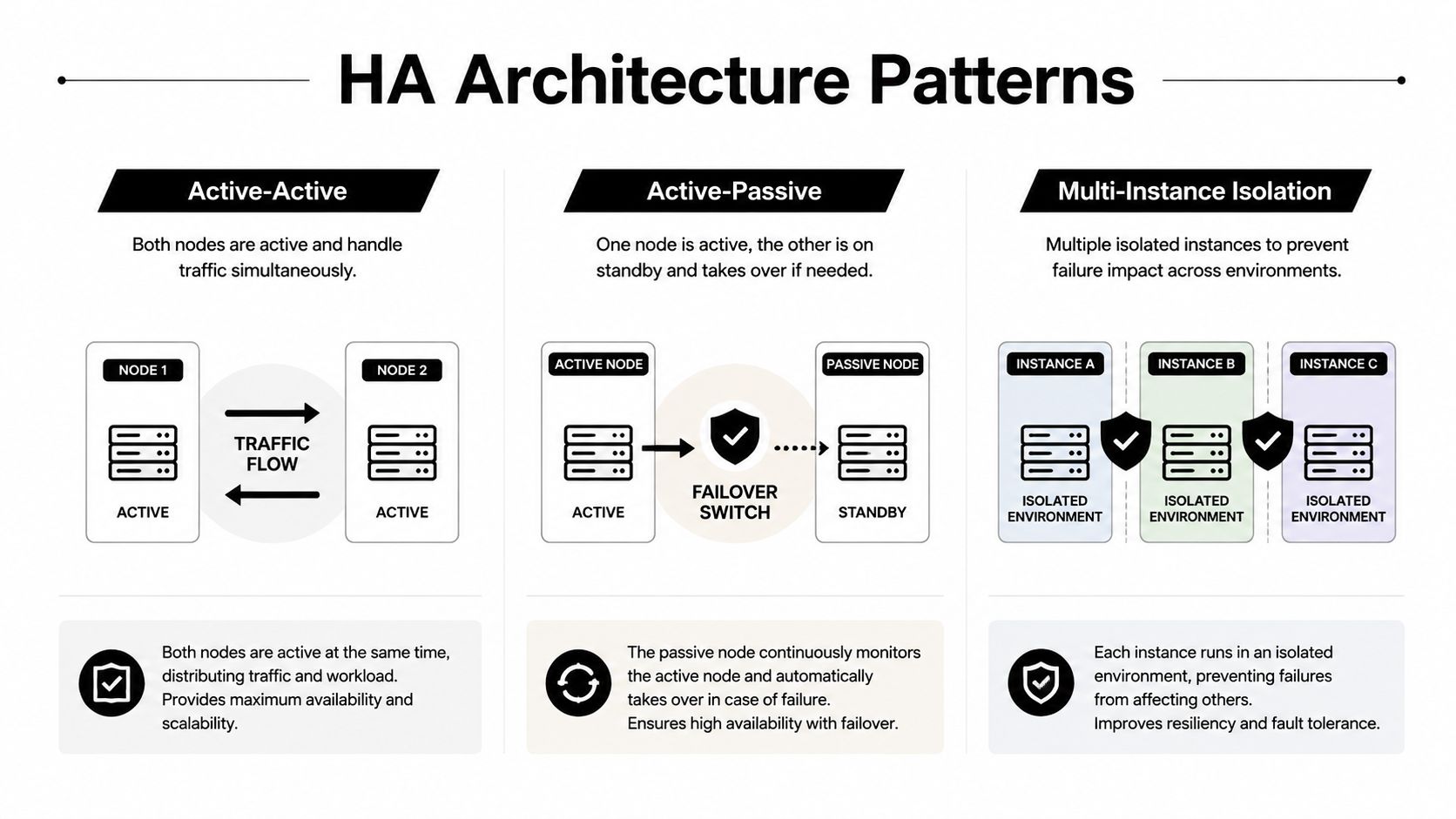
More replicas don't automatically create more resilience. The useful question is, which failure mode does this pattern protect against, and what new failure modes does it introduce? Guidance on business-mapped high availability architecture makes this point directly: teams should define availability by impact before choosing active-active, active-passive, or a mixed design.
| Pattern | Best For | Failure Modes Covered | Cost Profile | Complexity |
|---|---|---|---|---|
| Active-active | Workloads that can safely process requests on multiple live instances | Instance or zone loss, with appropriate state coordination | Higher infrastructure and coordination cost | High |
| Active-passive | Systems where one writer or primary worker must remain authoritative | Primary instance failure and controlled maintenance events | Moderate, with standby capacity | Moderate |
| Multi-instance isolation | Separate customers, teams, or workloads that must not share failure domains | Tenant-level faults, noisy neighbors, and scoped operational incidents | Scales with isolated workloads | Moderate |
Active-active
Active-active keeps multiple instances available for traffic at the same time. It can reduce dependence on one live worker and suits agents that can externalize conversation state, safely retry tool calls, and coordinate writes without ambiguity.
The trade-off is operational. Every instance must agree about state, leases, task ownership, and writes. If two agents can perform the same action simultaneously, the platform needs idempotency controls and conflict handling. Geographic distribution adds another layer of latency and write-authority decisions. A second region is not protection against a duplicated side effect if both regions believe they can act as leader.
Active-passive
Active-passive gives one instance or region authority while another waits to take over. This is often easier to reason about for agents with a single stateful coordinator, a primary database, or tool workflows that require ordered execution.
The standby still needs testing, current configuration, valid credentials, and a reliable promotion path. An unused replica can fail undetected for a long time. Active-passive also creates a transition event, so the handoff must preserve leases and distinguish completed tool calls from calls that were accepted but whose results never arrived.
Multi-instance isolation
Isolation addresses a different problem. It separates workloads so a failed deployment, runaway agent, or tenant-specific configuration issue doesn't spread across every customer or business function. For agencies and teams operating multiple AI employees, isolated containers and scoped data can be more valuable than adding distant replicas that share the same control plane.
Cost theater appears. Teams can spend on regions and replicas while leaving dependency chains, deployment controls, and recovery procedures underdesigned. A practical design often combines patterns, for example, isolated instances with active-passive stateful services and selective active-active workers. If you're evaluating an OpenClaw deployment model, Donely's OpenClaw API is one option to compare against building and operating those boundaries yourself.
Building the Redundancy Stack Layer by Layer
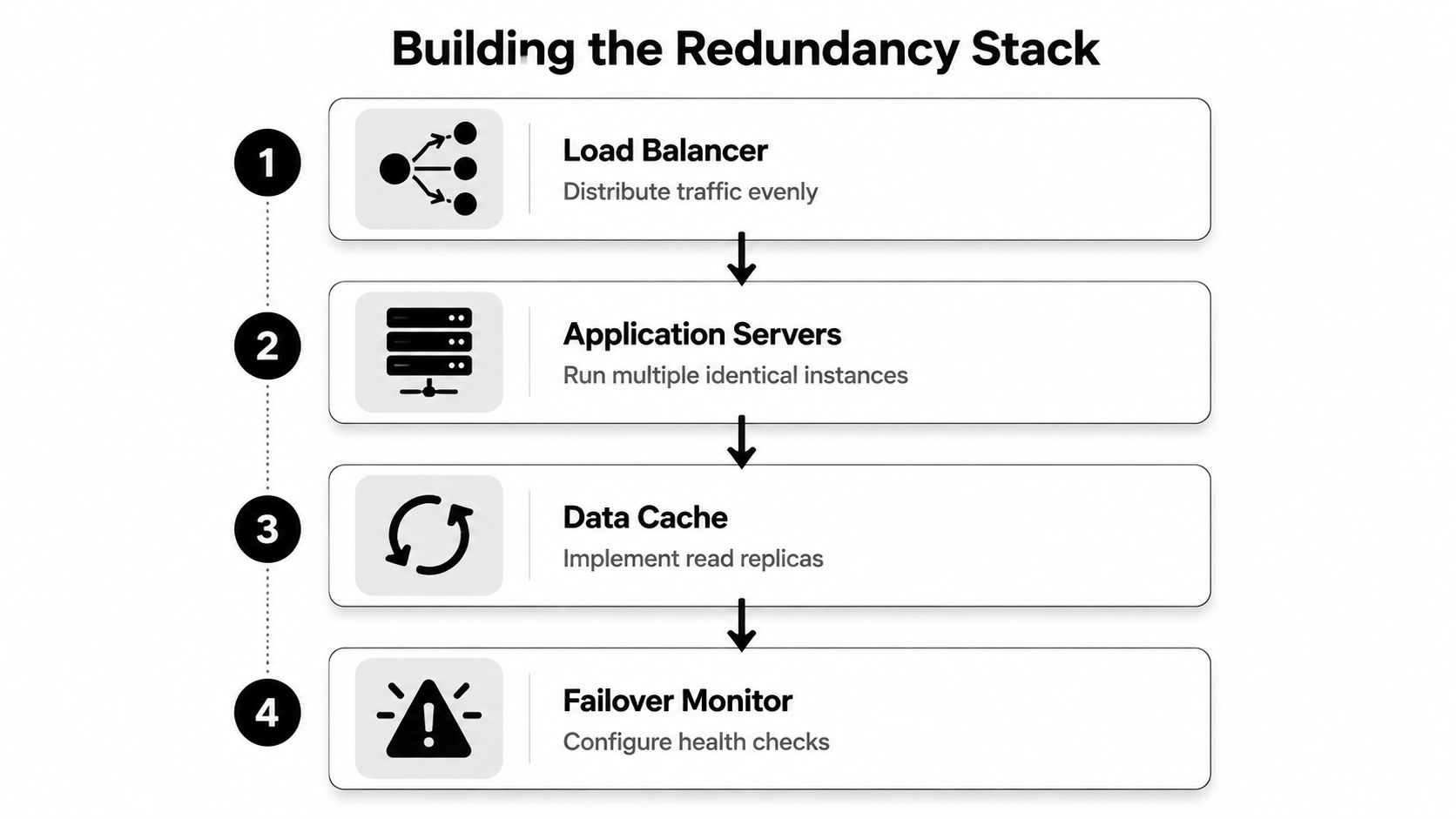
A reliable high availability setup is a chain. The load balancer, service registry, worker pool, state store, and monitoring system must agree about which instances are usable. Adding redundancy at one layer while leaving the next layer single-homed creates an attractive diagram and a fragile service.
Start with traffic and session handling
Use a load balancer that understands the agent's connection model. Short request-response calls can usually be distributed independently, but streaming responses and WebSocket sessions need connection-aware routing. If a worker disappears during a conversation, the replacement needs access to durable context, not just the next inbound message.
Avoid treating sticky sessions as the primary state strategy. Affinity can reduce unnecessary movement, but it also concentrates failure impact and makes scaling less flexible. Store conversation state externally, attach a session or workflow identifier to every operation, and make reconnect behavior explicit.
Health checks should test useful behavior. A process that returns a successful response while its model gateway, queue, or tool broker is failing isn't healthy from the customer's perspective. Separate liveness from readiness, and include dependency-aware checks without allowing a slow external integration to make every worker appear dead.
Make discovery tolerate churn
Container orchestration platforms replace workers, move workloads, and change addresses. Service discovery must remove failed instances quickly, avoid routing traffic to draining workers, and support graceful termination for active conversations.
A deployment should stop accepting new work before it exits. Existing tasks need either a completion window or a durable handoff. For long-running agents, the safer pattern is to persist workflow checkpoints and queue resumable work rather than relying on a process to remain alive until completion.
Replicate the application layer
Run multiple identical agent instances, but keep instance-local state disposable. Configuration should come from a controlled source, secrets should be scoped, and deployments should support rollback without invalidating active sessions.
Container isolation also helps contain faults. A malformed prompt configuration, excessive tool loop, or tenant-specific integration failure shouldn't consume resources assigned to unrelated agents. Teams looking for a hosted Hermes deployment can review Hermes agent hosting as one managed alternative to assembling the runtime, restart logic, and health checks independently.
Protect state, not just compute
Conversation memory, task queues, tool-call records, credentials, and audit events need separate durability decisions. Replication should reflect the business consequence of losing each type of data. Cached retrieval context might be rebuildable. A completed payment action or CRM mutation needs stronger guarantees and an audit trail.
Use idempotency keys for side effects. Record the request, execution status, external reference, and result before allowing a retry to proceed. For operational examples of managing resilient infrastructure, Faberwork LLC success stories provide useful context for evaluating the difference between infrastructure components and the operational practices that keep them dependable.
Database Clustering and Failover Recovery Procedures
The database is where many AI platforms discover that “stateless workers” were never stateless. Agents write conversation turns, workflow checkpoints, tool-call outcomes, permissions, and usage records. A failover that preserves the API process but loses the ordering or status of those records can create a more serious incident than a visible outage.
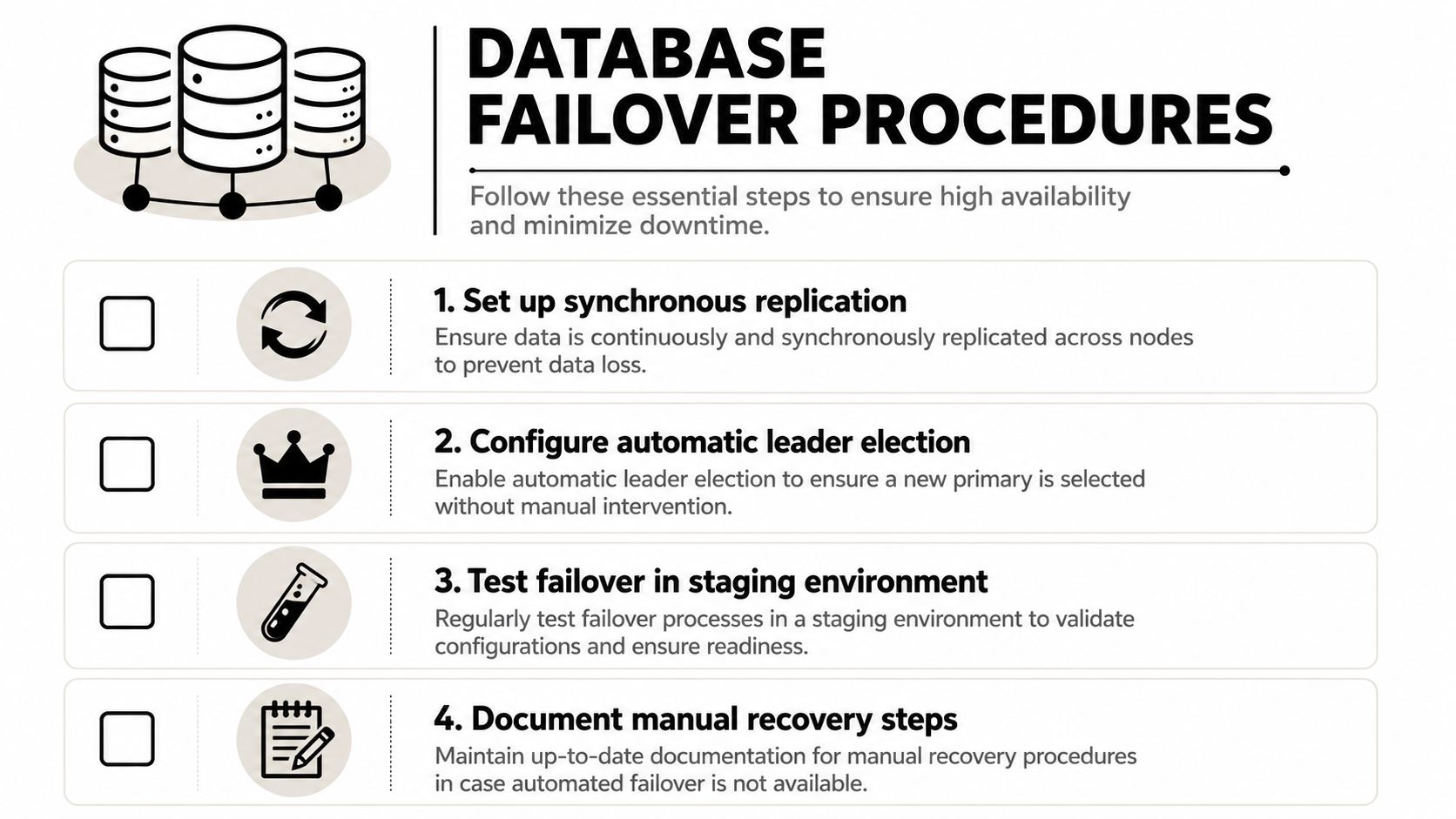
Choose the replication model according to the data's failure impact. A primary-replica arrangement can be easier to operate when writes need one authority. A distributed database can fit workloads that need broader write availability, but conflict resolution, consistency behavior, and operational ownership must be explicit. Synchronous replication can reduce uncertainty around committed state, while asynchronous replication can introduce a recovery gap that the business must accept.
Make agent work resumable
Treat every tool call as a state machine rather than a function that either succeeded or failed. Store states such as requested, dispatched, acknowledged, completed, and unknown. When a worker dies after dispatching a request, the recovery process can query the external system, use the idempotency key, and decide whether to resume or close the task.
Conversation sessions should reference durable records, not memory inside a process. On reconnect, the replacement worker loads the latest checkpoint, verifies the agent version and policy, and continues from a known boundary. This prevents a retry from sending the same email, creating a duplicate ticket, or repeating a destructive action.
Use an explicit recovery runbook
A practical runbook should answer four questions before an incident:
- Is the failure isolated? Confirm whether the problem affects one worker, the leader, the storage layer, or a shared dependency.
- Is the promoted target healthy? Check replication status, readable state, credentials, queue access, and dependency reachability.
- Can automation act safely? Automatic promotion is appropriate when the failure signal is clear and the standby has current, validated state. Pause when split-brain risk, corruption, or ambiguous write ownership exists.
- How will unfinished work be reconciled? Query pending and unknown tool calls, reconcile external outcomes, then release queued tasks.
Automatic failover should be narrow and reversible. It must include fencing or lease expiration so an isolated old leader can't continue writing after promotion. Manual recovery steps still matter for data corruption and multi-system incidents, but they shouldn't be the only path for routine instance failure when the downtime budget is measured in minutes.
Test the complete procedure in a safe environment. A failover test that only promotes the database misses application connection behavior, cache invalidation, queue ownership, agent resumption, and external side effects. Record what the operator must do, what automation does, and which signals prove recovery is complete.
Monitoring, Chaos Testing, and AI-Assisted Operations
High availability decays when nobody verifies it. A green process monitor can coexist with failing conversations, slow tool calls, exhausted context, or a queue that no worker can claim. Monitor the user-visible workflow and the dependencies that determine whether the agent can finish its job.
Useful signals include request errors, queue age, failover events, replication health, connection churn, tool-call latency, conversation completion, retry volume, and context-window utilization. Alert on symptoms that threaten business actions, not only infrastructure thresholds. A support platform should distinguish “the endpoint responds” from “the agent can receive, reason, call the required tool, and return a usable response.”
Teams building an observability baseline can use these monitoring and observability tips as a practical reference, then adapt the signals to their agent workflows.
Test the failures you claim to survive
Chaos testing should start with controlled, reversible experiments:
- Worker loss: Terminate an agent instance during an active conversation and verify that the session resumes without losing context.
- Dependency failure: Block access to a tool integration and confirm that the agent reports a bounded failure instead of looping indefinitely.
- Network partition: Separate workers from the state store or leader and check that fencing prevents competing writes.
- Deployment interruption: Stop a rolling deployment midway and verify that old and new versions don't process the same task incorrectly.
Run these tests against realistic workflows. A container restart proves little if the actual outage comes from expired credentials, a broken queue consumer, a schema change, or a model gateway that returns valid but unusable responses.
Add AI carefully to operations
Recent research is drawing attention to predictive fault management, self-healing systems, and hybrid AI architectures, while 2026 architecture guidance identifies AI-driven anomaly detection and zero-downtime schema migration as emerging defaults. These developments are discussed in research on AI-assisted autonomous operations, but automation must remain bounded by clear policies.
An AI operator can correlate unusual retry patterns, identify a likely dependency fault, or recommend a rollback. It shouldn't receive unrestricted authority to change routing, promote a database, or replay side effects without safeguards. Require approval for destructive actions, log every recommendation and execution, and keep deterministic runbooks available when the AI control loop fails.
Operational boundary: Let AI detect and recommend broadly. Give it narrowly scoped authority to act, with fencing, audit logs, and a tested rollback.
Security, Cost Trade-offs, and SLA Decision Framework
Redundancy expands the security boundary. Every additional instance can hold credentials, conversation data, tool permissions, and operational logs. A failover target that isn't governed like the primary target becomes an unmonitored path around your controls.
Use per-instance RBAC, isolated containers, scoped data access, and centralized audit logs. Keep credentials separate by workload, restrict tool permissions to the smallest useful scope, and make promotion preserve the same identity and authorization rules. Review the Donely security policy when assessing how a managed environment documents access, isolation, and data handling.
Choose the target before choosing the topology
A customer-facing agent that handles support or revenue workflows needs a tighter recovery design than an internal assistant whose users can retry later. Compliance requirements may prioritize isolation and auditability. A small operations team may achieve better real availability with automated restoration and a simple architecture than with a cluster nobody can confidently troubleshoot.
Use this decision frame:
- Business impact: What action stops when the agent is unavailable or loses state?
- Failure scope: Are you protecting against a worker crash, node loss, dependency outage, regional disruption, or bad deployment?
- Recovery behavior: Can the agent resume safely, or must an operator reconcile every unfinished action?
- Team capability: Who owns the database, networking, identity, deployments, and incident response?
- Sustainable cost: Can the team test and maintain every redundant component, including standby capacity and observability?
- Security boundary: Does the pattern preserve tenant separation, least privilege, and audit coverage during failover?
A 99.9% uptime SLA is a concrete target, not a promise that every workflow will complete successfully. Donely lists a 99.9% uptime SLA for its Enterprise offering, alongside managed multi-instance infrastructure, isolated containers, per-instance RBAC, centralized monitoring, and audit capabilities. If you compare a managed platform with self-hosting, evaluate the actual failure modes covered, the recovery actions automated, the state guarantees offered, and the evidence from failover testing.
Donely provides a unified platform for hosting, deploying, and managing AI employees with isolated instances, integrations, monitoring, and operational controls in one dashboard. Visit Donely to evaluate whether its managed multi-instance approach fits your availability target and reduces the DevOps work your team would otherwise own.