
You're probably in one of two situations right now. Either leadership has asked for a “real” test after a near miss or a fresh security investment, or your team already knows a standard penetration test won't answer the hard question, which is whether an attacker could move through your environment without getting stopped. That's where vendor choice gets difficult. Many firms can produce findings. Fewer can behave like a capable adversary, stay inside scope, work cleanly with defenders, and leave you with a better security program instead of a dramatic report.
Red teaming is meant to simulate a real-life attack and measure how well an organization withstands modern threats, rather than just identify known vulnerabilities, as described by Core Security's red team overview. The strongest providers also operate more covertly and use realistic techniques such as social engineering, network penetration, and lateral movement to expose blind spots, which is why the top end of the market looks very different from ordinary testing shops, as noted by IT Security Guru's review of top red teaming companies.
This guide focuses on the best red team companies from the perspective of someone choosing a partner, not collecting logos. It also includes practical advice on scoping for modern concerns like insecure internal AI deployments and where to enhance MSP security services before those issues become incidents.
Table of Contents
- 1. Mandiant (Google Cloud)
- 2. CrowdStrike Services (Adversary Emulation and AI Red Team)
- 3. IBM X-Force Red (Adversary Simulation)
- 4. Bishop Fox (Red Team and Cosmos platform)
- 5. SpecterOps
- 6. TrustedSec
- 7. NetSPI
- Top 7 Red Team Companies Comparison
- From Assessment to Action Building a Resilient Defense
1. Mandiant (Google Cloud)
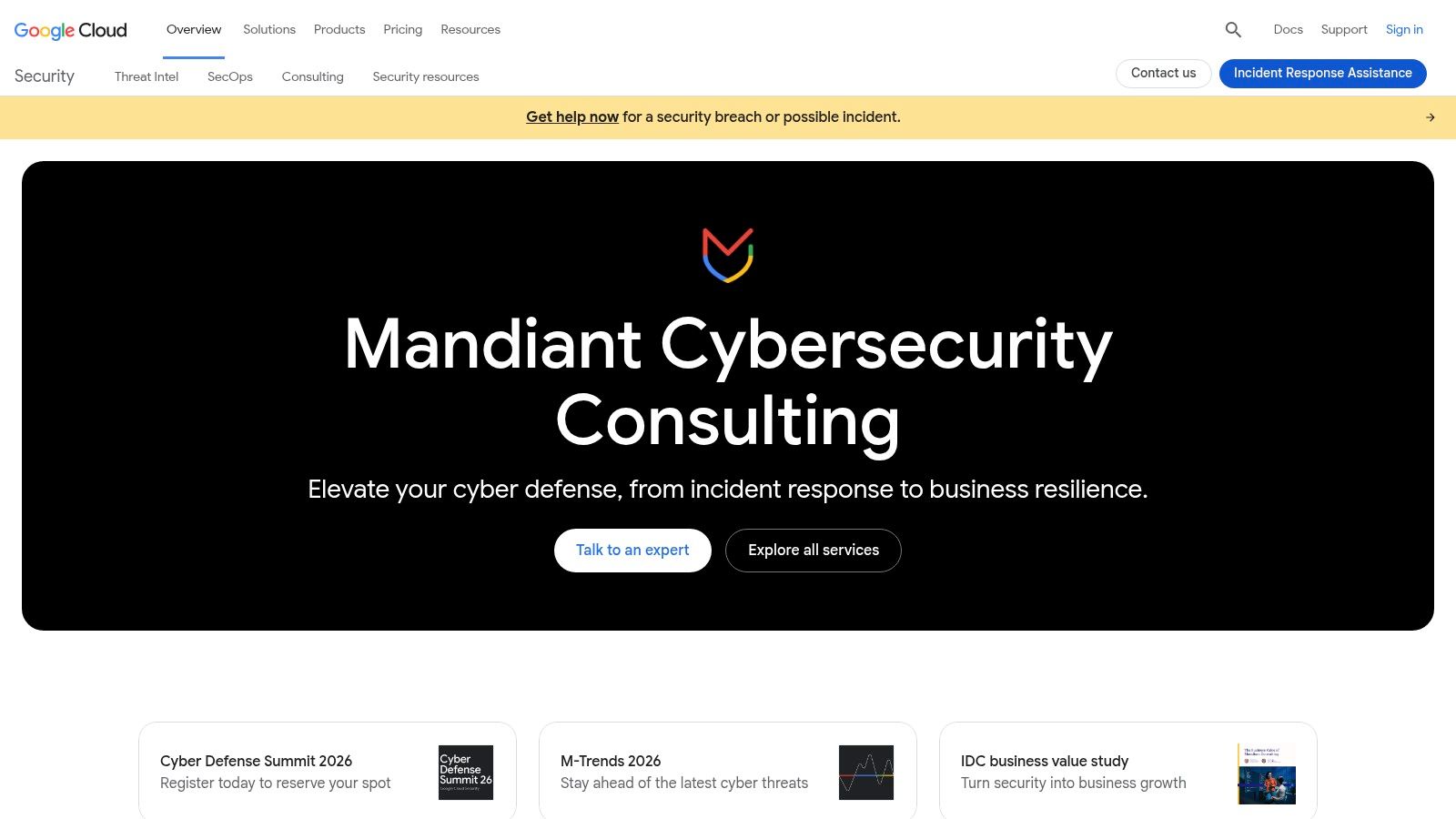
Mandiant is the option security leaders usually discuss when they want current threat intelligence baked into the exercise, not bolted on afterward. That matters if your environment changes fast or if the board wants confidence that the scenario reflects what active operators are doing. Mandiant's incident response background gives it a practical edge in campaign design, especially when the goal is to test detection and response against realistic attacker behavior.
Its website highlights services around adversary emulation, security validation, and cyber range style exercises through Mandiant at Google Cloud. In practice, the appeal is less about a single engagement and more about how point-in-time exercises can connect to ongoing control validation and team readiness.
Why teams hire Mandiant
Mandiant is strongest when an organization needs a threat-informed program, not just a red team event. If you're running a large enterprise, multiple business units, or a mature SOC, that model fits.
- Threat-informed scenarios: Engagements are generally shaped around known adversary tradecraft rather than generic attack paths.
- Continuous validation options: Security Validation can help teams retest assumptions between major exercises.
- Executive and SOC readiness: Cyber range style work is useful when leadership wants operational rehearsal, not just findings.
Practical rule: Hire Mandiant when you need the red team to influence detection engineering, executive readiness, and validation cadence, not just produce a breach narrative.
The trade-off is usually process overhead. Premium providers often require more stakeholder alignment, more lead time, and clearer internal ownership. That's manageable in a mature program. It's frustrating in a lean company that still needs basic logging, identity hygiene, or remediation discipline.
Mandiant also tends to make the most sense when red teaming sits inside a broader enterprise security strategy, especially for organizations building repeatable governance around attack simulation and remediation. Teams evaluating broader AI and operations maturity often pair this kind of security work with a more centralized enterprise platform such as Donely for enterprises.
2. CrowdStrike Services (Adversary Emulation and AI Red Team)
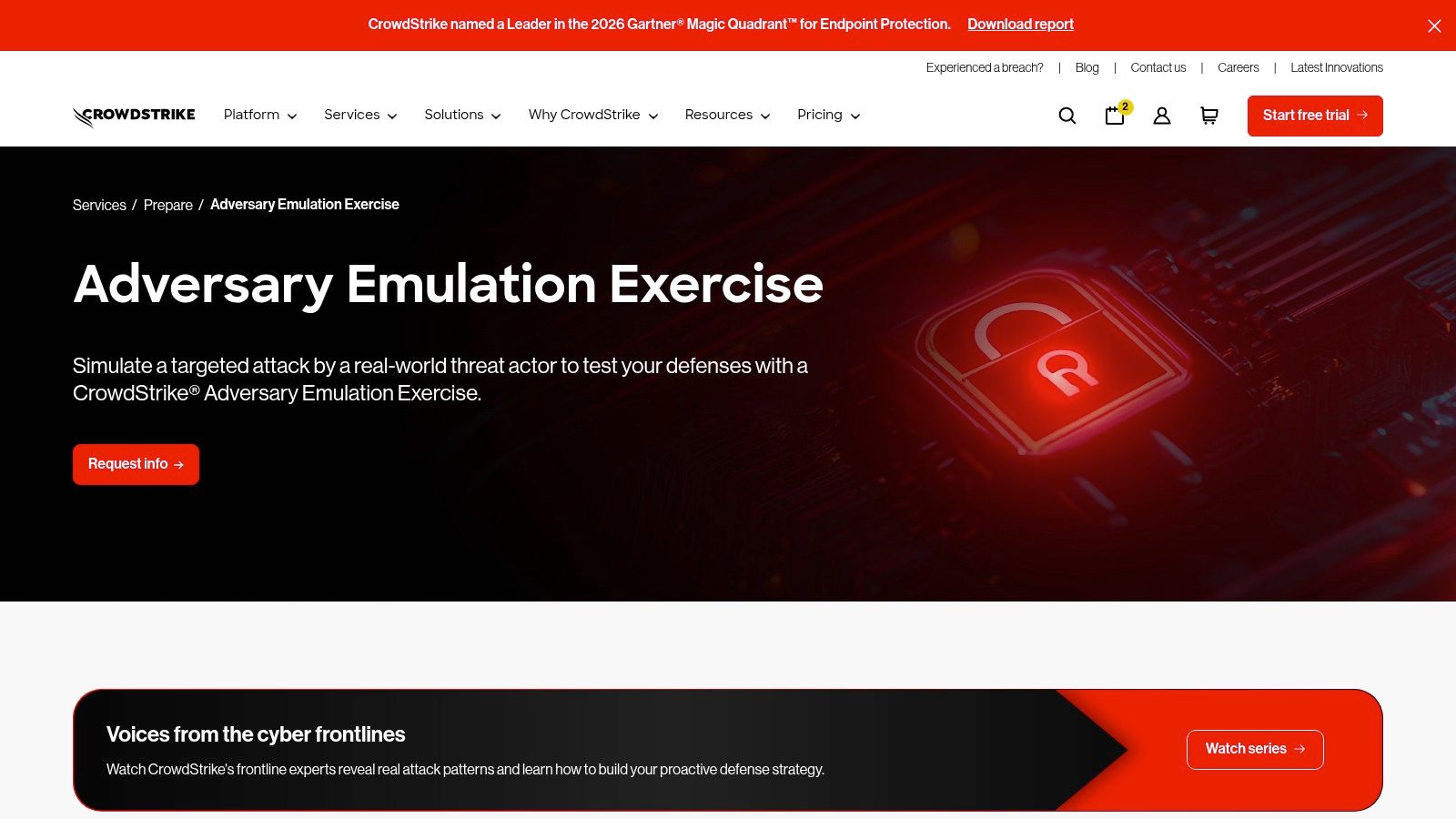
CrowdStrike earns its spot because it connects red teaming to broad visibility across modern enterprise environments. If you already rely on Falcon, that connection becomes even more useful. Scenarios can be shaped around what defenders are likely to see, miss, or misclassify, which makes post-engagement tuning more actionable.
CrowdStrike also stands out for explicitly offering AI red team work through CrowdStrike Adversary Emulation Exercise services. That's increasingly relevant because many companies now have internal copilots, retrieval systems, and employee-built automations in production long before security has formal review gates.
Where CrowdStrike stands out
If your concern is insecure AI adoption inside the business, CrowdStrike belongs on the shortlist. Many red team programs still focus heavily on endpoints, identity, and cloud paths while treating AI as a side topic. That's no longer enough.
A useful way to scope AI-focused red teaming is to test actual workflows, not just the model interface:
- Employee-built automations: Probe how prompts, secrets, or customer data move through internal workflows.
- Connected systems: Test whether the AI layer can be abused to reach Slack, CRM, ticketing, or code repositories.
- Response realism: Measure whether the SOC can distinguish model misuse from ordinary application activity.
A weak AI red team scope asks, “Can you jailbreak the model?” A strong one asks, “Can a user or attacker abuse this system to exfiltrate data or trigger unauthorized actions?”
CrowdStrike is often a strong fit when you want exercise intensity options, from tabletops to covert operations, and when AI risk needs to sit beside traditional adversary emulation instead of outside it. If your organization is already deploying internal agents or automations, it helps to review those systems in the same planning cycle as your AI employees deployment model.
The downside is familiar. The service catalog is broad, but that can push smaller teams toward larger scopes than they're ready to absorb operationally. Custom AI testing can also require more preparation than buyers expect, especially around safe handling, access constraints, and legal review.
3. IBM X-Force Red (Adversary Simulation)
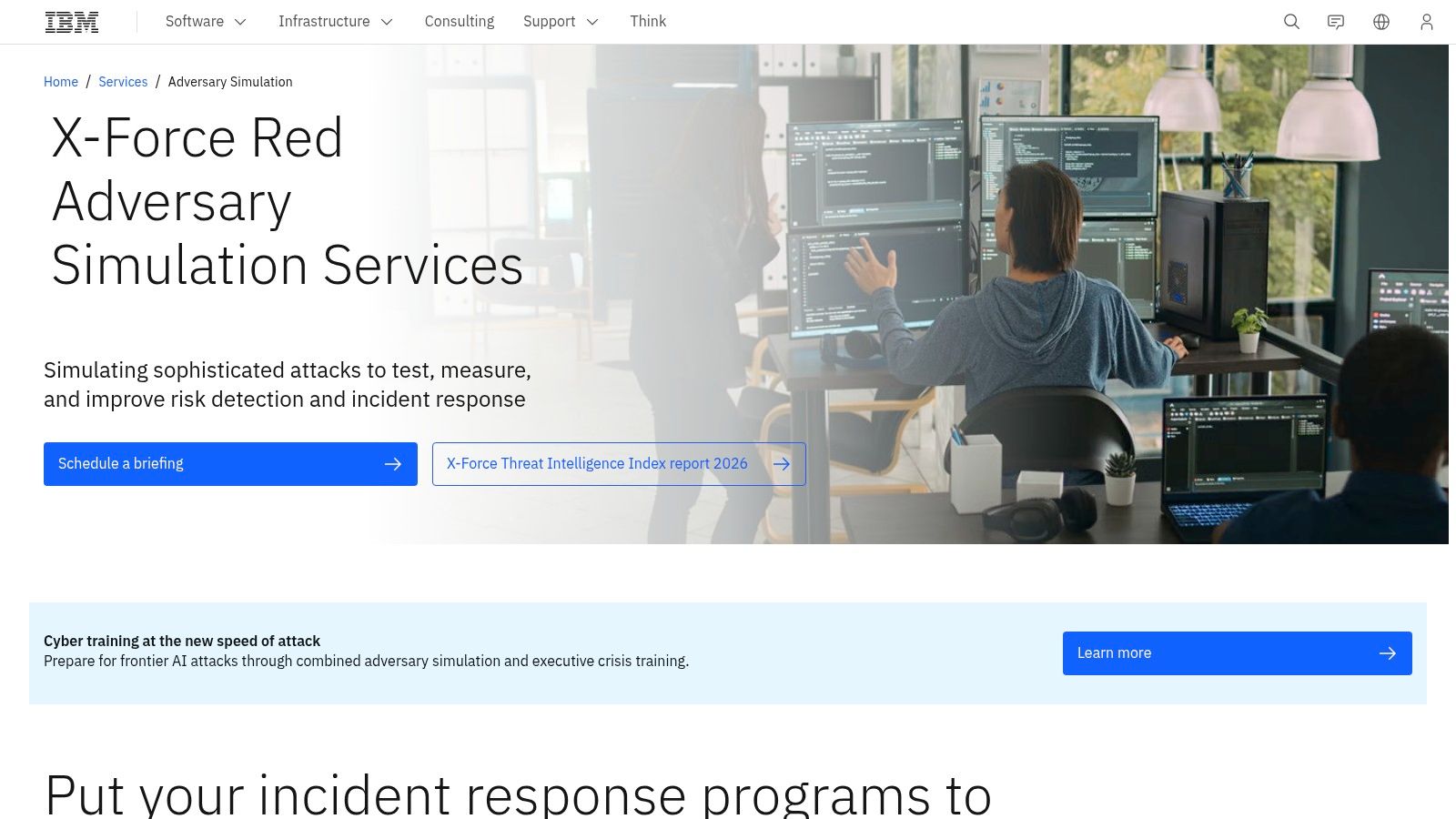
IBM X-Force Red is usually a sensible choice when the requirement isn't just “run a red team,” but “build a repeatable testing program that can scale across teams and regions.” Large organizations often need consistency as much as creativity. IBM's model tends to appeal to buyers who want structured methodology, managed options, and training environments alongside adversary simulation.
You can review the service line at IBM X-Force Red adversary simulation. For global companies, IBM's broader delivery footprint can be a practical advantage, especially when procurement, legal review, and regional coordination all matter as much as technical execution.
Best fit for IBM X-Force Red
IBM works best when the red team exercise needs to plug into a formal operating model. That may include repeat assessments, cyber range work, purple teaming, and a clear handoff into control improvement.
What I'd watch closely in an IBM-led engagement is how much of the exercise is customized versus standardized. Standardization isn't bad. It often improves delivery quality. The problem comes when the methodology is consistent but the scenario design doesn't reflect your actual crown jewels, identity architecture, or cloud attack paths.
A good buyer brief for IBM should specify:
- Business objectives: What matters most, such as ransomware resilience, identity compromise, cloud pivoting, or SOC readiness.
- Operational guardrails: Which systems are in scope, what persistence is allowed, and where legal or safety boundaries sit.
- Remediation outcomes: Whether you expect purple team sessions, detection content updates, or retesting after fixes.
IBM is less about boutique operator mystique and more about disciplined execution at scale. That's attractive for heavily governed environments. It can feel slower for companies that want a highly customized, fast-moving adversary simulation with minimal process friction.
4. Bishop Fox (Red Team and Cosmos platform)
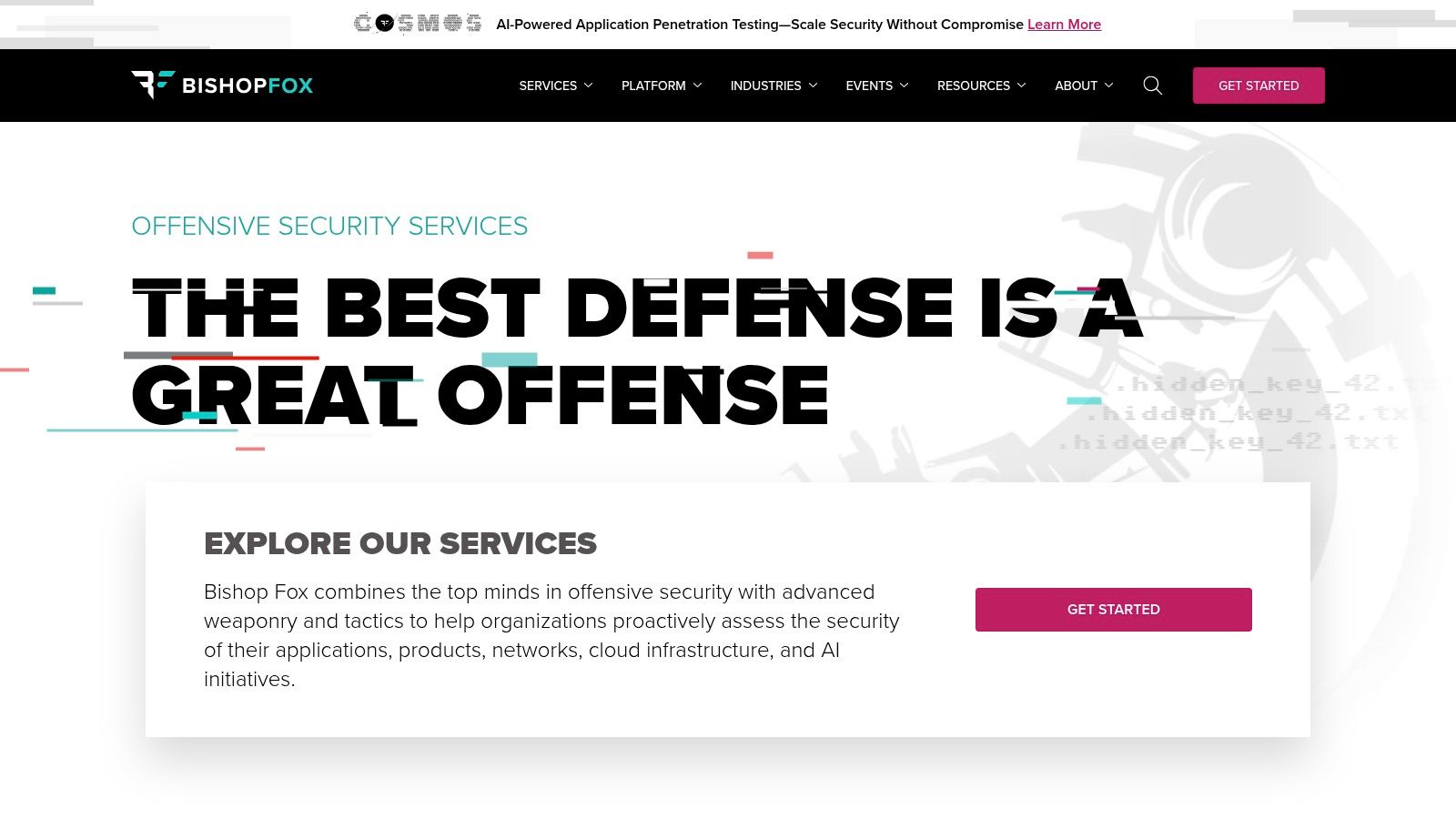
Bishop Fox is one of the best red team companies for buyers who want strong offensive depth and a path from periodic testing to continuous exposure discovery. That combination matters because many programs still treat red teaming as a once-a-year event. In practice, internet-facing change breaks that model quickly.
The company's services are outlined at Bishop Fox security services. The part I like most in vendor selection conversations is the ability to combine expert-led operations with the Cosmos platform, which supports continuous external attack surface testing and validation.
What makes Bishop Fox different
Bishop Fox is often at its best when you want external attack surface visibility tied to hands-on offensive work. That can sharpen scope before a larger red team exercise begins. It can also help teams avoid wasting budget on a wide but shallow campaign.
This approach is especially useful when your organization has accumulated risky SaaS, cloud assets, forgotten subdomains, or inherited exposure from acquisitions. In those environments, red teaming without attack surface cleanup often creates noisy findings and weak prioritization.
Buyer note: Continuous perimeter testing is useful. It isn't a substitute for internal identity, cloud privilege, and workstation-to-admin path testing.
There's another reason Bishop Fox deserves attention. The market has a real cost segmentation problem. According to BlueFire Red Team's 2026 enterprise buyers guide, mid-market engagements commonly land in the lower to mid five figures, while many widely promoted enterprise programs sit far higher, leaving growing firms stuck between premium scopes and generic tests. That gap matters because many security buyers are trying to get executive-resonant attack simulation without enterprise-only packaging.
For teams tightening governance around AI and human access before a broader adversary simulation, the quality of internal standards still matters. A practical complement is a hardened security policy framework for AI operations.
The main trade-off with Bishop Fox is scope clarity. Cosmos is strongest on the external side. If your biggest risk is identity abuse, lateral movement, or cloud control plane compromise, make sure the statement of work covers those paths directly instead of assuming the platform layer will.
5. SpecterOps
If identity is your soft underbelly, SpecterOps should be near the top of the list. Plenty of firms can simulate phishing or perimeter intrusion. Far fewer can map what unfolds after a foothold when privileges, delegation, trusts, and stale relationships turn a modest compromise into broad access.
SpecterOps has earned trust through operator-led work and widely used research and tooling, including BloodHound, which has shaped how defenders and attackers alike think about identity attack paths. You can explore its offerings at SpecterOps services.
When SpecterOps is the right call
The right reason to hire SpecterOps isn't brand recognition. It's that your organization has mature enough controls that the most meaningful questions now sit in Active Directory, Entra ID, hybrid identity, and privilege relationships. In that setting, generic red teaming often misses the full picture.
A SpecterOps-style engagement can be particularly valuable when:
- Identity sprawl is the issue: Multiple admins, service accounts, inherited access, and unclear trust boundaries create hidden routes.
- Detection engineering needs collaboration: You want the red team to help defenders improve visibility during the engagement, not just after it.
- Tradecraft realism matters: Your team wants operators who understand how small identity weaknesses chain together.
This won't be the best fit for every company. If your exposure is still mostly external and basic, you may get more immediate value from a broader offensive provider. But if your main concern is what happens after phishing, token theft, workstation compromise, or delegated admin abuse, SpecterOps brings a level of focus many vendors do not.
One practical caution. Specialist firms often have narrower bandwidth than global consultancies. If you want named operators or a complex multi-phase engagement, book early and align internally before the window opens.
6. TrustedSec
TrustedSec tends to appeal to buyers who want practitioner-led work without a lot of consulting theater. The firm is well known for offensive depth, social engineering capability, and reporting that usually lands well with defenders because it's built for action, not just executive display.
Its red team services are outlined at TrustedSec red teaming services. In my experience, this style of provider often works well for teams that need realism and flexibility more than they need a giant program wrapper.
Why buyers keep TrustedSec on the shortlist
TrustedSec is a strong pick when the exercise needs to be covert, objective-driven, and grounded in practical tradecraft. It's especially useful when your team wants to test how defenders respond to a believable intrusion chain instead of a large, highly choreographed event.
The firm is also a good reminder that “best red team companies” doesn't always mean “largest firms.” Boutique providers can be more direct about scope, faster in execution, and clearer in technical debriefs. That's valuable if you need quick learning cycles.
What works well with TrustedSec:
- Assumed breach and social engineering: Good for testing whether a modest foothold becomes material business risk.
- Senior practitioner access: Buyers often care who is running the operation, not just who sold it.
- Actionable output: The best boutique teams translate offensive findings into clear defender tasks.
Choose a boutique red team when you care more about operator quality and practical remediation than broad program packaging.
The limits are predictable. Capacity can be tight, especially for multi-vector or distributed operations. You may also find fewer productized, subscription-style options than with larger enterprise providers. That's not a flaw if your main priority is a sharp engagement with experienced operators.
7. NetSPI
NetSPI is a practical option for companies that want red teaming tied to an operational security program instead of isolated from it. That usually means combining red team operations with PTaaS, external attack surface management, and retesting workflows. Some organizations need exactly that. They don't just want one dramatic exercise. They want a system for validating that fixes hold.
Its services sit under NetSPI security assessments. The broader point is that NetSPI tends to fit buyers who want offensive findings to move quickly into recurring validation and vulnerability management processes.
Where NetSPI works best
NetSPI is often strongest in environments where security leaders need structure, documentation, and retestability. Regulated organizations and large internal security teams usually appreciate that. So do companies trying to reduce the gap between “finding” and “program change.”
There's also a market reason this model matters. The global red teaming market reached USD 1.8 billion in 2025 and is projected to grow at a 14.2% CAGR through 2030, reaching an estimated USD 3.5 billion, according to Cybersecurity Switzerland's state of red teaming 2026 research. Growth like that reflects more organizations treating offensive security as a standing capability rather than a one-off event.
NetSPI makes sense when you want:
- Operational follow-through: PTaaS and EASM can shorten the path from finding to retest.
- Executive and technical alignment: Structured outputs help both audiences work from the same facts.
- Program fit: Red team work can connect to broader remediation and vulnerability workflows.
The trade-off is specialization. If your top concern is AI or LLM-specific red teaming, NetSPI may need more custom shaping than providers with a dedicated AI focus. Still, for organizations that value recurring validation over isolated assessments, it's a very defensible choice.
Top 7 Red Team Companies Comparison
| Provider | Implementation Complexity 🔄 | Resource Requirements ⚡ | Expected Outcomes 📊⭐ | Ideal Use Cases 💡 | Key Advantages ⭐ |
|---|---|---|---|---|---|
| Mandiant (Google Cloud) | High 🔄, enterprise processes, continuous validation | Significant ⚡, subscriptions, change management, expert teams | High 📊⭐, intel-mapped control efficacy, SOC/executive readiness | Enterprise continuous validation, threat-intel–driven emulation | Deep breach intelligence; continuous, evidence-based validation |
| CrowdStrike Services | Medium‑High 🔄, telemetry integration and bespoke scenarios | High ⚡, Falcon telemetry access, custom engagement pricing | Strong 📊⭐, telemetry-backed emulations; AI/LLM testing | Telemetry-backed scenarios and AI/LLM red teaming | Global intel + platform telemetry; specialized AI Red Team |
| IBM X‑Force Red | Medium‑High 🔄, managed programs and formal processes | Moderate‑High ⚡, large‑vendor procurement and regional variance | Reliable 📊⭐, scalable simulations, detection engineering uplift | Scalable needs from single assessments to managed red teams | Repeatable ATT&CK alignment; integration with X‑Force research |
| Bishop Fox | Medium 🔄, modular methodology with continuous platform | Moderate ⚡, Cosmos subscription plus analyst validation | Continuous 📊⭐, external attack-surface discovery + expert verification | Continuous external attack-surface testing with expert windows | Strong offensive research reputation; continuous testing (Cosmos) |
| SpecterOps | Medium 🔄, operator‑led, identity‑centric tradecraft | Moderate ⚡, specialist operators, scheduled engagements | Deep 📊⭐, identity attack‑path insights and detection improvements | Identity compromise, detection engineering, realistic tradecraft | Expert operators; influential open‑source tooling (e.g., BloodHound) |
| TrustedSec | Medium 🔄, practitioner‑led, covert objective-driven ops | Moderate ⚡, boutique capacity, senior operator access | Actionable 📊⭐, high signal reports, social‑engineering outcomes | Organizations needing social engineering and practitioner-led red teams | High signal-to-noise reporting; flexible scoping and practitioner expertise |
| NetSPI | Medium 🔄, red team + PTaaS/EASM operationalization | Moderate ⚡, subscription + program integrations | Operational 📊⭐, findings tied to retesting and VM programs | Red team results operationalized via PTaaS/EASM and compliance programs | Strong PTaaS/EASM integration; programmatic retesting and documentation |
From Assessment to Action Building a Resilient Defense
A red team report lands on Monday. By Friday, the SOC has skimmed it, engineering has logged half the findings, and leadership has already moved to the next priority. Three months later, the same identity path, cloud permission issue, or unsafe AI workflow is still there. That is how expensive exercises turn into shelfware.
Red teaming pays off when the exercise changes detection logic, access design, response playbooks, and ownership. Vendor selection matters, but operational follow-through matters more. Buyers that get the most value treat the engagement as the start of a remediation cycle, not the end of a procurement cycle.
The first decision is scope. “Test our security posture” is too broad to produce useful pressure. Good scopes name the business risk and the path an attacker might take. Test whether ransomware operators can reach recovery infrastructure. Test whether a compromised employee account can pivot from SaaS into cloud administration. Test whether an internal AI deployment can expose sensitive data, misuse connected tools, or bypass approvals through automation logic. Teams that need a plain-language primer on red teaming can enhance MSP security services while they build internal alignment on what the exercise should and should not cover.
AI deserves tighter scoping than many buyers give it. The actual issue is usually not the model. It is the surrounding system: connectors with broad permissions, shared service accounts, hidden prompt chains, weak approval steps, and logs that do not show who triggered what. A capable red team should test the workflow end to end, including data access, tool execution, human signoff points, and failure handling. If a vendor only talks about prompt attacks and ignores identity, integrations, and admin controls, the scope is too narrow.
Use a selection checklist that forces concrete answers:
- Attack scenario design: Ask what threat intelligence, environmental inputs, and business context shape the operation.
- Operator assignment: Ask who will run the exercise, what experience they have, and what work is subcontracted.
- Coverage boundaries: Confirm whether identity, cloud, social engineering, internal movement, and AI-connected systems are in scope.
- Defender outcomes: Require live debriefs, detection mapping, and a plan to retest fixes.
- Safety controls: Define no-go systems, legal approvals, escalation paths, and kill switches before kickoff.
- Remediation ownership: Name the teams responsible for fixes, target dates, and the success criteria for closure.
The best vendor is the one that matches the constraint you have. Mandiant fits intelligence-led enterprise validation. CrowdStrike works well when AI red teaming needs to sit beside broader adversary emulation. IBM X-Force Red suits formal programs that need consistency across large environments. Bishop Fox is a strong fit when continuous external exposure testing should inform targeted operator-led work. SpecterOps stands out for identity-heavy risk. TrustedSec is a good boutique option for covert, practitioner-led operations. NetSPI fits teams that want findings tied back into recurring validation and program operations.
Pick the firm based on the problem, the environment, and the remediation model you can sustain. That is what turns a red team from a one-time stress event into a repeatable way to improve resilience.
Donely helps organizations deploy and govern AI employees without creating the kind of shadow automation risk that red teams later expose. With Donely, teams can launch production-ready agents connected to hundreds of business tools, keep workloads isolated by instance, apply granular RBAC, and monitor activity through unified logs and centralized management. For companies scaling internal AI while trying to keep security, compliance, and operational control intact, that kind of structure makes red team scoping cleaner and remediation much easier.