
Your company is moving faster than your security program was built to handle. Engineering is shipping new services, the data footprint is growing, and someone is proposing AI agents to handle support, sales ops, or internal workflows. At that point, “we should probably test security” stops being a vague intention and turns into a budget line.
Many leadership teams often encounter confusion. They hear penetration test and red team used as if they mean the same thing. They don't. One is designed to systematically surface weaknesses in a defined environment. The other is built to act like a real attacker trying to reach a meaningful objective without getting caught.
If you choose the wrong one, you usually get the wrong outcome. A startup preparing for SOC 2 may buy an impressive adversary simulation and still fail to fix basic exposed paths. A mature security team may run another narrow pen test and learn very little about whether their analysts can detect and contain an intrusion. The same confusion now applies to AI systems, where the risk isn't only vulnerable infrastructure, but also how agents interact with prompts, tools, identities, and sensitive data boundaries. Teams thinking through operational trust often benefit from reviewing a vendor's privacy manifesto alongside their testing strategy.
Table of Contents
- Choosing Your Armor An Introduction
- Penetration Testing The Foundational Security Audit
- Red Teaming The Real-World Attack Simulation
- Key Differences A Side-by-Side Comparison
- When to Choose Each A Practical Decision Framework
- Building a Mature Security Testing Program
- Frequently Asked Questions
Choosing Your Armor An Introduction
A CTO at a growing SaaS company usually asks some version of the same question: “We have budget for one serious security engagement this quarter. What should we buy?” The wrong answer is “whichever sounds more advanced.” Advanced isn't the same as useful.
A penetration test and a red team engagement solve different business problems. One helps you identify and prioritize weaknesses in a known scope. The other tells you whether a capable adversary can turn a chain of small failures into real impact across technology, people, and process.
That distinction matters more as companies scale. New web apps, cloud environments, Slack automations, CRM integrations, and AI-driven workflows all create attack paths. Some of those paths are simple and technical. Others depend on stolen credentials, weak internal approvals, over-trusted tools, or employees clicking the wrong message at the wrong time.
If you think about security as program maturity, the red team vs penetration test decision becomes much clearer. Pen tests build the foundation. Red teams test whether the whole structure holds under pressure. The strongest programs don't argue over one or the other. They sequence both at the right time.
Penetration Testing The Foundational Security Audit
Penetration testing is closest to hiring a building inspector who checks every lock, access point, and alarm against a defined checklist. It's structured, deliberate, and bounded. The value comes from coverage and clarity.

According to Rapid7's explanation of penetration testing versus red teaming, penetration testing is a controlled, time-limited technical assessment that typically occurs over 1–2 weeks, with the primary objective of exhaustively discovering and exploiting as many vulnerabilities as possible within a specific scope.
What a good pen test actually does
A strong penetration test doesn't just run scanners and dump findings into a PDF. It validates exploitability, shows impact, and gives engineering a practical remediation path. In most engagements, stakeholders know the test is happening, rules are agreed in advance, and the work stays inside a defined target set such as:
- A customer-facing web application with auth flows, role controls, and session handling
- A cloud environment with exposed services, IAM issues, and risky configurations
- An internal network segment where lateral movement and privilege escalation matter
- An API surface used by mobile apps, partners, or internal automations
This is why pen tests fit product and engineering rhythms well. They line up with launch readiness, annual control reviews, platform changes, and compliance evidence collection.
Where penetration testing shines
The practical strength of a pen test is that it finds the fixable work. It's built to answer questions like these:
- What's exposed right now
- Which flaws are exploitable
- What should engineering fix first
- What evidence can we show an auditor or customer
Practical rule: If the business needs a prioritized remediation list, start with a penetration test.
That makes penetration testing especially useful before releasing a new application, after significant infrastructure changes, or when leadership needs a baseline security picture. It also helps separate noise from risk. A long vulnerability scan might flag many issues, but a pen test shows which ones create a credible path to compromise.
What penetration testing does not do well
Penetration testing is not a realistic measure of whether your SOC, incident response process, or staff will detect a patient attacker. The wider team usually knows the exercise is underway. Some safety controls may be adjusted. The operators are trying to find as many weaknesses as possible, not hide for weeks and discreetly reach a business objective.
That isn't a flaw in the model. It's the point of the model.
Red Teaming The Real-World Attack Simulation
Red teaming starts from a different premise. Instead of asking, “What vulnerabilities exist in this environment?” it asks, “Can an adversary achieve a meaningful goal against this organization?”
According to Synack's breakdown of red teaming versus penetration testing, red teaming is an adversarial, goal-oriented simulation that unfolds over weeks or months to test detection, defense, response, and recovery, with the objective of achieving a specific business impact rather than listing every vulnerability.
What a real red team engagement looks like
A red team usually operates with limited visibility from the organization. Security leadership may know the engagement is happening. Most defenders do not. That changes the nature of the test immediately.
The red team's job is to behave like an attacker. They can combine technical exploitation with human manipulation and, in some cases, physical intrusion. A campaign might involve credential harvesting, phishing, abusing remote access paths, or using employee trust against the company. It may also test how well analysts recognize suspicious behavior when there's no warning banner saying, “This is only a drill.”
That's why the final report reads differently. You don't get a long inventory of every medium-risk flaw. You get an attack story. It shows what the team targeted, what worked, what defenders missed, and what business outcome became reachable.
Why mature teams use red teaming
Red teaming is valuable when the organization already has a baseline of technical hygiene and now needs to test resilience. Mature security leaders often want answers to harder questions:
- Would our analysts notice the intrusion early enough
- Do our response workflows work under pressure
- Can an attacker chain people, process, and technical gaps together
- Are we protecting the systems and data that matter most
A red team doesn't prove that every weakness is gone. It proves whether your organization can withstand a realistic attack path.
Where red teaming disappoints companies
Red teaming produces poor value when the basics aren't under control. If patching is inconsistent, identity hygiene is weak, logging is incomplete, and ownership of remediation is fuzzy, the exercise tends to confirm what you already suspected. Attackers got in because the doors were open.
That can be a useful wake-up call, but it's an expensive one. In practice, red teams are most effective after an organization has already cleaned up the obvious technical issues and wants to test the full defensive system, not just individual assets.
Key Differences A Side-by-Side Comparison
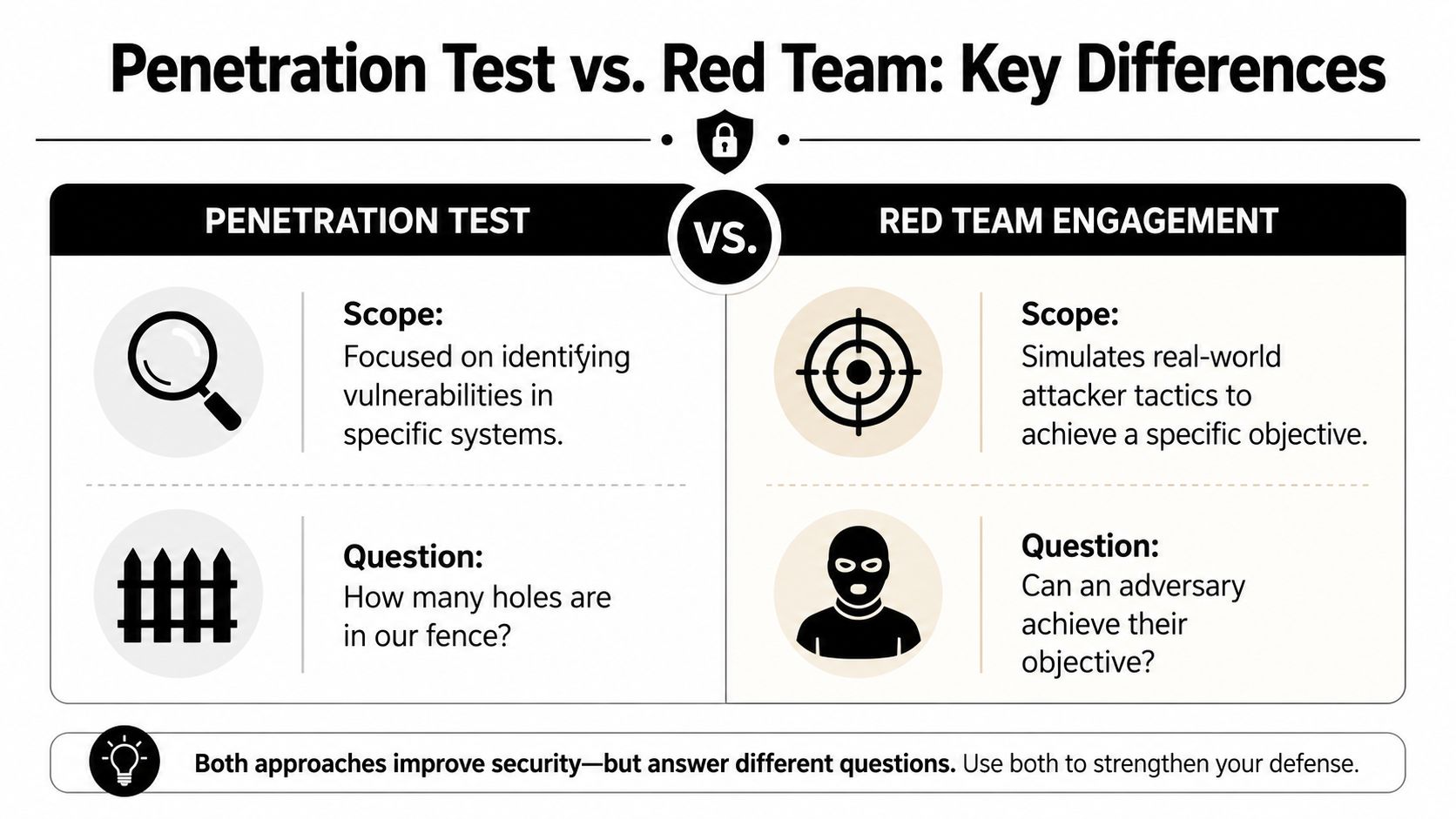
The red team vs penetration test decision gets easier when you compare them by operating model rather than by marketing language. Both use offensive security skills. Their question, scope, and success criteria are different.
Quick comparison table
| Criterion | Penetration Testing | Red Teaming |
|---|---|---|
| Primary goal | Find and validate as many vulnerabilities as possible within a defined scope | Achieve a specific adversarial objective |
| Scope | Specific systems, apps, APIs, or network segments | Whole organization, including people, process, and sometimes physical controls |
| Visibility | Usually known and coordinated with stakeholders | Typically known only to limited leadership |
| Operating style | Structured and coverage-oriented | Stealthy and adversarial |
| Output | Vulnerability report with remediation guidance | Attack narrative showing path, failures, and business impact |
| Best fit | Compliance, launch readiness, baseline hardening | Detection, response, resilience, and security culture testing |
The mindset gap matters most
The biggest difference isn't duration or even scope. It's operator intent.
Find all flaws versus achieve one goal.
A penetration tester is rewarded for broad discovery. They want to surface unpatched software, broken access controls, weak authentication paths, dangerous defaults, and misconfigurations across the agreed target set.
A red team operator is rewarded for success against the mission. If phishing one employee and abusing one workflow gets them to the target data, they may never touch dozens of other weaknesses in the environment.
This is why leadership teams often misread outputs. They see a red team report with fewer findings and assume the organization is healthier. That's not what it means. It may mean the attackers found one efficient route and took it.
Later in procurement or internal planning, teams often compare this with more tactical service descriptions such as Technovation LLC's security testing guide, which is useful for sorting vulnerability assessments from hands-on exploitation work before you even get to red team scope.
A useful explainer on the operational distinction is below.
What the deliverables actually tell leadership
Metrics reinforce the same split. As noted by Aikido's comparison of penetration testing and red teaming, red teaming success is measured through defense metrics such as time-to-detection, time-to-containment, and time-to-eviction, while penetration testing success is quantified by the count of identified vulnerabilities and their severity ratings.
For a CTO or Head of Engineering, that means the report should map to the decision you're trying to make.
- If you need engineering action, a pen test report is more directly useful.
- If you need operational truth, a red team report is more revealing.
- If you need both, sequence them. Don't force one engagement to be something it isn't.
When to Choose Each A Practical Decision Framework
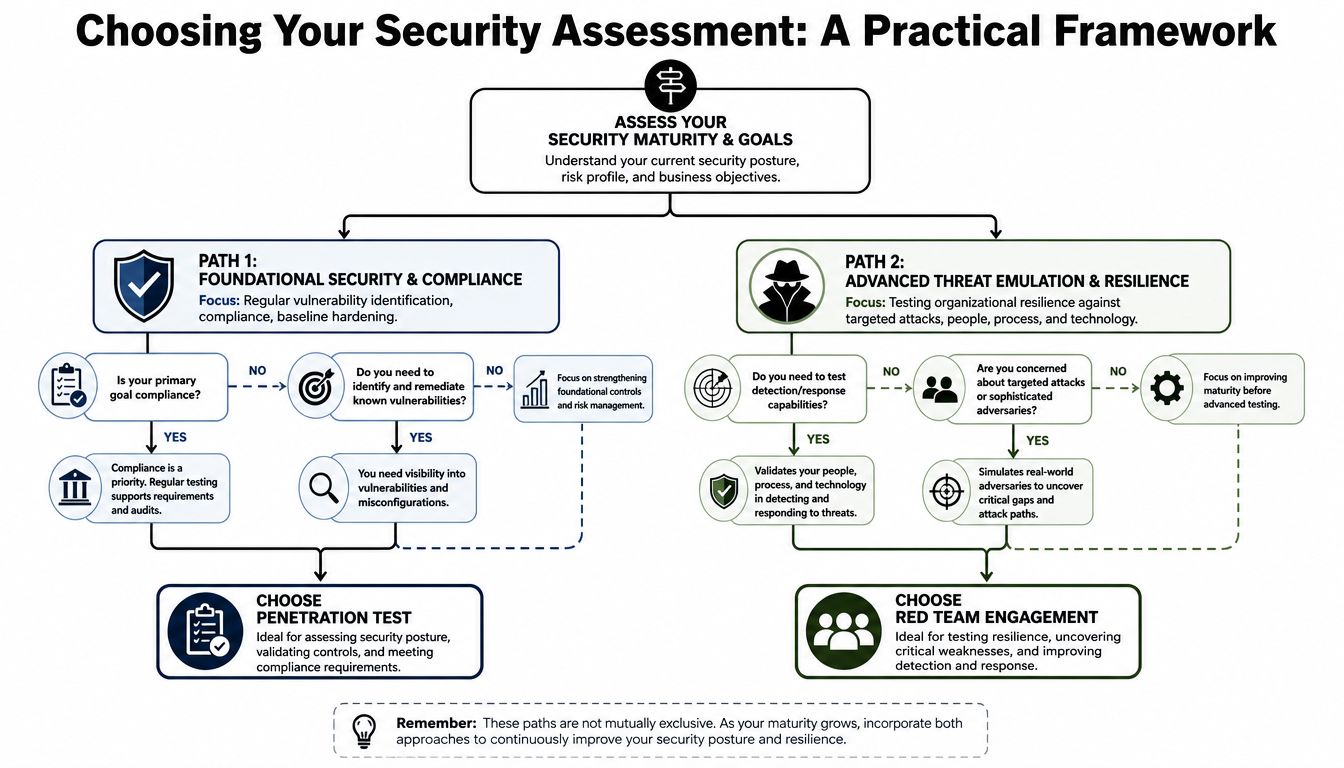
Most organizations shouldn't ask which service is superior. They should ask which service matches their current risks, internal maturity, and business pressure. That framing leads to better spending decisions.
Choose a penetration test when the business needs certainty
A penetration test is the right call when the organization needs a disciplined answer about technical exposure. This is common in earlier-stage security programs and in fast-growing product teams.
The strongest use cases are straightforward:
- Compliance validation. The Cloud Security Alliance comparison of penetration testing and red teaming says 78% of enterprises use pen testing for compliance validation, including frameworks like PCI-DSS and SOC 2, because it systematically identifies and categorizes vulnerabilities.
- Pre-launch assurance. Before shipping a new application, API, or customer-facing workflow, you want engineers fixing concrete issues, not reviewing a stealth exercise narrative.
- Foundational hardening. If your team hasn't yet built a reliable remediation cycle, red teaming will expose that problem but won't solve it. A penetration test gives you tractable work.
A lot of companies know they need better security but haven't yet formalized data handling, ownership, and privacy controls. In that phase, working from a documented governance baseline such as a public privacy policy often helps leadership align legal, security, and engineering expectations before commissioning offensive testing.
Choose a red team when the business needs realism
A red team engagement makes sense when the company wants to test how its defenses behave against a real attacker model. That usually means there is already a functioning blue team or at least a meaningful detection and response capability to stress.
Good triggers for red teaming include:
- Your SOC exists and needs validation
- Leadership wants to test incident response under realistic pressure
- You care about attack paths across identity, endpoint, cloud, and human workflows
- You suspect that social engineering or process abuse is a bigger risk than missing patches
This is often where mature SaaS companies, fintechs, and enterprises land. They've already been through several rounds of technical hardening. The unresolved question is no longer “Do we have vulnerabilities?” It's “Can an attacker turn our residual weaknesses into impact before we stop them?”
If the main thing you need next quarter is a better patching backlog, don't buy a red team.
A simple graduation test
Use this short check.
Choose a penetration test first if most of these are true:
- You still have recurring remediation debt.
- Ownership for security fixes sits mostly with engineering.
- Audit or customer assurance requests are a pressing driver.
- Your logging and alerting don't yet support meaningful adversary simulation.
Choose a red team next if most of these are true:
- Technical hygiene is reasonably stable
- You have responders who can investigate alerts
- Leadership wants to validate resilience, not just discover flaws
- You can act on findings that involve process and human behavior, not only code changes
That's the practical roadmap. Don't skip stages.
Building a Mature Security Testing Program
The strongest security programs treat penetration testing and red teaming as different phases in the same operating model. One improves technical coverage. The other validates organizational resistance. Used together, they create a much more honest picture than either one used in isolation.
Start with coverage then move to resistance
Organizations should begin with recurring penetration tests focused on the systems that matter most: customer-facing apps, core APIs, identity paths, admin tooling, and cloud boundaries. Those findings force ownership. Engineering patches exposed components, tightens auth, removes dangerous defaults, and closes common escalation routes.
Once that discipline exists, red teaming becomes far more valuable. The organization has fewer obvious openings, so the exercise can test what matters next: whether defenders spot suspicious behavior, whether incident commanders make good decisions, and whether employees and workflows become the weak link.
This is also where risk framing becomes more useful than checklist language. A broader operating model often benefits from a structured method for ranking assets, threats, and business impact, and Logical Commander's guide to risk assessment is a practical reference for that planning layer.
How this applies to AI agents
AI systems add a new wrinkle to the red team vs penetration test conversation. Traditional infrastructure still matters, but now you also have tool permissions, prompt boundaries, memory behavior, approval workflows, and external integrations to secure.

A penetration test for an AI-enabled deployment might focus on the surrounding technical stack:
- API authentication and authorization
- Broken tenant isolation
- Exposed admin controls
- Unsafe integration permissions across Slack, HubSpot, Jira, or Zendesk
- Weak session handling or logging gaps
A red team exercise against the same environment asks different questions. Can an attacker socially engineer a user into granting the wrong workflow permission? Can they manipulate prompts or chained instructions to make an agent disclose sensitive data? Can they abuse a trusted integration to move from one business function into another without triggering review?
That's why AI security needs both layers. Technical hardening catches the obvious and the known. Adversarial simulation tests whether the whole human-system-agent loop can be manipulated.
Organizations deploying AI in production should also align testing expectations with published controls and governance commitments such as a security policy, especially when multiple teams, instances, or data boundaries are involved.
Mature AI security isn't just “Did we scan the app?” It's also “Can this agent be steered into doing the wrong thing with legitimate access?”
What mature teams budget for
Budget and time should reflect the kind of answer you want. Praetorian's benchmark overview of red team versus penetration testing notes that penetration tests typically last days to weeks with a narrow scope, while red team engagements run weeks to months with broader scope including social engineering and physical intrusion. The same benchmark says penetration tests generally require at least $30,000, while red team testing is $40,000 or more.
Those figures matter less as price tags than as signals of operating complexity. A red team costs more because it asks more from everyone involved. Scoping is harder. Rules of engagement matter more. Findings often require changes across security operations, IT, HR, and leadership workflows.
That's why graduation matters. Earn the right to spend on realism by first fixing what disciplined testing already knows how to find.
Frequently Asked Questions
Is a vulnerability assessment the same as a penetration test
No. A vulnerability assessment usually identifies possible issues at scale. A penetration test goes further by validating exploitability and impact within a defined scope. If leadership needs evidence for actual remediation priorities, a pen test is usually more useful than a scanner output.
Can automated scanners replace a pen test or red team
They can't. Automated tools are good at breadth, repeatability, and catching known patterns. They don't think like a human adversary, chain weaknesses creatively, or judge business impact well. They also won't test whether your responders recognize and contain a stealthy intrusion.
What should a company do before its first red team
Clean up the basics first. Make sure identity hygiene, logging, alert triage, and remediation ownership are in decent shape. Pick a business-relevant objective for the exercise, not a vague goal like “test our security.” Good objectives sound like attacker outcomes: access payroll data, reach an executive mailbox, or pivot from a user workstation into a sensitive cloud system.
Does a red team replace regular penetration testing
No. Red teaming and penetration testing answer different questions. If you stop doing pen tests after starting red team exercises, you'll often lose the detailed vulnerability discovery that engineering still needs.
What's the best first step for AI-heavy environments
Start by mapping the agent's permissions, data access, integrations, and approval paths. Then test the technical perimeter with a pen test. After that, run targeted adversarial scenarios against the full workflow, including prompts, operators, and downstream tools.
If you're deploying AI employees into real business workflows, security testing can't stop at the application layer. You need confidence in access boundaries, auditability, operational isolation, and how agents behave with live tools and sensitive data. Donely gives teams a unified way to host, deploy, and manage AI employees with isolated instances, granular RBAC, and centralized monitoring, which makes it easier to build the kind of governed environment that both penetration testing and red teaming can evaluate properly.