
Your team passed the annual penetration test. The report looked clean, leadership relaxed, and everyone moved on to shipping features. Then a new vulnerability dropped, an integration changed, a cloud role drifted, or an LLM prompt update opened a path nobody had tested. By the time the next scheduled assessment comes around, the environment is already different.
That gap is the fundamental problem. Modern systems don't sit still, and AI agent platforms change even faster than conventional apps. Prompts evolve, tools get added, retrieval sources expand, and new agent instances appear for customers, departments, or clients. A point-in-time test can still be useful, but it can't carry the weight of your entire security program.
Continuous red teaming closes that gap by treating offensive validation as an operating practice instead of a yearly event. It asks a harder question than "Did we pass?" It asks whether your controls still work today, against the attack paths that matter now, across infrastructure, identities, APIs, and AI behavior.
Table of Contents
- Introduction Beyond the Annual Pen Test
- What Is Continuous Red Teaming Really
- Key Frameworks and Common Risk Models
- Building Your Continuous Red Teaming Program
- Securing AI Agents with Continuous Red Teaming
- Tooling Playbooks and Common Pitfalls
- Conclusion The Future of Proactive Security
Introduction Beyond the Annual Pen Test
A lot of security teams still run on a calendar. The pentest happens once a year, maybe twice if the budget allows it. The report arrives, tickets get filed, a few urgent fixes move, and the organization treats the result as reassurance.
That model made more sense when environments changed slowly. It breaks when your stack includes cloud infrastructure, SaaS sprawl, ephemeral workloads, CI/CD releases, and AI agents that can change behavior when you modify a prompt, add a tool, or connect a new data source. A system can be materially different a week after an assessment.
The weakness isn't that annual testing is useless. The weakness is that it's episodic. Attackers don't wait for your next retest window, and your own engineers don't freeze production between audits.
Practical rule: If an environment changes continuously, its offensive validation has to change continuously too.
That's why continuous red teaming matters. It turns red team activity from a periodic engagement into a standing capability. Instead of asking consultants to inspect a snapshot, you build a program that constantly validates controls, attack paths, and detection quality as the environment evolves.
For AI-heavy organizations, the potential impact is greater. The attack surface isn't just hosts, credentials, and web endpoints anymore. It's also system prompts, model routing, guardrails, retrieval pipelines, tool permissions, tenant boundaries, and agent-to-agent workflows. If you're running multiple customer or department instances, you also need proof that one compromised agent can't step into another instance's data or actions.
What Is Continuous Red Teaming Really
A traditional penetration test is like an annual physical. Useful, necessary, and limited. Continuous red teaming is closer to a health monitor that keeps checking your condition while you work, travel, eat badly, improve your habits, and age in real time.
That distinction matters because many teams still lump several activities together. Vulnerability scanning tells you what's exposed based on known checks. Penetration testing explores a scoped target in depth. Continuous red teaming validates whether real attack paths can succeed across a living environment, repeatedly and with feedback that operators can act on.
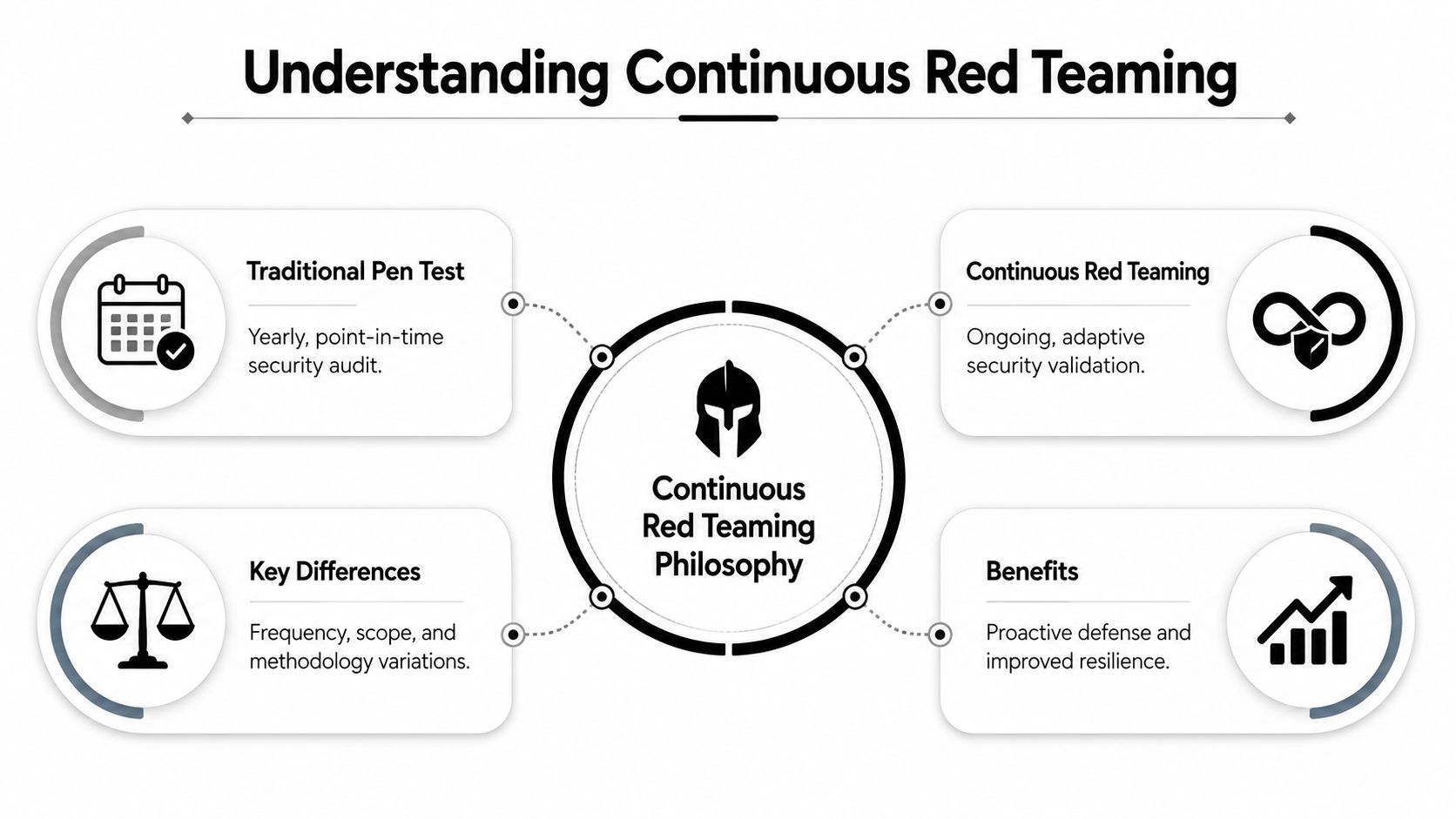
The shift from snapshot to signal
The core idea is persistent adversarial pressure. Instead of waiting for a human-led engagement to discover drift months later, the program keeps testing whether the controls you believe in stop the techniques you're worried about.
That shift has measurable consequences. Organizations that implement continuous and structured AI red teaming experience approximately 67% fewer security incidents and vulnerabilities than those relying on annual assessments, according to BlueFire Red Team's red teaming statistics. The same source notes that attackers exploit newly disclosed CVEs in roughly 3 days, which makes long gaps between assessments an obvious liability.
If you're evaluating adjacent approaches, this overview of automated continuous penetration testing is useful because it clarifies where continuous validation fits relative to legacy pentest models.
The three parts that make it work
The first pillar is automation. Not because automation is trendy, but because humans can't keep pace with constant infrastructure and application change. Scheduled attack simulations, asset discovery, control validation, and attack path checks have to run often enough to catch drift before an attacker does.
The second pillar is authentic adversary emulation. A scanner that reports missing patches isn't the same as a program that validates whether an attacker can chain identity abuse, privilege escalation, lateral movement, weak API authorization, and prompt manipulation into a meaningful breach. Continuous red teaming has to model attacker behavior, not just enumerate weaknesses.
The third pillar is a fast remediation loop. The program fails if findings land in a PDF nobody reads. It works when outputs become tickets, owner assignments, retests, and proof that a fix actually removed the path.
| Aspect | Traditional Red Teaming | Continuous Red Teaming |
|---|---|---|
| Frequency | Periodic and scheduled | Ongoing and repeated |
| Scope | Usually scoped to a project or time box | Broader validation across changing systems |
| Method | Heavily manual | Automated with human oversight |
| Output | Report-based | Operational feedback tied to remediation |
| Best use | Deep expert assessment | Persistent control and attack path validation |
The value isn't an endless list of findings. The value is knowing which attack paths still work after yesterday's changes.
Teams also use continuous red teaming to validate security spending. If you buy EDR, SIEM detection content, IAM controls, WAF rules, or AI guardrails, you need evidence they perform under realistic pressure. In this context, continuous programs outperform one-off tests. They show whether the defense effectively blocks the attack today.
Key Frameworks and Common Risk Models
A strong program needs a shared language. Otherwise every exercise turns into isolated tester creativity, and every report turns into a debate over terminology. Frameworks solve that by giving security, engineering, and leadership a consistent way to describe attacker behavior and prioritize response.
ATT&CK gives the program a common language
MITRE ATT&CK is the framework security teams commonly use to map what attackers do. It helps translate a simulation into behaviors defenders recognize, such as credential access, discovery, lateral movement, persistence, and exfiltration. That matters because a red team result isn't useful if the SOC can't connect it to detections and the engineering team can't map it to controls.
In practice, ATT&CK becomes the index for your playbooks. A cloud-focused scenario might emphasize identity abuse and privilege escalation. An internal enterprise scenario may focus on credential harvesting and lateral movement. An AI application scenario will still use familiar attacker concepts, but the execution path now includes prompt extraction, function abuse, and data access through agent workflows.
A good framework also keeps the program from becoming tool-driven. Vendors often showcase whichever techniques their platform simulates best. ATT&CK gives you an external reference so you can see what's covered, what's missing, and where manual work is still required.
Risk models should rank attack paths, not just findings
Most organizations don't suffer from a lack of findings. They suffer from too many findings with too little context. That's why the risk model matters more than the raw issue count.
A mature continuous red teaming program ranks problems by questions like these:
- What can be reached: Can an attacker move from this weakness to a sensitive system, privileged role, or business-critical workflow?
- What business function is exposed: Does the path end in customer data, financial operations, production administration, or an AI agent with tool access?
- What controls failed on the way: Did identity policy fail, did logging fail, did segmentation fail, or did the agent accept unsafe instructions?
- What can be fixed fastest: Some paths need architecture changes. Others disappear with one permission change or one prompt constraint.
That last point is where practitioners save time. Not every serious path gets solved with the same urgency or same owner. A cloud IAM chain belongs with platform engineering. A weak tool permission model in an agent belongs with application security and product engineering. A retrieval leak from one tenant context into another may require architectural isolation review.
A high-severity issue without a viable path to business impact often waits. A medium-looking issue that completes an attack chain shouldn't.
One useful habit is to group results by attack path instead of by scanner category. That produces reports people can act on. "Misconfigured role, exposed token, and weak service trust policy combine to grant cross-environment access" is much more actionable than three separate technical findings scattered across different dashboards.
This is also where continuous red teaming is better suited to cloud and SaaS-heavy estates than classic reporting models. The important question isn't "How many issues exist?" It's "Which three routes would let an attacker do something that hurts the business?"
Building Your Continuous Red Teaming Program
Programs succeed or fail on operating model. Tools matter, but the hard part is ownership, workflow, and the discipline to keep tests aligned to changing risk.
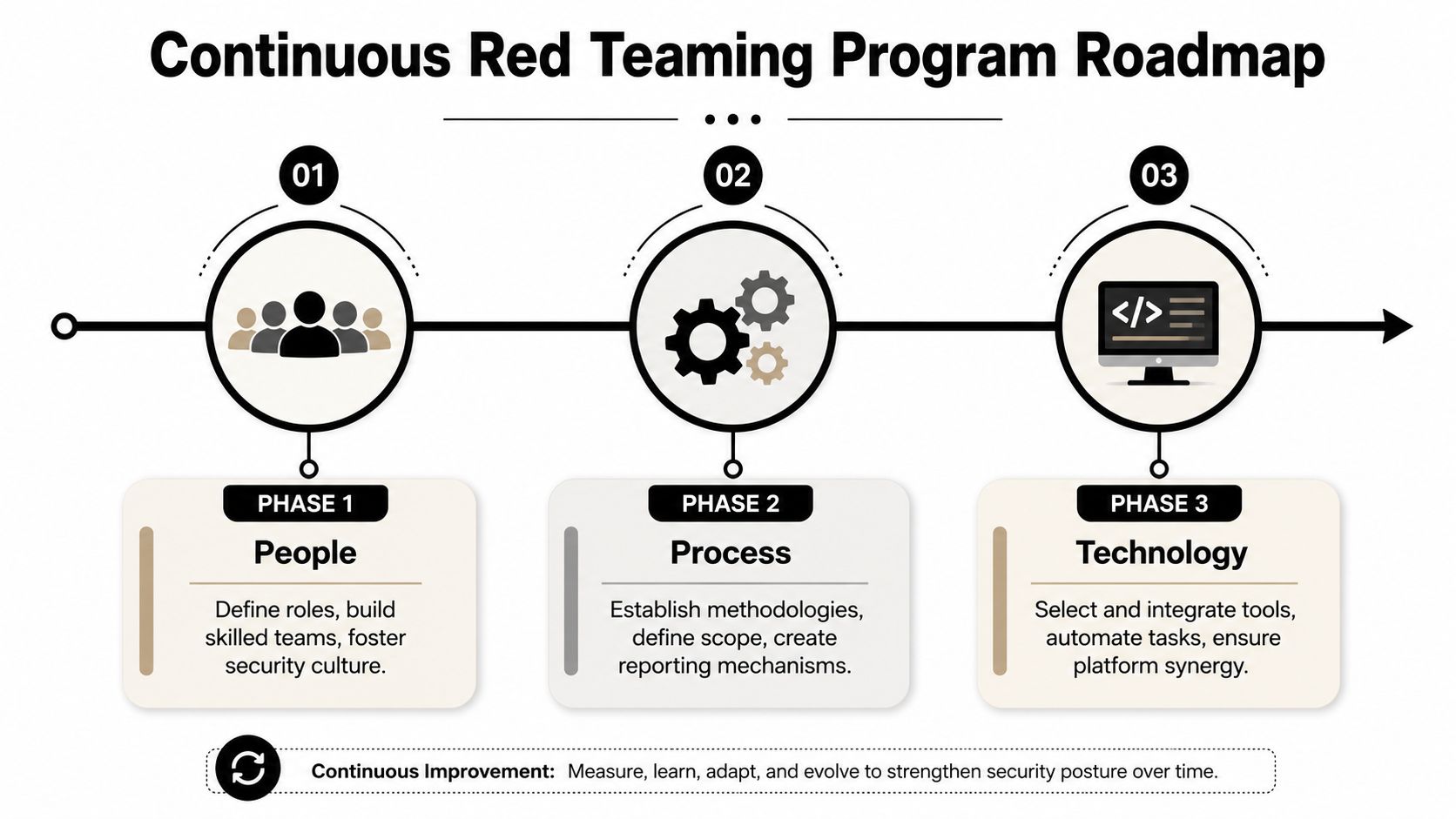
People need clear ownership
Continuous red teaming requires a cross-functional governance structure where a steering group made up of security ops, engineering, DevOps, application owners, and business stakeholders approves scope, SLAs, and risk tolerances, as described by Rootshell Security's overview of Continuous Automated Red Teaming. If that group doesn't exist, the program will produce findings faster than the organization can absorb them.
The steering group has a practical job. It decides what can be tested in production, what needs a staging control, which attack simulations require executive awareness, and what constitutes acceptable risk in customer-facing systems. It also decides who owns remediation when one finding touches identity, infrastructure, and application code at the same time.
A working structure usually looks like this:
- Security operations owns monitoring, triage coordination, and detection validation.
- Platform or DevOps teams own infrastructure controls, deployment hooks, and rollback safeguards.
- Application owners own code, prompt logic, tool permissions, and business-logic fixes.
- Business stakeholders decide where operational risk is acceptable and where it isn't.
Human review stays essential. Automated findings need analyst triage when severity is high, ambiguous, or likely to create noisy work. Periodic manual red-team audits also matter because they catch the things automation tends to miss, especially business-logic abuse and creative attack chaining.
Process decides whether findings get fixed
A lot of programs stall after the first burst of enthusiasm because findings don't enter the same machinery that runs engineering work. The best program design is boring on purpose. It turns simulated attacks into backlog items, ownership, service levels, and retests.
The process needs a few core requirements.
Rules of engagement
Define what systems are in scope, what hours high-risk tests can run, what credentials may be used, and what kill switches exist if a simulation causes instability.Trigger conditions
Decide what events launch tests. Examples include a new public endpoint, a changed identity policy, a major infrastructure release, an updated system prompt, or a new retrieval connector.Ticketing integration
Findings should open work in the systems your engineers already use. The ticket needs proof, reproduction context, impacted asset or workflow, and a retest state.Verification after remediation
Closing a ticket isn't enough. The program should re-run the path and confirm the attacker can no longer complete it.Human escalation paths
Some scenarios need legal review, incident-response participation, or executive notification before execution.
Security teams also underestimate the documentation burden. If you need audit evidence, architecture rationale, and repeatable procedures, you'll save time by streamlining compliance documentation efforts instead of rebuilding every control narrative manually.
Operator advice: If your red team findings can't become engineering work within a day, your process is too detached from delivery.
The same principle applies to integrations. The systems under test should connect cleanly to the rest of the environment, including identity, messaging, ticketing, CRM, and data systems. For organizations validating interconnected workflows, the range of platform integrations involved in agent-driven operations is exactly why change-triggered testing matters.
Technology should support the workflow, not define it
Technology decisions come last, not first. Start by deciding whether your main problem is control validation, attack path emulation, AI application abuse, or all three. Then choose tools accordingly.
Some organizations need a commercial platform for breadth, safety controls, and integration maturity. Others can combine open-source tools with internal orchestration if they already have strong engineering support. The trade-off is predictable. Buying gets you faster operationalization. Building gives you flexibility, but it also gives you maintenance, playbook upkeep, and reliability work.
A sensible stack usually includes these layers:
- Attack orchestration: To schedule and execute simulations safely.
- Asset and identity context: To understand what changed and what to test next.
- Detection integration: So the SOC can confirm whether the behavior was seen and classified correctly.
- Workflow integration: So remediation gets assigned and verified.
- AI-specific testing capability: If agents, prompts, or retrieval pipelines are in scope.
The program gets better when you start narrow. Pick one critical attack path. Automate it. Tie it to remediation. Prove you can rerun it after every meaningful change. Then expand. Many organizations don't need more findings first. They need a repeatable loop.
Securing AI Agents with Continuous Red Teaming
AI agents introduce a security problem that many legacy red team guides barely address. The system isn't just software serving requests. It's software that interprets instructions, chooses actions, uses tools, pulls context from data sources, and often operates across multiple tenants or instances with different permissions.
That means the offensive model has to widen. You still care about identity, access, APIs, and infrastructure. But now you also care about prompt injection, tool misuse, context poisoning, unsafe function calling, retrieval leakage, memory abuse, and whether the agent can be steered outside its intended operating boundary.
Near the start of an assessment, a platform view helps anchor the attack surface:
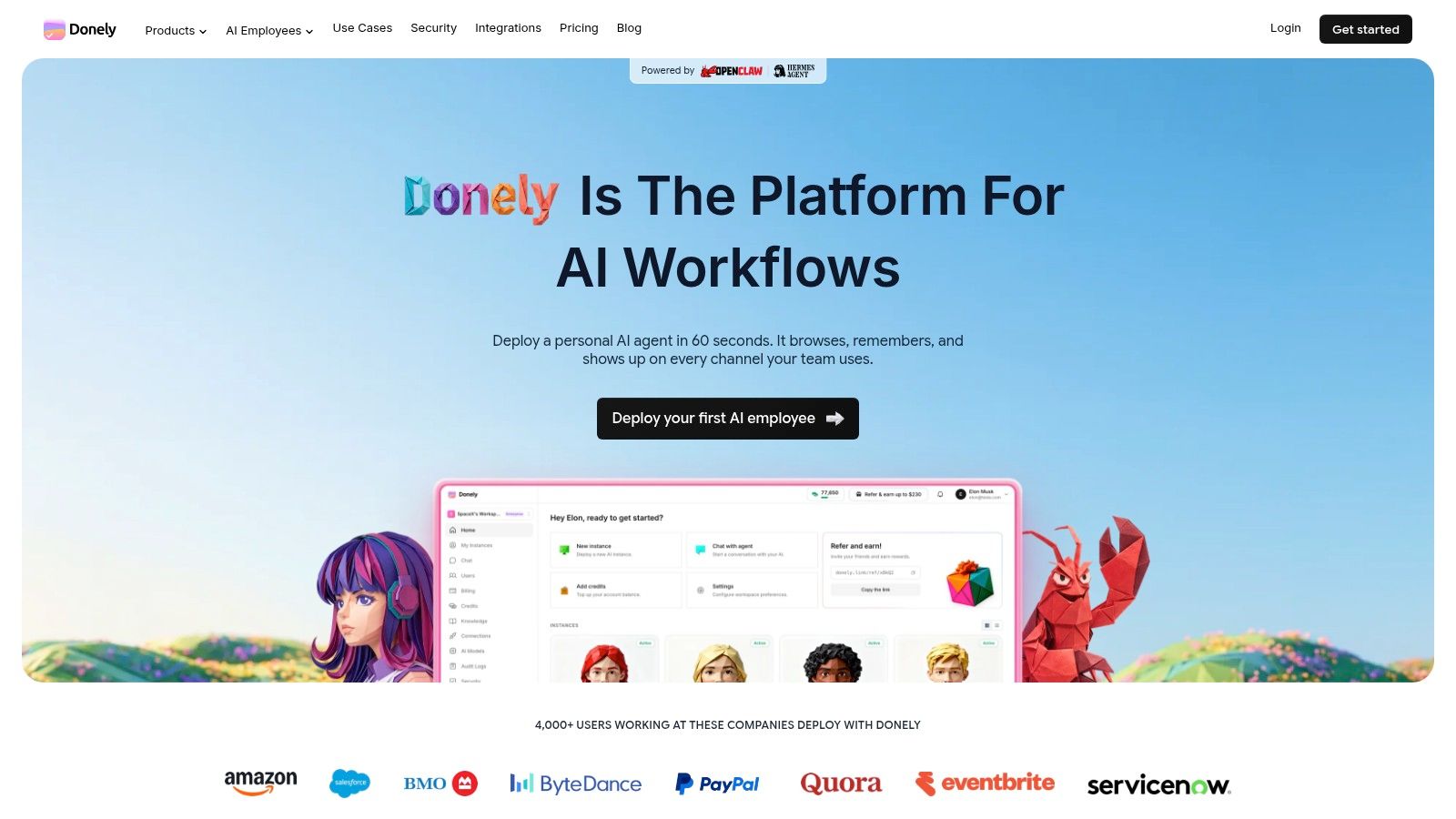
Test the agent like an attacker who knows nothing at first
Effective AI red teaming needs to work in a black-box setting, where the attacker enumerates as much context as possible, including model identities, system prompt extraction, guardrail determination, and framework enumeration, before building adversarial tests. That's the approach described in Promptfoo's OWASP red teaming guidance.
That requirement changes how you write playbooks. Don't start by assuming you already know the hidden prompt or the exact tool schema. Start by asking what a capable attacker would learn through observation, trial prompts, metadata leaks, documentation fragments, error handling, or exposed integrations. The resulting tests are more realistic and usually harsher.
For AI systems, I like to validate at least these categories:
- Instruction manipulation: Can the agent be induced to ignore policy, reveal hidden instructions, or reinterpret role boundaries?
- Tool abuse: Can a low-trust prompt coerce function calls that should require stronger approval or narrower scopes?
- Context contamination: Can a poisoned retrieval source or untrusted user content alter downstream behavior?
- Output-based exploitation: Can the response expose secrets, internal logic, or actions that enable a second-stage attack?
A broad primer like Bridge Global's AI risk analysis can help frame the operational risk categories, but continuous red teaming is where those abstract risks become testable behavior.
Multi-instance AI platforms need isolation testing
Modern agent platforms create a very specific challenge. A company may run separate instances for internal operations, customer support, sales workflows, partner automation, or agency-managed client deployments. The architecture may look clean on paper, yet proof comes from hostile testing.
For multi-instance environments, the primary questions are simple:
| Test objective | What the red team is trying to prove |
|---|---|
| Tenant isolation | One compromised instance can't read or act in another |
| RBAC enforcement | Low-privilege users can't expand agent capabilities indirectly |
| Audit integrity | High-risk actions create logs that support investigation |
| Tool scoping | Connected systems only expose the functions intended for that instance |
A useful product reference for this class of agent architecture is the Hermes agent deployment model, because it reflects the operational reality many teams now face. One platform may host many distinct agents and workloads. Security validation has to prove those boundaries hold under pressure, not just during acceptance testing.
If an agent can access a tool, assume an attacker will try to repurpose that tool through the agent before they ever attack the tool directly.
Put red team triggers into the AI delivery pipeline
The most effective implementation pattern is shift-left execution tied to change events. AI red team runs should trigger automatically when prompt files change, when a new retrieval source is added, when a model is swapped, or when an agent gets a new capability. The source material on AI red teaming also notes that teams schedule these runs from 12-hour to weekly cron intervals, but the better trigger is meaningful change rather than the clock alone.
That means your CI/CD pipeline needs security hooks for AI artifacts, not just code artifacts. A prompt update can be as security-relevant as a dependency update. A new connector can create a fresh exfiltration path. A change to retrieval ranking can expose data that was previously unreachable.
After the pipeline discussion, a visual walkthrough can help teams align on what "continuous" looks like in practice:
For practitioners, the most valuable habit is treating AI behavior changes as deployable risk. If your release process notices code diffs but ignores prompt diffs, you don't really have continuous red teaming for agents. You have conventional AppSec with an LLM bolted on.
Tooling Playbooks and Common Pitfalls
The tooling market is crowded because several categories now overlap. Vendors use terms like BAS, exposure validation, automated red teaming, and adversarial simulation interchangeably, but they don't all solve the same problem.
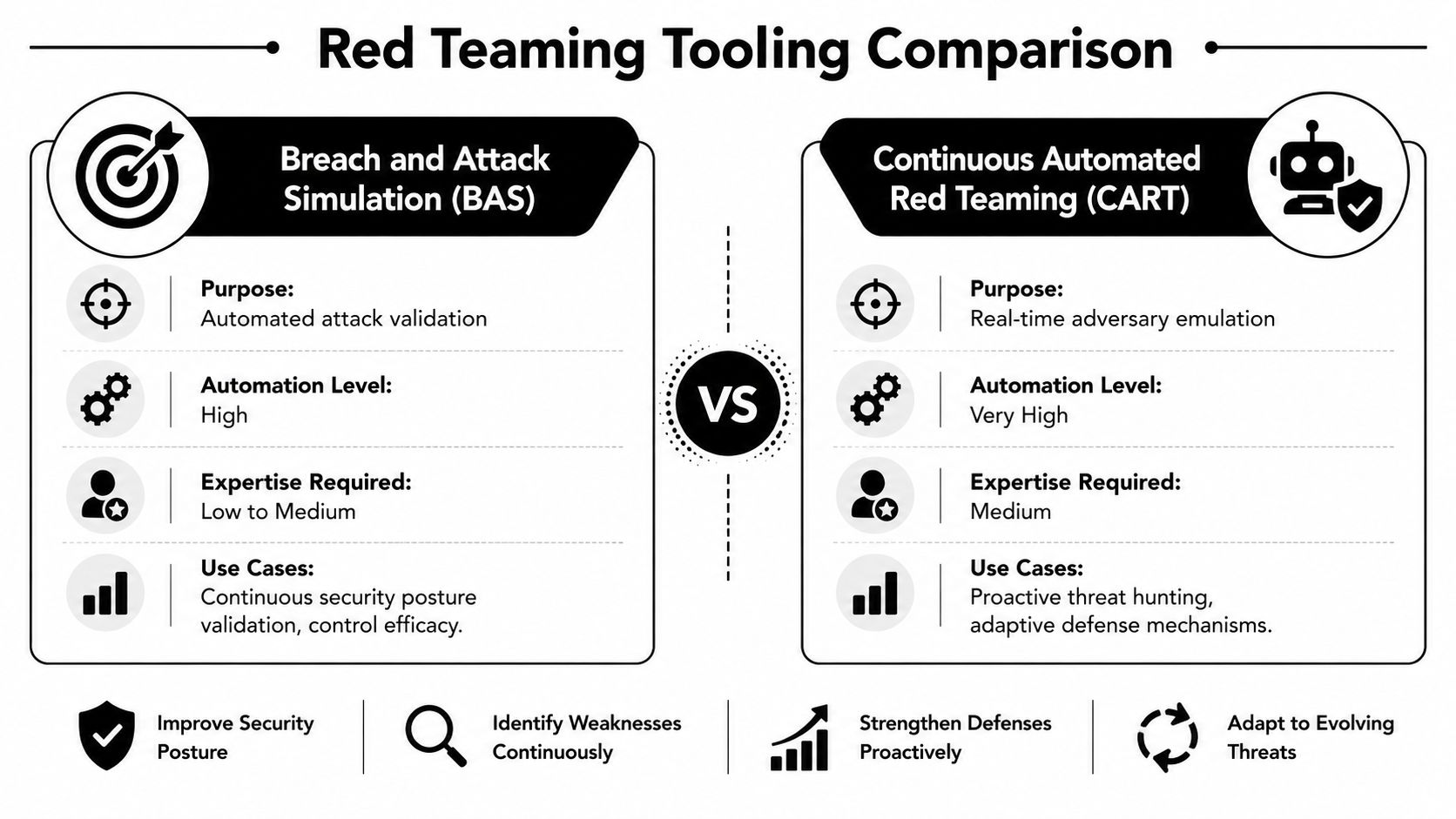
BAS and CART solve different problems
Breach and Attack Simulation (BAS) is usually strongest at repeated control validation. It asks whether a known behavior is detected, blocked, or allowed. That's useful when you want broad, repeatable assurance across endpoints, email controls, identity paths, or network defenses.
Continuous Automated Red Teaming (CART) goes further into attack chaining and adaptive path exploration. It focuses more on how an attacker could move through the environment and what combinations of weaknesses open a meaningful route.
Here's the practical distinction:
- Choose BAS first when your main need is validating control efficacy at scale.
- Choose CART first when your main need is realistic attack path emulation and post-compromise movement.
- Use both carefully when you have the operational maturity to tune noise, triage results, and push fixes into engineering.
For teams working with agentic systems and orchestration-heavy AI workflows, the underlying runtime also matters. The OpenClaw agent framework is a good example of why security testing can't stop at host or API level. The framework behavior itself can become part of the attack surface.
Two playbooks worth operationalizing first
The first playbook I recommend is new public asset validation. Every time a public-facing service, endpoint, or agent channel becomes reachable, the program should automatically:
- Discover the asset and classify its exposure.
- Confirm authentication, authorization, and rate-limiting expectations.
- Probe for misconfigurations, weak defaults, and obvious chaining opportunities.
- Validate whether logging and alerting see the activity.
- Open remediation work if the path succeeds.
The second is credential harvesting and privilege use simulation. This one matters because many breaches still hinge on identity misuse, and AI agents often sit close to messaging, ticketing, CRM, and internal knowledge tools.
A practical sequence looks like this:
- Initial lure validation: Test whether the user or workflow can be induced to reveal credentials, tokens, or approval artifacts.
- Privilege boundary check: Use the lowest available access to see what secondary movement becomes possible.
- Tool adjacency review: Validate whether the compromised identity can instruct or influence agents connected to useful systems.
- Detection review: Confirm the SOC can distinguish benign automation from malicious behavior using the same channel.
Where programs usually stall
Most failures aren't caused by weak tooling. They're caused by bad operational assumptions.
Current literature on automated continuous testing rarely explains how to simulate simultaneous attack scenarios, executive crisis response, or social engineering that requires human nuance, which leaves a critical blind spot in automated frameworks, as discussed in OffensAI's analysis of continuous red teaming in cloud security. That's a real problem. Attackers don't politely attack one control plane at a time.
Common failure patterns show up quickly:
- Tool-first deployment: The team buys a platform before deciding who owns findings and how remediation works.
- Noise overload: Every low-value result becomes a ticket, and engineers stop trusting the program.
- No human layer: Nobody validates ambiguous findings or runs periodic manual exercises for realism.
- Missing business context: Simulations hit technically interesting systems while ignoring crown-jewel workflows.
- AI blind spots: The team tests infrastructure but never attacks prompts, tools, retrieval, or tenant boundaries.
The fastest way to discredit a continuous program is to flood the organization with technically correct but operationally useless findings.
The fix isn't complicated, but it does require discipline. Run fewer scenarios at first. Tune them well. Attach each to a business objective, a clear owner, and a detection expectation. Then add complexity, including combined scenarios that involve both technical compromise and human decision-making.
Conclusion The Future of Proactive Security
Security programs used to be judged by coverage documents, annual assessments, and whether known issues were closed before the audit cycle ended. That standard isn't enough anymore. Environments change too quickly, attackers adapt too quickly, and AI platforms introduce too many new ways for behavior to drift into risk.
Continuous red teaming is the practical response. It replaces occasional reassurance with persistent verification. It tells you whether your controls, detections, permissions, and architectural boundaries still hold after the last release, the last integration, and the last model or prompt change.
That's especially true for AI agent deployments. Once agents can act across tools, channels, and data stores, security has to validate behavior continuously, not just infrastructure occasionally. For multi-instance platforms, tenant isolation, RBAC, and auditability have to be proven under adversarial pressure.
Start smaller than you think. Pick one attack path that would matter if it worked. Automate it. Tie it to ownership. Re-run it after every meaningful change. When that loop works, expand to adjacent paths, then to AI-specific behaviors, then to multi-step scenarios that include both technical and human response.
The future of proactive security isn't more reports. It's a system that keeps testing whether the business is hard to break.
If you're deploying AI employees across separate teams, customers, or client environments, Donely gives you a practical foundation to do it without rebuilding the platform layer yourself. Its unified dashboard, isolated multi-instance architecture, granular RBAC, audit logs, and built-in agent infrastructure make it easier to enforce the boundaries that continuous red teaming should be validating in the first place.