
Finding a single log entry in a sea of SaaS events feels like hunting for a needle in a haystack. Without a solid audit‑log strategy you can miss breaches, fail audits, and waste time digging through chaos. In this guide we break down the leading enterprise audit‑log solutions, compare their compliance chops, and show you how to pick the right fit for your SaaS stack today.
We pulled data from six platforms, checked each claim against vendor docs, and added real‑world observations from security teams. The result is a usable shortlist you can use right now. And because we know you need speed, we’ve added a quick buyer’s checklist at the end.
Need a unified view of who did what, when, and why? Enterprise AI Agents , Zero‑Trust Security & Governance gives you that baseline, and it’s the only product that couples RBAC with a full API out of the box.
1. Unified Immutable Audit Log Solution (Our Pick), Unified immutable audit logs
This solution brands itself as an immutable‑by‑design log store. Every event lands in a write‑once, read‑many (WORM) bucket, so no one can alter history. The platform captures user ID, timestamp, IP, and payload for every API call, admin action, and data change. That level of detail lines up with GDPR Article 30 and PCI DSS Requirement 10, which both demand a tamper‑evident trail.
What makes it stand out is the single‑pane dashboard that lets you filter by user, resource, or risk score in milliseconds. You can also push logs to a SIEM like a leading security analytics platform for deeper correlation.

Pros:
- True immutability via WORM storage.
- Built‑in compliance templates for SOC 2, GDPR, and HIPAA.
- Out‑of‑the‑box connectors for cloud services.
Cons:
- Higher price tier for long‑term retention.
- Requires a dedicated log‑ingestion pipeline.
Imagine a breach where a compromised service account starts exfiltrating files at 2 a.m. The solution would instantly surface the odd IP, the unusual file path, and the exact chain of calls that led to the leak. Your incident team could then isolate the account before any damage spreads.
Pricing starts at $2,500 per month for 1 TB of daily ingest, with volume discounts for larger enterprises. That cost covers encryption at rest, audit‑log retention policies, and 24/7 support.
According to industry best practices, an audit log is a chronological, tamper‑evident record of system events and user actions, exactly what this solution promises.
Key takeaway: immutability plus ready‑made compliance templates make this solution a strong base for any regulated SaaS.
2. Scalable Multi‑Tenant Logging Solution
The solution focuses on scale. It shards logs across a distributed cluster, letting you keep billions of events online without a performance hit. Multi‑tenant isolation means each customer gets a logical view of its own logs, while the backend stays shared.
The platform supports JSON, Syslog, and OpenTelemetry formats, so you can ingest data from microservices, containers, and legacy apps with the same pipeline.
Pros:
- Horizontal scaling, add nodes as you grow.
- Tenant‑level RBAC, admins only see their own data.
- Native integration with a streaming platform for real‑time streaming.
Cons:
- Complex setup, you need a Kubernetes cluster.
- Retention defaults at 30 days; longer periods cost extra.
Let’s say your SaaS onboards a new enterprise client overnight. The platform lets you spin up a new tenant in minutes, assign role‑based access, and start collecting logs without touching the core infrastructure.
Pricing is usage‑based: $0.10 per GB ingested, with a minimum of $500 per month. That model works well for fast‑growing startups that need to keep costs predictable.
Best practice tips: define a log‑schema early, enable OpenTelemetry on all services, and set retention policies that match the most stringent regulation you face.
For a deeper dive on secure logging practices, see Donely guide. It walks through source identification, collection, and retention, steps that map directly onto the platform’s workflow.
Ready to cut through log noise? Try Donely free →
Bottom line: if you need raw scalability and multi‑tenant isolation, the platform gives you the plumbing without locking you into a single‑tenant model.
3. AI‑driven anomaly detection
The platform adds a layer of smart detection on top of any log source. Its AI engine learns normal user behavior and flags deviations in real time. When an unusual pattern pops up, the system creates a cryptographic receipt that proves the event wasn’t tampered with.
Key features include:
- Full‑text search across millions of records in milliseconds.
- One‑click export to PDF, CSV, or JSON‑LD for auditors.
- Configurable retention up to 10 years, matching EU AI Act requirements.
Pros:
- AI‑based anomaly scoring reduces false alerts.
- WORM storage guarantees evidence integrity.
- Granular policy tagging (GDPR, CCPA, etc.) for compliance reporting.
Cons:
- AI model training needs historical data; you may need a warm‑up period.
- Pricing can rise quickly with high event volumes.
Picture this: an employee tries to export a large set of PII after hours. The platform spots the deviation, attaches the relevant policy tag, and sends an immediate alert to the security team. The audit log already contains the cryptographic proof, so you can hand it to regulators without delay.
Pricing starts at $3,000 per month for up to 5 million events, with a per‑event overage fee.
According to the referenced source, every AI decision is documented with cryptographic proof receipts and policy snapshots, making it easy to prove compliance.
Key takeaway: AI‑driven alerts turn raw logs into actionable security signals.
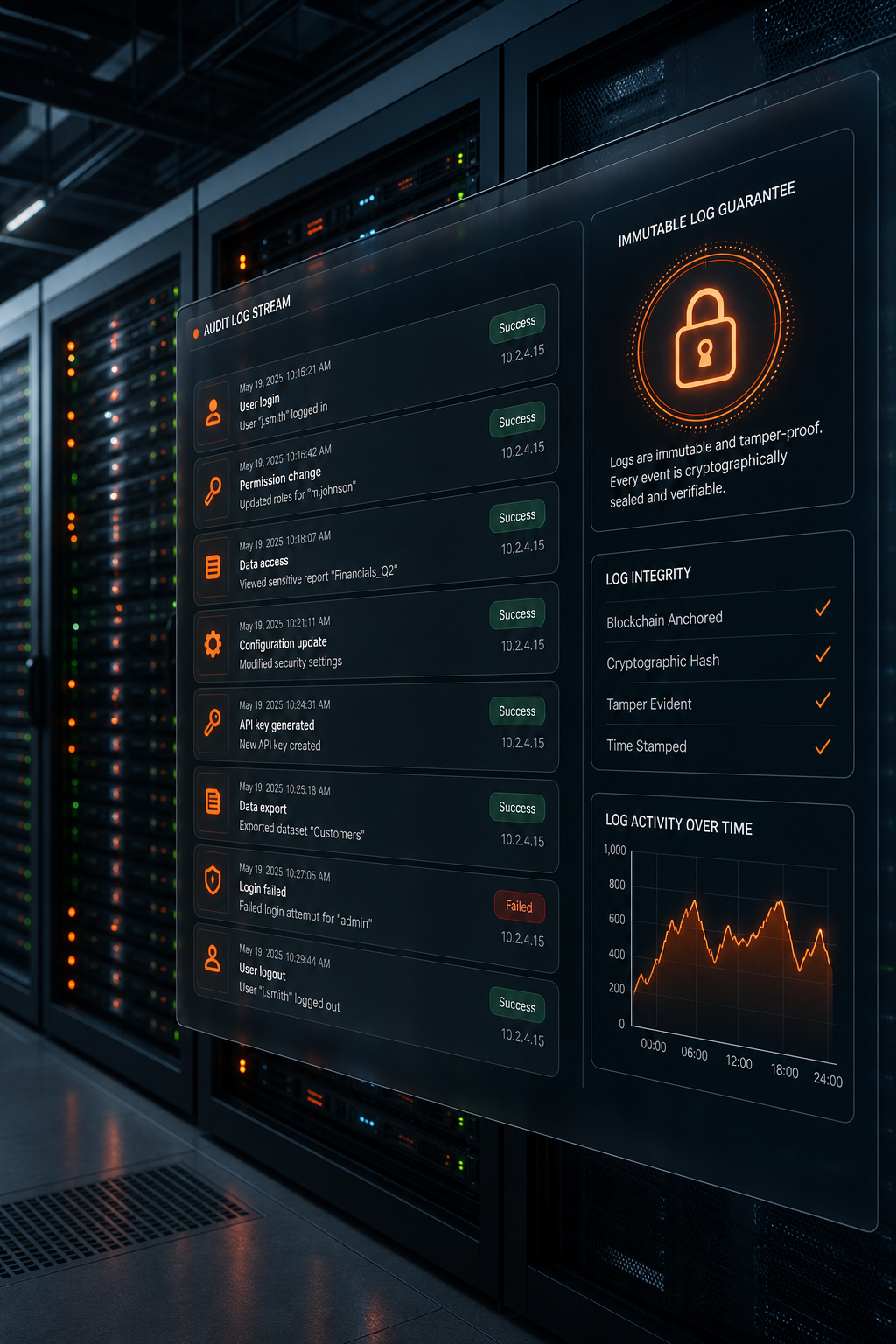
4. Real‑time compliance dashboard solution
This solution builds on a streaming platform’s append‑only log to give you instant visibility. Instead of waiting for batch exports, you get a live feed of every audit event, enriched with user context and risk scores.
The platform enforces five non‑negotiable requirements: immutability, encryption, RBAC, data lineage, and tiered storage. That matches the demands of HIPAA, PCI DSS, and SOC 2.
Pros:
- Millisecond latency, alerts fire as events happen.
- Schema Registry ensures consistent data formats.
- Tiered storage moves older logs to cheap object storage while keeping them queryable.
Cons:
- Requires streaming platform expertise to set up.
- Initial cost can be high for on‑prem deployments.
Use case: a financial services firm needs to retain audit data for seven years. The solution writes events to the streaming platform, streams them to a WORM object store, and keeps the most recent week online for quick searches. Auditors can pull a CSV export with one click, and compliance officers get a dashboard that shows login failures per minute.
Pricing is consumption‑based: $0.15 per GB stored plus $0.05 per GB streamed. There’s a managed cloud option that bundles support.
The industry blog explains how the append‑only nature provides natural immutability, which is exactly what this solution uses the source article.
Pro tip: pair the dashboard with a SIEM to correlate audit events with threat intel feeds for richer detection.
Bottom line: if you need live insight and can handle the streaming platform, this solution turns compliance into a real‑time operation.
5. Unified Compliance Suite, Built‑in GDPR & SOC 2 templates
This compliance‑automation platform ships with ready‑made GDPR and SOC 2 evidence packs. It auto‑collects logs from cloud services, code repositories, and identity providers, then maps them to the required control tables.
Features include:
- One‑click generation of auditor‑ready PDFs.
- Real‑time gap analysis that flags missing evidence.
- Policy wizard that creates lawyer‑vetted documents in minutes.
Pros:
- Saves hundreds of hours on manual evidence collection.
- Free tier works for early‑stage founders.
- Integrates with popular dev‑ops tools for continuous compliance.
Cons:
- Focuses on documentation; you still need a log‑store for raw events.
- Limited custom policy support beyond the built‑in templates.
Think about a startup that lands its first enterprise deal. The client asks for SOC 2 Type II evidence. With this solution, you click a button, pull the latest logs, and the platform auto‑fills the audit spreadsheet. No extra consulting fees.
Pricing: free for a limited number of integrations, then a standard monthly fee for unlimited connectors.
Further details on automation of SOC 2 and GDPR compliance can be found here.
Key takeaway: if you need a fast path to audit‑ready paperwork, this solution removes the paperwork headache.

How to Choose , Quick Buyer’s Checklist
- Do you need immutable storage? Look for WORM or blockchain anchoring.
- What retention period does your regulation demand? Choose a platform that supports that out of the box.
- Is real‑time alerting a must? Prioritize tools with AI or streaming pipelines.
- Do you have multi‑tenant customers? Verify tenant‑level RBAC and isolation.
- Do you already have a SIEM? Pick a solution that can push logs directly to it.
Use this list as a scoring sheet when you demo each vendor.
FAQ
What is an audit log and why does it matter for SaaS?
An audit log records every user action, system event, and data change with a timestamp, user ID, and context. It lets you prove who did what, which is required by regulations like GDPR, HIPAA, and SOC 2. When a breach occurs, the log gives investigators a clear timeline to trace the attack, reducing response time and potential fines.
How do I ensure my audit logs are immutable?
Use write‑once, read‑many (WORM) storage or blockchain anchoring. Platforms that provide append‑only storage buckets that cannot be altered are ideal. Pair this with role‑based access control so only authorized staff can view or export logs, and require dual‑approval for deletions.
What retention periods should I set?
Retention depends on your industry. Financial services often need seven years, healthcare six years, and most SaaS aim for at least 90 days of hot storage plus archival for longer periods. Choose a solution that lets you configure policies per regulation, such as tiered storage options.
Can I centralize logs from multiple SaaS tools?
Yes. Most platforms support standard formats such as JSON, Syslog, or OpenTelemetry. Various providers offer connectors for cloud services, databases, and Kubernetes. Once collected, you can route logs to a SIEM for correlation and alerting.
Do I need AI to detect anomalies?
AI helps cut through noise by learning normal behavior and flagging outliers. Advanced AI models can reduce false positives, but simple rule‑based alerts can work for smaller teams. Start with basic thresholds, then layer AI on top as your data volume grows.
How does RBAC affect audit logging?
RBAC (role‑based access control) limits who can view or modify logs. When a privileged user accesses a log, the system records that action as well, creating a chain of accountability. Platforms that integrate RBAC with logging, like Donely, give you end‑to‑end traceability.
What should I look for in pricing?
Watch for hidden overage fees. Some providers charge per GB stored, others per event processed. Compare your expected daily ingest to the pricing tiers. For example, certain services bill $0.10 per GB, while others add per‑event fees after a base tier. Factor in long‑term retention costs, too.
Conclusion
Enterprise audit‑log compliance isn’t a one‑size‑fits‑all puzzle. A immutable storage solution gives immutability and ready templates. A scalable multi‑tenant logging platform scales effortlessly for SaaS. An AI‑driven alerting system adds alerts that turn raw data into security insights. A real‑time dashboard solution brings dashboards built on an append‑only log. A compliance generator speeds up paperwork with auto‑generated GDPR and SOC 2 evidence.
When you stack these capabilities against the regulations you face, SOC 2, GDPR, HIPAA, ISO 27001, you’ll see clear gaps and clear solutions. Remember the checklist: immutable storage, proper retention, real‑time alerts, tenant isolation, and SIEM integration. Score each vendor against those points, and you’ll land on the right tool faster.
Donely already ships with built‑in RBAC and unified audit logs, so you can start testing any of these platforms without building a logging layer from scratch. Ready to see how it works in your stack? Start your free trial and get a sandbox environment with full audit‑log visibility.