
You got the prototype working.
It can browse a site, summarize a document, move data from one tool to another, maybe even respond in Slack with something that feels useful. In a demo, that's enough to win attention. In production, it's where the demanding work starts. The first failed run, the first duplicate action, the first unclear audit trail, or the first security review changes the conversation fast.
That's why most OpenClaw vs AutoGPT comparisons miss the point. They focus on autonomy, prompt flexibility, or general capability. Buyers and operators usually need a different answer. They need to know which one stays predictable when it runs every day, who can access it, how failures are handled, and what happens when one agent turns into ten.
That shift from prototype to production is where the trade-off becomes concrete. OpenClaw's rise has been unusually fast. One industry write-up says it crossed 330,000 GitHub stars and became the fastest-growing software repository in GitHub history, while the same broader wave of coverage also noted that by late 2025 more than 30,000 improperly configured instances were exposed online, which shows both adoption and the security cost of unmanaged rollout (Serverspace coverage of OpenClaw growth and exposed deployments).
A prototype only proves that the task is possible. A production deployment has to prove that the task is repeatable, observable, and governable. OpenClaw and AutoGPT can both be useful. They just solve different operational problems, and treating them like interchangeable agent frameworks is how teams end up with brittle systems.
Table of Contents
- Introduction From Prototype to Production
- Core Architecture and Design Philosophy
- Production Readiness A Detailed Comparison
- Security Compliance and Governance
- Ideal Use Cases and Business Scenarios
- Go Live in 2 Minutes with Production OpenClaw
- Your Decision Checklist Choosing the Right Path
Introduction From Prototype to Production
Teams usually arrive at this comparison after an encouraging first result. An agent handled lead triage, pulled information from a portal, or stitched together a few internal tools. The result looked good enough that someone asked the dangerous next question. Can we roll this out across the business?
That question changes everything.
A prototype can tolerate inconsistency. A production workflow can't. If a support assistant misses a field once in a while during testing, you retry manually. If the same miss happens inside an active support queue, someone has to explain the customer impact. If a research agent loops for too long in a sandbox, that's annoying. If a business process agent loops inside a recurring operational run, that becomes cost, drift, and cleanup work.
The practical OpenClaw vs AutoGPT decision starts there. It's not about which framework is more impressive in isolation. It's about where each one sits in your stack, and what kind of operational burden it creates after deployment.
Most teams don't fail at the prototype stage. They fail when nobody owns retries, logs, permissions, and failure recovery.
There's also a pattern in how these tools get adopted. An engineer or founder proves the use case, then more people want access. Sales wants a lead-handling workflow. Operations wants a daily reconciliation task. Support wants triage. Agencies want client separation. Suddenly the issue isn't whether the agent can do the task. The issue is whether the system around the agent is mature enough to keep the task controlled.
Why This Comparison Matters In Practice
OpenClaw and AutoGPT both sit in the agent conversation, but they don't create the same operating model.
Some teams need broad reasoning and a self-directed loop that can work through ambiguity. Others need narrower execution where the agent performs a known workflow with tighter structure. The second group usually feels production pain sooner, because recurring work exposes every weak point in logging, permissions, and observability.
That's why this article treats OpenClaw vs AutoGPT as an operations decision, not a novelty comparison. If you're already thinking about maintenance burden, auditability, tenant separation, or whether your team can support agents without hiring platform engineers, you're asking the right questions.
Core Architecture and Design Philosophy
The biggest mistake in OpenClaw vs AutoGPT evaluations is treating them as direct substitutes. They aren't built with the same first principle.
Independent comparisons describe AutoGPT as an autonomous goal-planning framework and OpenClaw as a targeted execution layer for web and workflow automation, with OpenClaw's narrower scope intended to improve reliability, token efficiency, and action auditability for production use (Flowith's analysis of targeted OpenClaw workflows).

Quick Comparison Table
| Area | OpenClaw | AutoGPT |
|---|---|---|
| Primary role | Targeted execution for web and workflow automation | Autonomous goal planning and self-directed reasoning |
| Core strength | Structured, auditable operational runs | Exploratory task decomposition |
| Typical fit | Repeatable business workflows | Open-ended problem solving |
| Production posture | Reliability and control focused | Flexibility and breadth focused |
| Operational style | Constrained execution domain | Broader decision space |
Why The Layer Matters
AutoGPT is useful when the path isn't well defined. You give it a goal, and it works through subtasks, iterates, and adjusts. That's valuable for exploration. It's also where unpredictability enters. Broad autonomy gives the system more choices, and more choices usually mean more ways to fail, drift, or consume tokens in ways your operations team didn't plan for.
OpenClaw is narrower by design. That's not a limitation in the negative sense. In business environments, narrower often means easier to validate. If the agent's job is to browse, extract, move through a known workflow, and produce a structured output, constrained behavior is a feature.
This is the architectural dividing line many teams need. AutoGPT sits closer to reasoning and planning. OpenClaw sits closer to execution and workflow delivery. If your next step is to operationalize web tasks or repeatable business flows, it's worth looking at a production-oriented OpenClaw deployment model rather than treating the framework as just another experiment.
Practical rule: If you need creativity, tolerance for ambiguity, and broad strategy generation, start by evaluating AutoGPT. If you need repeatable execution with an audit trail, start by evaluating OpenClaw.
That distinction also affects who can support the system internally. A general autonomous loop often needs technical owners who are comfortable debugging chain behavior. A targeted execution layer is easier to hand over to operations teams once the workflow is defined.
Production Readiness A Detailed Comparison
When teams say they want “production-ready agents,” they usually mean five things. They want the system to start reliably, fail in understandable ways, recover without drama, expose enough logs for troubleshooting, and stay manageable as more workflows get added.
Independent benchmark writeups report that OpenClaw outperforms AutoGPT on latency, throughput, and cost-efficiency across common workloads like document summarization and multi-turn conversation, with lower latency identified as a key edge (UBOS benchmark comparison for OpenClaw and AutoGPT).
Here's the short version early.
| Production criterion | OpenClaw | AutoGPT |
|---|---|---|
| Day-to-day operational predictability | Stronger for structured runs | Stronger for open-ended chains |
| Retry and monitoring fit | Better aligned with repeatable workflows | Usually needs more custom operating discipline |
| Performance posture | Reported edge on latency and throughput in benchmark framing | More variable under exploratory workloads |
| Auditability | Better suited to exact action tracking | More planning-oriented than action-auditing-oriented |
| Fit for recurring business tasks | Strong | Situational |

What Production Teams Actually Need
A production agent is closer to an enterprise application than a prompt. That means deployment discipline matters. If you already manage background jobs, queues, API integrations, or scheduled workloads, the same operational instincts apply here. The workload may be “AI,” but the ownership model still looks like software operations.
That's one reason resources on broader enterprise application development patterns stay relevant. Once agents become recurring business systems, concerns like rollback behavior, logging consistency, separation of environments, and operator visibility stop being optional.
The practical checks look like this:
- Failure visibility: Can an operator see what step failed, what data was involved, and whether a retry is safe?
- Recovery path: Does the agent support predictable retries, or does each rerun risk creating duplicate actions?
- Run consistency: Will the same workflow produce similarly structured outputs day after day?
- Maintenance overhead: Can a lean team keep it alive without constant manual intervention?
For business use, predictable execution usually beats raw autonomy. A less creative agent that finishes cleanly every morning is often more valuable than a more ambitious one that needs babysitting.
Where OpenClaw Usually Fits Better
OpenClaw is typically the better fit when the work itself is known. The agent needs to execute a web task, move through a defined workflow, and produce something structured enough that another system or human can trust it.
That matters for recurring runs. Daily reporting, portal updates, message handling, triage flows, lead routing, and extraction pipelines all benefit from a tighter execution layer. In those environments, speed isn't just a performance metric. Speed also affects queue behavior, timeout risk, and how long an operator waits before knowing something went wrong.
Because OpenClaw is framed as a more structured workflow tool, it tends to align better with the habits operators already have. Monitoring, retry rules, and governance fit naturally when the task itself is bounded.
Where AutoGPT Still Makes Sense
AutoGPT still has a clear place. If the work starts with a broad objective and no one knows the right path yet, broad reasoning has value. Research, synthesis, planning, option generation, and exploratory problem solving all benefit from an autonomous loop that can branch, reconsider, and self-direct.
The trade-off is operational discipline. The more open-ended the run, the harder it is to define what success looked like before execution began. That makes post-run evaluation and incident handling more subjective. It can still work, but it places a heavier burden on the technical team that owns the system.
For many businesses, that means AutoGPT is useful earlier in the lifecycle, when the workflow is still being discovered. OpenClaw becomes more useful later, when the workflow has stabilized enough to deserve predictable execution.
Security Compliance and Governance
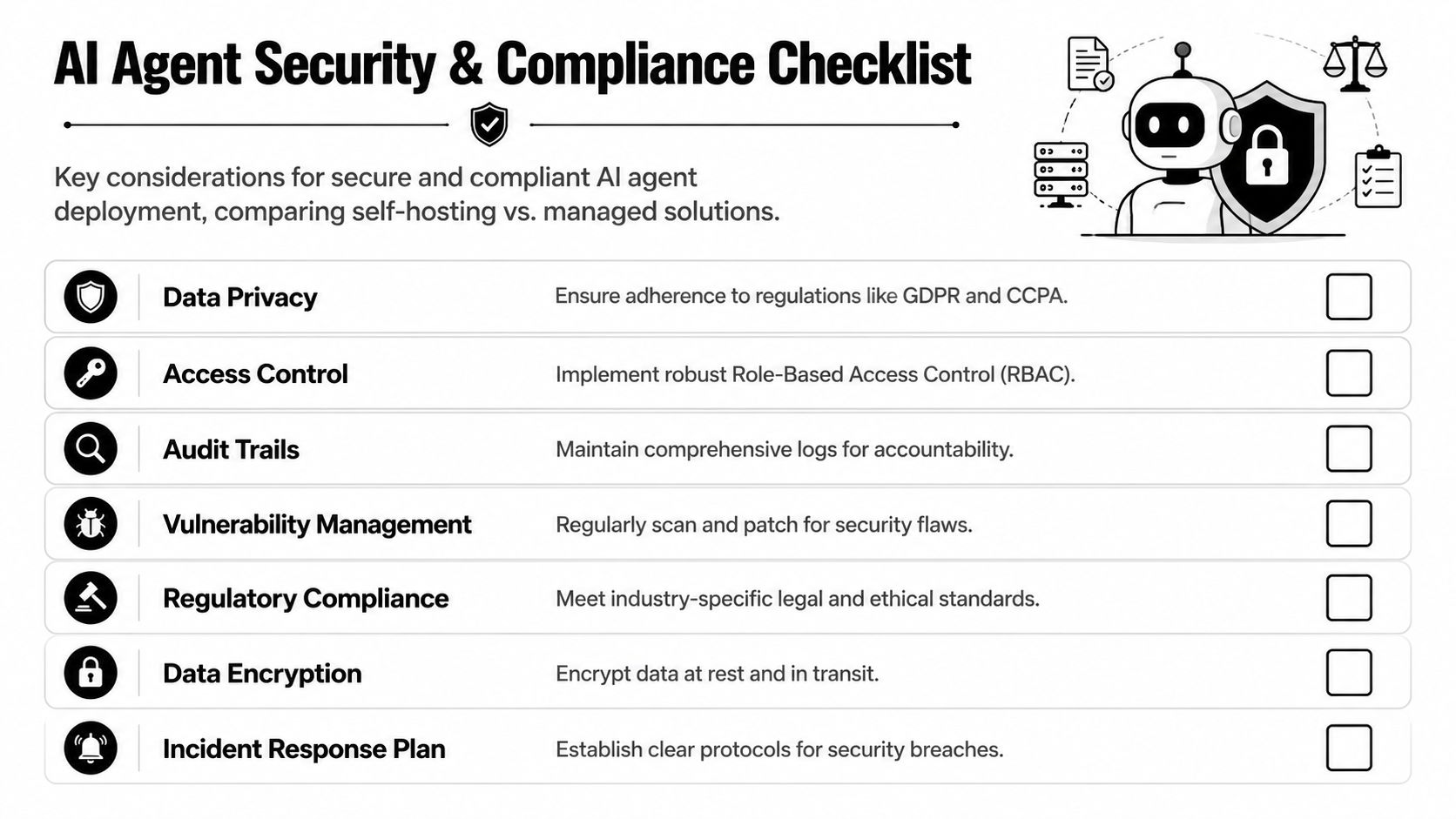
Security is where the OpenClaw vs AutoGPT discussion gets too shallow. A lot of articles stop at “run it locally for privacy.” That's not enough once the agent touches customer data, internal records, or client workflows.
Coverage of the category has pointed out a real gap here. Many comparisons mention local execution for privacy, but they don't deal with enterprise controls such as RBAC, audit logs, and data boundaries between instances, even though those controls are what turn a private setup into a governable one (OfLight coverage on local execution and governance gaps).
Local Execution Is Not A Security Strategy
Running an agent on your own infrastructure gives you control over location. It doesn't automatically give you governance.
A team still needs to answer basic questions:
- Who can launch or edit workflows
- Who can view logs and outputs
- How client or department data stays isolated
- What gets recorded for audit and incident review
- How secrets and credentials are scoped
That's where many self-hosted efforts go sideways. The framework may be capable, but the surrounding controls are improvised. If your workload includes regulated data, agency client separation, or cross-functional operator access, “it runs locally” won't satisfy security reviewers.
Governance Questions That Show Up Late
In practice, governance pain usually appears after success. The first agent is easy to justify. The fifth one creates confusion. Someone asks why one team can see another team's run history. Someone notices that logs are split across systems. Someone needs to prove who changed a workflow and when.
Those are standard software governance problems, but agent deployments magnify them because behavior can be more dynamic than a fixed service.
A useful way to approach this is to treat agent deployment like any other secure delivery discipline. Work through threat modeling and secure coding practices before rollout, then evaluate whether the operating layer gives you enough controls to enforce what the model can access and who can operate it. Privacy posture matters too, especially if you're deciding between self-managed and managed environments. A platform's privacy approach and operating commitments should be part of the review, not an afterthought.
Security reviews rarely fail because the model was impressive. They fail because access scope, auditability, and tenant boundaries were unclear.
AutoGPT can absolutely be run carefully, but it isn't usually framed around multi-instance business governance. OpenClaw enters the conversation more often where operational controls matter, especially for structured workflows that need oversight.
Ideal Use Cases and Business Scenarios
The cleanest way to choose between OpenClaw and AutoGPT is to stop comparing features and start comparing task shapes.
Independent comparisons describe AutoGPT as better suited to exploratory task planning and OpenClaw as better for repeatable operational runs with monitoring, retry rules, auditability, and control (Hire Overseas comparison of AutoGPT and OpenClaw roles).
Use AutoGPT For Exploration
AutoGPT fits when the assignment sounds like a goal, not a workflow.
Examples:
- Research briefs: “Investigate this market and summarize the competitive environment.”
- Planning tasks: “Break down this initiative and propose next steps.”
- Open-ended analysis: “Review these documents and surface likely risks.”
- Idea generation: “Suggest multiple approaches, compare them, then refine the best one.”
These tasks benefit from iteration and self-direction. You may not know the best route ahead of time, and that's exactly where a planning-oriented agent helps.
Use OpenClaw For Repeatable Operations
OpenClaw fits when the work sounds like a runbook.
Examples:
- Lead handling: Read inbound messages, extract fields, and route them into a CRM with a consistent structure.
- Support triage: Watch a shared channel, classify requests, and push them into the right queue for follow-up.
- Daily web workflows: Log into a portal, pull specific data, and produce a recurring operational report.
- Client operations: Run isolated workflows for different customers without mixing logs, access, or outputs.
A simple decision rule helps. If you'd normally write an SOP for the task, OpenClaw is probably closer to the right abstraction. If you'd normally brief a strategist and ask them to figure out the path, AutoGPT is probably the better fit.
That distinction also saves money in the long run. Teams often force a general autonomous framework into a repeatable operations role, then spend months building the controls they should have selected for up front.
Go Live in 2 Minutes with Production OpenClaw
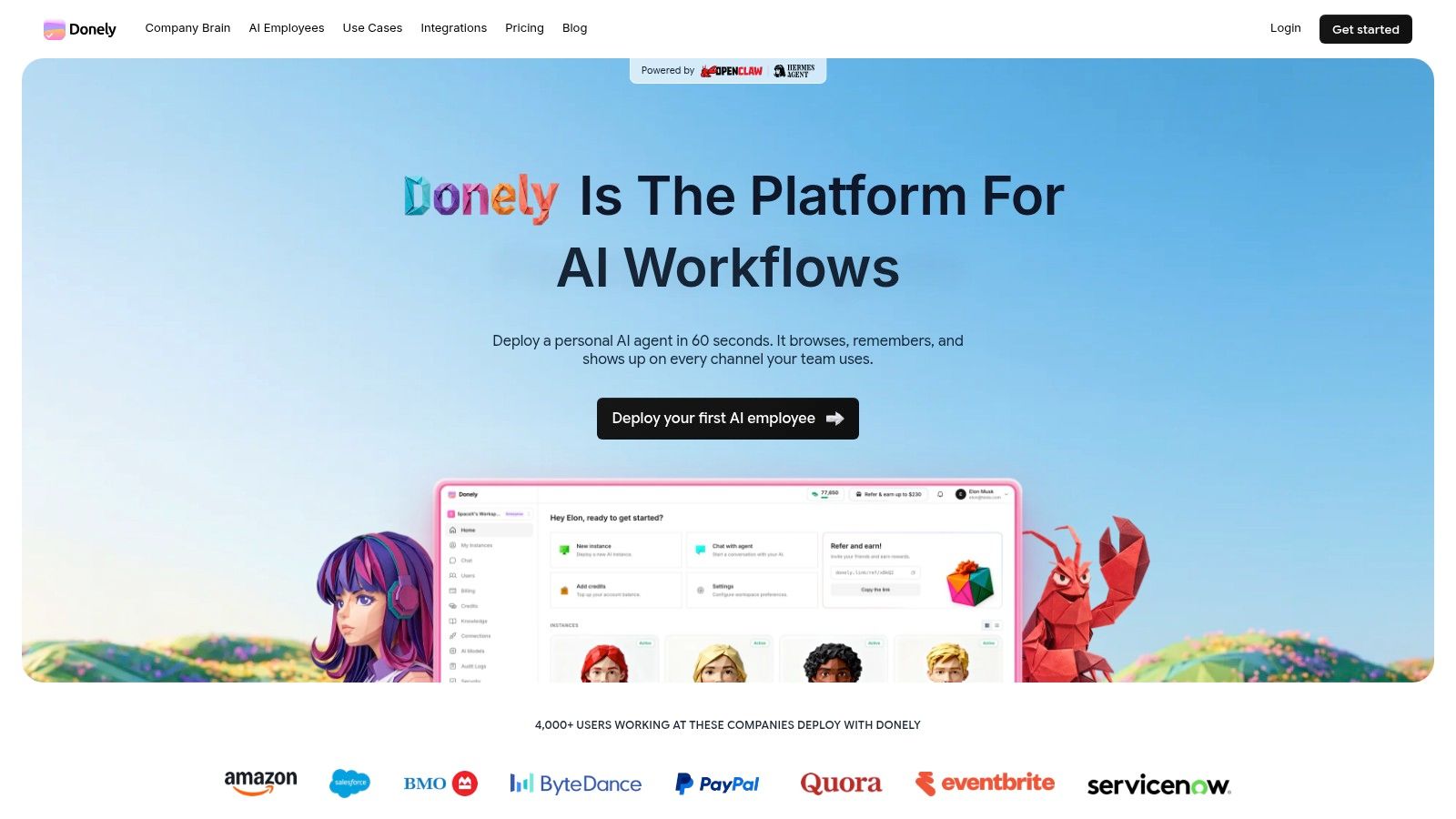
If you've decided that OpenClaw is the better fit, the next problem is familiar. You don't just need the framework. You need hosting, isolation, access control, integrations, logs, and a way to manage more than one instance without turning every change into a DevOps task.
What A Production Shortcut Should Remove
A serious production shortcut should eliminate four categories of overhead:
- Infrastructure setup: You shouldn't need to spend days wiring the initial runtime.
- Security hardening: Access scope, auditability, and isolation should already exist as part of the platform.
- Integration sprawl: Business workflows break down fast when every connector is a one-off.
- Instance management: Separate personal, team, and client workloads need operational boundaries from day one.
That's where managed OpenClaw hosting becomes useful. Rather than self-assembling the stack, teams can use a hosted option such as OpenClaw hosting on Donely, which is positioned around fast deployment, built-in integrations, isolated instances, and centralized monitoring. For teams moving from one prototype to many active workflows, that operating layer usually matters more than another round of prompt tuning.
A quick product walkthrough helps make that difference concrete.
A Faster Path To Hosted OpenClaw
A practical production path should let you launch the first agent quickly, then keep the same control plane as adoption expands. That includes business tool integrations, log visibility, per-instance separation, and a billing model that doesn't require separate manual setups for every new workload.
That's the point many teams miss in OpenClaw vs AutoGPT. The framework choice matters, but the management layer often decides whether the rollout survives contact with real users.
Your Decision Checklist Choosing the Right Path
The right choice usually becomes obvious when you ask operational questions instead of capability questions.
Choose Based On Failure Cost
Ask these first:
What happens when the run fails?
If a failure creates customer impact, duplicate records, or manual cleanup, you want tighter execution and clearer auditing.Is the task exploratory or repeatable?
Unknown path means AutoGPT deserves a look. Known path means OpenClaw usually maps better.Do you need an exact action trail?
If someone will review what the agent did step by step, prioritize auditability over broad autonomy.
Pick the tool that fails in ways your team can understand and recover from. That's more important than picking the tool with the broadest ambition.
Choose Based On Operating Model
Then ask the harder internal questions:
- Who owns the agent after launch? If that owner is an ops team, favor simpler execution and stronger governance.
- Will multiple teams or clients share the system? If yes, separation and permissioning matter immediately.
- Can your team absorb DevOps overhead? If not, self-managed complexity becomes a business decision, not just a technical one.
- Will this run continuously or occasionally? Always-on workflows expose every weak point faster.
OpenClaw vs AutoGPT isn't a winner-take-all comparison. AutoGPT remains useful for discovery and broad task planning. OpenClaw is the stronger fit when the work has to run predictably, repeatedly, and under supervision. That's the difference between an interesting agent and an operational one.
If you're ready to move from experiments to managed AI operations, Donely provides a unified way to host, deploy, and govern OpenClaw-based AI employees with isolated instances, centralized monitoring, built-in integrations, and less DevOps overhead.