
Agencies need a pricing plan that matches how they sell AI agents. Too many models hide costs, too few leave money on the table. In this list you’ll see the main per‑instance billing styles, when each works best, and how to pick the right one for your clients. We’ll also walk through the key factors to check before you sign up.
1. Fixed-Rate Per-Instance Model , Predictable Costs
With a fixed‑rate per‑instance model you pay the same amount for every AI agent you spin up, no matter how much it runs. The price is set upfront and appears as a single line on the invoice. That makes budgeting a breeze for agencies that want to show clients a clean, flat cost.
Imagine you run three client bots. Each one costs $25 a month. Your client sees $75 total, no hidden fees. You can quote a price in a proposal and know exactly what you’ll earn each month.
Why agencies love predictability
- Finance teams can approve spend without digging into usage logs.
- Sales can create simple contracts that read “$25 per instance per month”.
- Operations avoid surprise spikes that could break margins.
Donely’s platform exemplifies this approach. Managing multiple OpenClaw instances costs a flat $25 per instance on the Personal plan, with volume discounts for larger fleets. The dashboard shows a single bill for all agents, keeping accounting tidy.
Pros:
- Easy to explain to clients.
- Stable cash flow for the agency.
- Minimal admin work to reconcile usage.
Cons:
- Heavy users may feel they’re overpaying.
- Light‑weight bots generate no extra revenue.
Best for agencies that run a steady set of bots with similar workloads, think a support bot that handles a fixed volume of tickets each month.
2. Tiered Per-Instance Model , Scalable Pricing
Tiered pricing groups instances into brackets. The first five agents might cost $25 each, the next five $22, and any beyond that $20. As you add more bots the per‑instance price drops, rewarding growth.
This model blends predictability with a growth incentive. Small agencies can start cheap, while larger firms benefit from lower marginal costs.
Here’s a typical tier layout:
Instances 1‑5: $25 per instance
Instances 6‑10: $22 per instance
Instances 11‑20: $20 per instance
Instances 21‑+: $18 per instance
When you reach a new tier, the price for every instance usually stays at the lower rate, some vendors only apply the discount to the new ones. That detail matters for cash‑flow projections.
Real‑world tip: map your client pipeline to the tiers. If you anticipate adding three new clients each quarter, you can forecast when the discount will kick in and plan a marketing push around that milestone.
Donely’s pricing page shows automatic volume discounts that follow a similar tiered logic, making it easy to see the cost drop as you add more agents.
Pros:
- Encourages agencies to grow their fleet.
- Clients see a clear path to lower costs.
- Better alignment between usage and revenue.
Cons:
- Complexity in contract language.
- Mid‑month tier jumps can cause billing confusion.
Best for agencies that expect rapid client acquisition and want to reward scale without renegotiating contracts each time.

3. Usage-Based Per-Instance Model , Pay As You Go
Usage‑based billing charges you for every API call, token, or compute minute an AI agent consumes. If a bot runs 1,000 calls a month you pay for those 1,000 calls; if it sits idle you pay almost nothing.
This model mirrors cloud compute pricing and works well when bot workloads vary wildly, like a seasonal marketing campaign that spikes in December and drops to near‑zero in July.
Key components to watch:
- Base instance fee (often a small monthly minimum).
- Metered unit price (e.g., $0.0001 per token).
- Free tier or included allowance.
A generic competitor publishes a token‑based pay‑as‑you‑go model on its pricing page. That contrast highlights the transparency challenge agencies face when comparing per‑instance options.
Donely’s free tier gives you one instance with 1,000 token credits each month, then charges $25 per extra instance plus usage‑based AI credit costs. This hybrid of flat and metered fees offers a safety net for low‑volume bots while still charging for heavy usage.
Pros:
- Pay only for what you use.
- Great for bursty workloads.
- Scales automatically with client demand.
Cons:
- Billing can be unpredictable.
- Requires monitoring tools to avoid surprise spikes.
- Clients may question variable invoices.
Best for agencies that build bots for ad‑hoc projects, event‑driven flows, or A/B testing where usage is not steady.
Pro tip: set usage alerts in your dashboard so you get a warning before a month’s spend exceeds a threshold.
4. Hybrid Per-Instance Model , Flexibility & Control
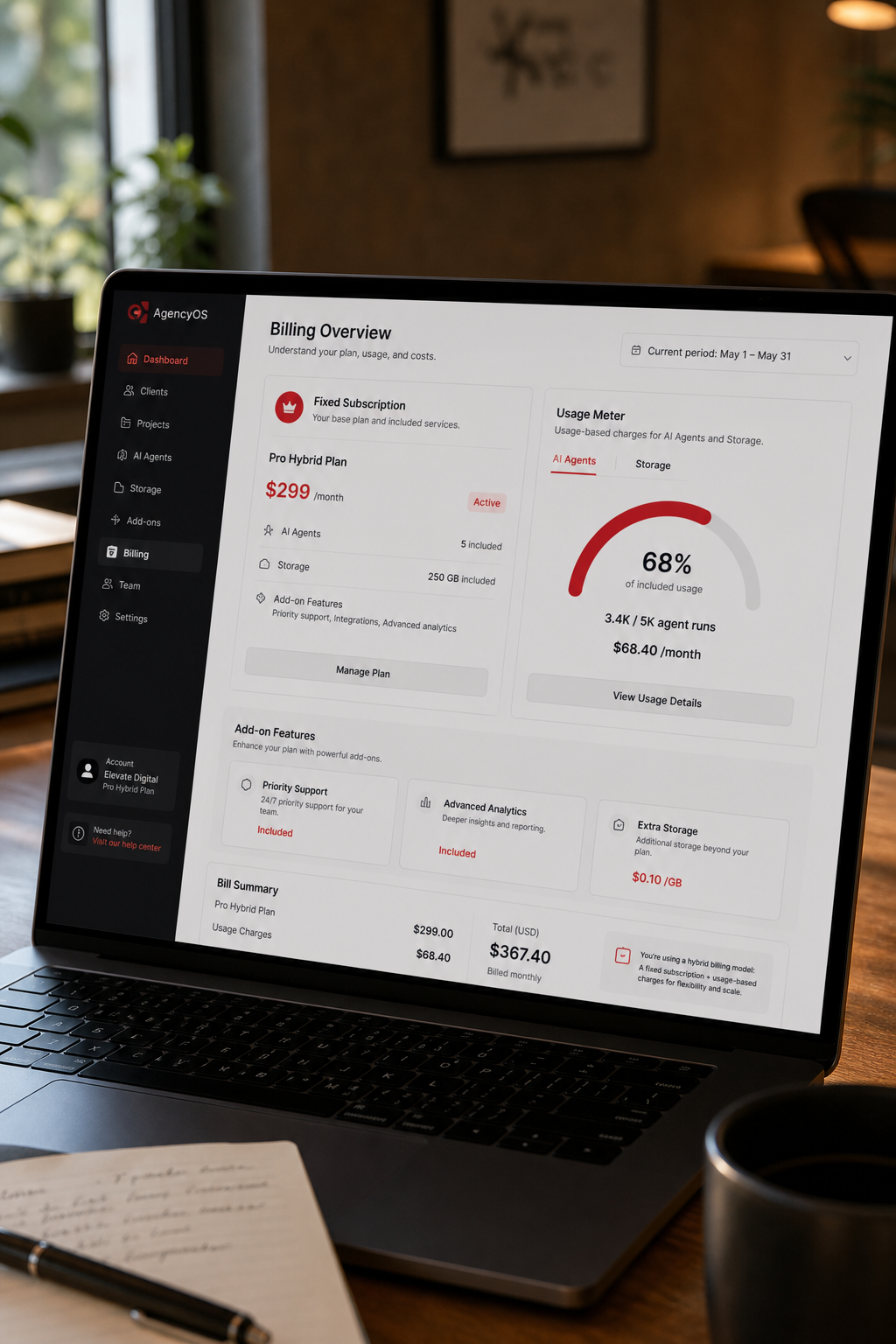
Hybrid models combine a fixed base fee with a variable usage charge. You pay a predictable monthly subscription for platform access, then add on extra costs for additional users, data storage, or high‑volume API calls.
Industry research on hybrid pricing shows that 22% of SaaS businesses adopted this blend in 2024, and the pattern is growing as firms look for revenue stability plus growth upside. The model works for AI platforms that need a solid revenue floor while still rewarding heavy‑use customers.
Typical hybrid stack for an agency:
- Base fee: $100 per month for the dashboard and core AI engine.
- Per‑agent add‑on: $15 for each extra AI instance beyond the first five.
- Data overage: $0.50 per GB after 100 GB of storage.
That structure means a small client with five bots pays $100, while a larger client with fifteen bots and 200 GB of logs pays $100 + (10 × $15) + (100 GB × $0.50) = $350. The bill scales with the value delivered.
Donely’s own pricing mirrors this hybrid feel: a base subscription for the unified dashboard, then per‑instance fees that drop with volume, plus optional overage charges for premium integrations.
Pros:
- Predictable baseline revenue.
- Clients only pay extra when they need more capacity.
- Balances agency cash flow with client growth.
Cons:
- More components to explain.
- Requires accurate metering infrastructure.
- Potential for “sticker shock” if overage rates are high.
Best for agencies that have a core set of services but also sell premium add‑ons like advanced analytics or extra storage.
5. Custom Enterprise Per-Instance Model , Tailored Solutions
Enterprise‑level contracts often go beyond any published price list. Vendors work with the client to craft a custom per‑instance rate, add‑on bundles, SLA guarantees, and dedicated support.
The industry billing guide explains how large organizations negotiate custom rates for compute, storage, and API usage. It notes that “reserved or spot instances can provide the greatest cost savings if they’re suitable for the organization’s use case.” The same idea applies to AI platforms: you can lock in lower per‑instance fees in exchange for a multi‑year commitment or a minimum volume.
When you sign a custom deal, you typically get:
- Dedicated account manager.
- SLAs that cover uptime, response time, and data residency.
- Fine‑grained billing tags for each client, department, or project.
- Option to bundle premium integrations at a negotiated rate.
Donely’s Enterprise plan offers exactly this: custom pricing, SSO, dedicated support, and the ability to tag usage per client for charge‑back reporting. The platform’s audit logs and RBAC make it easy to separate cost centers.
Pros:
- Tailored pricing matches your margin goals.
- High‑touch support reduces operational risk.
- Compliance features (SOC 2 in progress, GDPR) can be baked into the contract.
Cons:
- Longer sales cycle.
- Requires legal review of SLAs.
- May need a minimum commitment that limits flexibility.
Best for agencies with enterprise clients that demand strict governance, data residency, and predictable large‑scale spend.
6. What to Look For When Choosing a Per-Instance Billing Model
Picking the right model isn’t just about price; it’s about how the model fits your workflow, your clients’ expectations, and your internal finance processes.
First, map your typical client usage patterns. Do most bots run a few hundred requests a month, or do you see spikes into the millions? That will steer you toward a fixed or usage‑based model.
Second, check the platform’s metering capabilities. Accurate tracking is essential for hybrid and usage‑based plans. Look for real‑time dashboards, usage alerts, and exportable CSV reports.
Third, evaluate governance features. Per‑instance RBAC, audit logs, and isolated containers protect client data and make charge‑back easier. Choosing hosted AI employee platforms often hinges on these controls.
Fourth, consider scalability. Tiered and hybrid models shine when you expect growth, but they need clear tier definitions to avoid billing disputes.
Finally, review the contract terms. Custom enterprise deals may lock you into a multi‑year price, which is great for budgeting but reduces agility if the market shifts.
When you weigh these factors, you’ll land on the model that aligns cost, control, and client satisfaction.
FAQ
What is a per‑instance billing model for agencies?
A per‑instance billing model charges agencies based on each AI agent or “instance” they run. The fee can be flat, tiered, usage‑based, hybrid, or custom‑negotiated. This lets agencies match costs to the exact number of bots they deploy for each client, simplifying invoicing and margin tracking.
How does a fixed‑rate per‑instance model affect agency margins?
Because the price per instance never changes, agencies can predict revenue and set clear profit targets. If you know each bot brings $25 a month, you can calculate the exact contribution margin after subtracting hosting and support costs.
When should an agency use a tiered per‑instance model?
Tiered pricing works best when you expect steady growth in the number of bots. The decreasing price per instance rewards scale, making it easier to win larger contracts without constantly renegotiating rates.
Is usage‑based billing risky for agencies?
It can be. Variable invoices may surprise clients if a bot spikes unexpectedly. Mitigate risk by setting usage alerts, capping overages, and communicating the metering logic up front. Many platforms, including Donely, let you define a free allowance to keep baseline costs low.
What advantages do hybrid models provide?
Hybrid models give a predictable base fee plus the ability to charge for extra usage. This balances cash‑flow stability with fairness, clients pay more only when they consume more resources, which can improve satisfaction and reduce churn.
Do custom enterprise contracts include SLAs?
Yes. Enterprise deals usually bundle service‑level agreements that cover uptime, response time, and data‑security commitments. These SLAs help agencies assure their own clients that the AI platform meets high‑availability standards.
How important is per‑instance RBAC for agency billing?
Per‑instance role‑based access control separates who can view or edit each client’s bot. This isolation protects data, simplifies audit trails, and makes it easy to allocate costs to the right client or department during billing.
Can I switch billing models later?
Most platforms let you migrate between models, but there may be a transition period and contract notice. Plan ahead by choosing a model that can grow with you, or negotiate a flexible clause that permits a later switch without penalty.
Conclusion
Choosing the right per‑instance billing model is a strategic decision that impacts cash flow, client trust, and operational overhead. Fixed‑rate plans give you crystal‑clear invoices, tiered plans reward growth, usage‑based plans match spend to demand, hybrid plans blend stability with flexibility, and custom enterprise contracts deliver tailored governance for large clients. By weighing your client mix, usage patterns, and governance needs, you can pick the model that fits your agency’s roadmap.
Donely’s multi‑instance platform covers all five styles, from a simple flat fee to custom enterprise terms, and adds built‑in RBAC, audit logs, and a unified dashboard to keep billing clean. If you’re ready to simplify AI agent pricing and boost profitability, start a free trial today and see how per‑instance billing can work for your agency.