
You've probably already had the first win.
An agent handled a repetitive workflow, logged into the right tool, moved data where it needed to go, and saved someone on your team real time. That's the moment when the question changes from “can this work?” to “what should we standardize on?”
The choice between openclaw lab vs autonomee often presents a dilemma. A solo founder might want raw flexibility. An agency might need clean separation across client environments. An ops team might care less about autonomy and more about logs, permissions, and who gets paged when something breaks at 11 p.m.
The wrong choice usually doesn't fail on day one. It fails on day thirty, when you need approvals, environment isolation, billing separation, and a way to explain agent behavior to someone outside engineering. If you work in a sensitive domain, the bar is even higher. Teams evaluating AI operations in legal workflows, for example, often cross-check their stack against resources like these top AI legal tools because the standard isn't novelty, it's traceability and risk control.
A lot of buyers also confuse chat interfaces with agent platforms. If that line is still fuzzy in your org, it helps to ground the discussion in the difference between AI agents and chatbots before comparing vendors.
Table of Contents
- The AI Agent Crossroads Choosing Your Path
- Understanding the Core Platforms OpenClaw and Autonomee
- Capabilities and Architecture A Detailed Comparison
- Comparing Security Compliance and Governance
- Evaluating Scalability and Developer Experience
- Analyzing Pricing Use Cases and Total Cost of Ownership
- Decision Checklist Who Should Choose What
The AI Agent Crossroads Choosing Your Path
A founder starts with one agent. It books meetings, updates a CRM, drafts follow-ups, and watches an inbox. For a week, that feels like a great boost.
Then the founder adds a second workflow for support, a third for onboarding, and a fourth for a contractor. Now the setup needs access boundaries, separate credentials, clearer ownership, and a way to stop one experiment from touching production systems. That's usually when the platform decision becomes urgent.
Three paths teams usually consider
OpenClaw Lab appeals to technical teams because it gives them the raw engine. You can self-host it, shape the environment, decide how much autonomy to allow, and keep the system close to your own infrastructure. If your team values control and can operate the stack, that's a real advantage.
Autonomee fits buyers who want a more guided experience. In practical terms, that usually means less setup friction, fewer infrastructure decisions, and more opinionated workflows. The trade-off is that convenience often comes with narrower boundaries around customization, deployment model, or environment design.
A third path sits between those two extremes. Some teams want OpenClaw's flexibility but don't want to own the full operational burden of self-hosting. In those cases, a managed option built around the same agent model can make more sense than either pure DIY or a fully closed SaaS.
Practical rule: If your team is still proving one internal workflow, you can tolerate more rough edges. If you're supporting multiple customers, rough edges become governance issues.
What actually drives the decision
Most buyers say they're comparing features. In practice, they're comparing failure modes.
OpenClaw Lab gives you more room to build exactly what you want. It also gives you more ways to misconfigure access, over-permission an agent, or create an operational mess across environments. Autonomee narrows the surface area, which can be helpful, but it may also narrow what your team can automate.
The question isn't which product sounds smarter. It's which one still works when you go from one agent to many, from one workspace to many, and from one owner to shared responsibility across engineering, ops, and compliance.
Understanding the Core Platforms OpenClaw and Autonomee
The easiest way to understand openclaw lab vs autonomee is to look at their operating assumptions.
OpenClaw was built around persistent agents, local control, and deep system access. NVIDIA's 2026 write-up describes it as a self-hosted, persistent AI assistant that runs locally or on private servers and stays active on a heartbeat instead of ending after a single prompt-response cycle, which is a useful summary of the platform's design philosophy in NVIDIA's OpenClaw overview.
OpenClaw is an agent runtime first
That heartbeat model matters more than people expect. A normal chatbot waits. OpenClaw keeps operating in the background, which changes how teams use it.
That makes it attractive for workflows like:
- Inbox handling: The agent doesn't need a user to initiate every step.
- File and shell tasks: It can act closer to the operating system.
- Cross-tool automation: It can keep state across actions instead of behaving like a stateless assistant.
OpenClaw is also part of a broader open-source shift toward more autonomous personal agents with local control. That explains why technical teams gravitated to it quickly. It also explains why non-technical stakeholders often get uneasy the moment they understand what the agent can reach.
If you want the OpenClaw-specific deployment model without building from scratch, it helps to review a hosted implementation path like OpenClaw on Donely, because the underlying question is usually operational, not philosophical.
Autonomee is usually chosen for structure
Autonomee tends to sit on the other side of the trade-off. Buyers looking at it are often trying to reduce setup overhead, constrain behavior, and move faster with business-ready workflows rather than infrastructure-heavy experimentation.
That's why Autonomee usually appeals to teams that want:
- Opinionated defaults instead of assembling every part themselves.
- A simpler user experience for non-engineers.
- More bounded operation around specific business tasks.
OpenClaw gives you room. Autonomee gives you rails.
Neither philosophy is automatically better. The mismatch is what hurts. A solo technical founder can thrive with OpenClaw. A services firm juggling multiple clients may regret every extra degree of freedom if there's no clean way to isolate workspaces, credentials, and operator access.
Capabilities and Architecture A Detailed Comparison
The architectural split becomes obvious once you stop looking at marketing labels and start looking at how work gets executed.
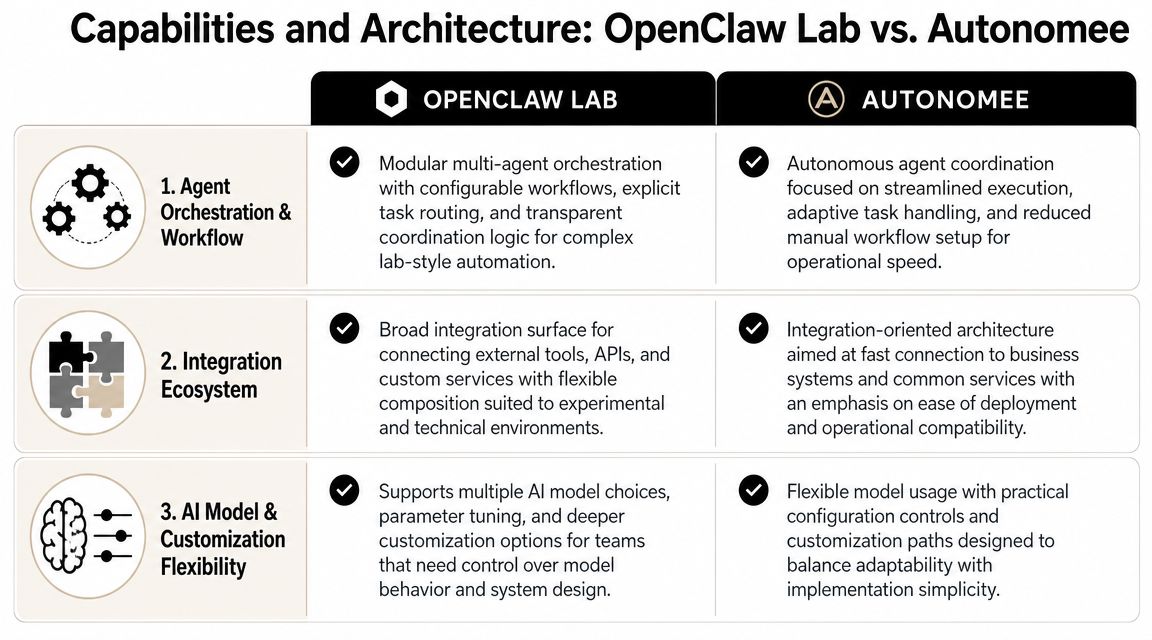
How the agents actually operate
OpenClaw is built for direct computer use. A 2026 comparison describes it as a real-time computer-use agent that captures screenshots, sends them to a vision-capable LLM, and receives low-level actions such as click(x, y), type(…), and scroll(…). That control loop runs roughly 3 to 8 times per minute according to the Blink comparison of OpenClaw and AutoGPT.
That matters if your workflow depends on UI state. Think internal admin panels, legacy systems, vendor portals, or desktop apps with no clean API coverage. In those cases, OpenClaw's interaction model is often closer to what the business needs.
Autonomee, by contrast, is more likely to feel comfortable when the workflow is structured, repeatable, and intentionally constrained. That's often a better fit for teams that don't want an agent continuously interpreting a live screen and acting on it.
Where integration strategy changes the outcome
Integration count isn't the whole story. The harder issue is how integrations behave across environments.
OpenClaw's ecosystem benefits from an open model and broad extensibility. That's powerful for technical teams, but it also means every added capability creates more responsibility around review, permissions, and lifecycle management. An agency handling client systems feels this pain fast because each client may need different secrets, scopes, approval paths, and rollback procedures.
Autonomee likely reduces that burden by standardizing how connectors and workflows are exposed. That can improve consistency, but it may also limit edge-case automation when the target app isn't fully supported or the workflow crosses several heterogeneous systems.
Early comparison table
| Feature | OpenClaw Lab (Self-Hosted) | Autonomee (Presumed SaaS) | Donely (Managed OpenClaw) |
|---|---|---|---|
| Core model | Open-source, persistent agent runtime | Structured managed platform | Managed platform for OpenClaw-powered agents |
| Autonomy style | High autonomy, direct environment control | More bounded and guided | OpenClaw flexibility with managed operations |
| Computer use | Strong fit for interactive browser and desktop workflows | Likely more workflow-oriented than low-level computer control | Depends on deployed OpenClaw configuration |
| Hosting model | Self-hosted on local or private infrastructure | SaaS-style managed environment | Hosted and managed OpenClaw infrastructure |
| Customization | Deep, but operator-owned | Easier, but more opinionated | Moderate to deep, without full self-hosting burden |
| Multi-instance operations | Possible, but you design and run it | Depends on product architecture | Built around separate instances from one dashboard |
| Governance overhead | Highest. Your team owns it | Lower than self-hosting | Lower operational burden than self-hosting |
| Best fit | Technical teams that want maximum control | Teams prioritizing simplicity | Teams that want OpenClaw without full DevOps ownership |
Use OpenClaw when the UI is the system. Use a more structured platform when the process is the system.
Comparing Security Compliance and Governance
Security is where enthusiasm for agent autonomy usually meets reality.
A widely cited report said OpenClaw reached 196,000 GitHub stars and 2 million weekly users before OpenAI hired its creator. The same report said Cisco researchers found vulnerabilities in 26% of 31,000 agent skills they analyzed, and Shodan scans found hundreds of OpenClaw instances exposed to the internet without authentication. It also noted Gartner categorized OpenClaw as an “unacceptable cybersecurity risk” in that context, as summarized in this industry discussion on OpenClaw's rise and security exposure.
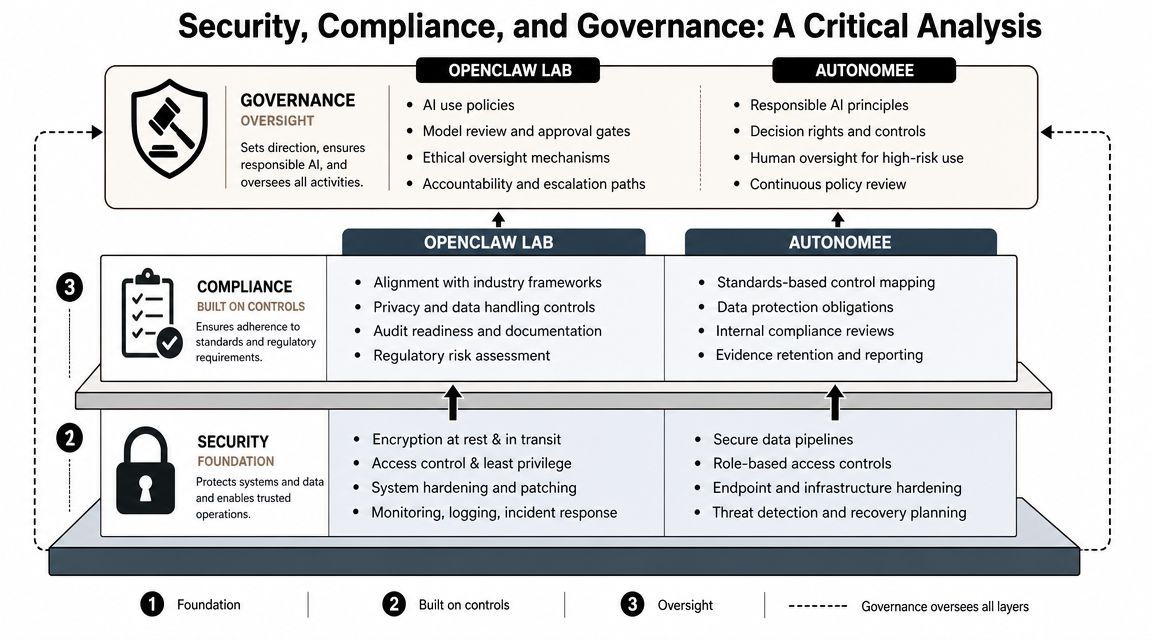
Why raw autonomy raises the stakes
OpenClaw's strength is that it can do real work across tools, files, and interfaces. That same strength expands the blast radius when controls are weak.
With self-hosted OpenClaw, your team owns:
- Access design: Who can invoke which agent and from where.
- Credential handling: How secrets are stored, rotated, and scoped.
- Environment hardening: How you isolate the runtime from production systems.
- Auditability: What happened, who triggered it, and what changed.
That's manageable for a disciplined infrastructure team. It's risky for a startup treating agents like lightweight plugins.
What governance looks like in practice
Autonomee's likely advantage is that a SaaS platform can narrow the ways users make dangerous choices. That doesn't guarantee enterprise readiness, but it usually improves baseline consistency. The cost is reduced freedom around architecture, lower portability, and less direct control over the runtime.
For regulated or security-conscious buyers, the checklist tends to be less about model quality and more about operational controls:
- RBAC and approvals: Can you prevent broad access by default?
- Isolation: Can one business unit or client environment be cleanly separated from another?
- Logs: Can legal, compliance, or ops reconstruct what happened after an incident?
- Credential scope: Can the agent access only the systems it needs?
Governance starts before the agent acts, not after.
This is the point where many teams realize their real issue isn't “openclaw lab vs autonomee” in abstract terms. It's whether they can explain the platform's behavior to security reviewers, customers, and internal owners without hand-waving.
Evaluating Scalability and Developer Experience
The phrase “we'll just self-host it” sounds cheap until the third environment starts drifting from the first two.
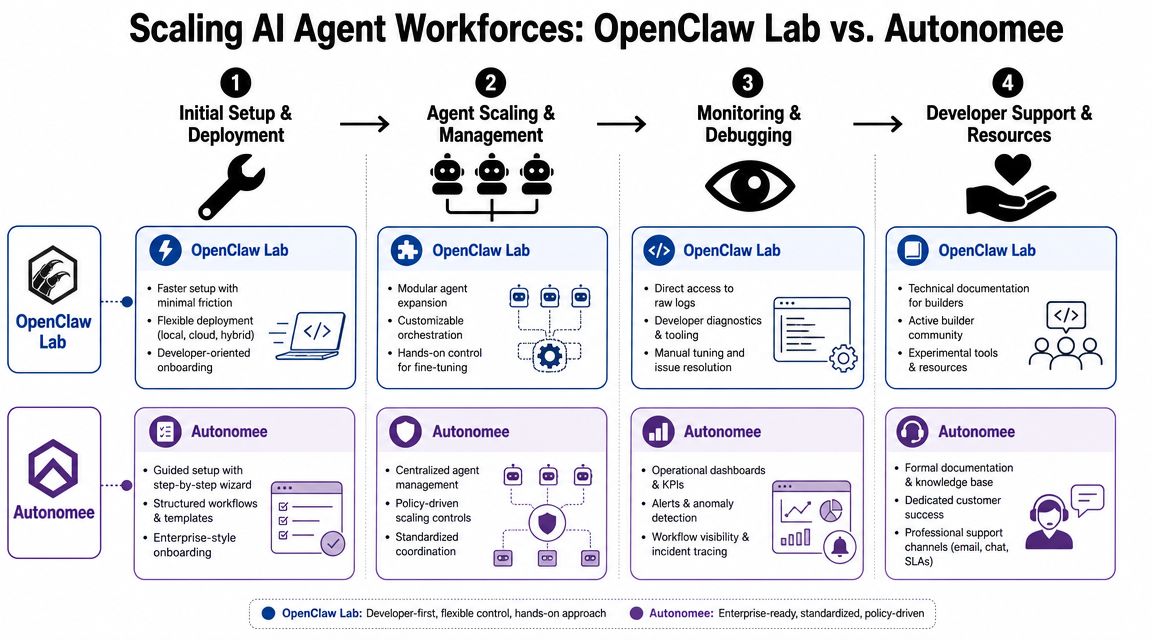
Day one is easy day two is expensive
OpenClaw is often straightforward enough for a technical user to get running. The challenge starts later, when teams need reliability and repeatability.
Self-hosted agent operations usually create work in four buckets:
Monitoring and alerting
You need to know whether the agent failed, stalled, or looped. A successful demo doesn't solve that.Debugging and replay
Agents that interact with UIs are harder to troubleshoot than deterministic scripts. Failures can come from timing, screen state, permissions, or tool behavior.Lifecycle management
Upgrades, dependency drift, integration changes, and secret rotation all become operational chores.Cross-environment consistency
A personal setup, a team setup, and a client-facing setup shouldn't behave like three unrelated snowflakes.
Enterprise-focused comparisons in 2026 increasingly emphasize allowlists, secrets management, credential isolation, audit logs, and container isolation as the controls that separate production-ready systems from experiments, as noted in this enterprise OpenClaw comparison.
The multi instance problem most teams ignore
This is the most under-discussed part of the market.
A founder can tolerate one messy environment. An agency with many client accounts can't. Separate clients often need isolated credentials, separate operators, distinct billing trails, and confidence that one agent's memory or tools won't bleed into another environment.
That's why multi-instance management matters more than another benchmark or model debate. If the platform can't support isolated business contexts cleanly, scaling the agent program turns into migration work and governance cleanup.
For teams that want OpenClaw capability without carrying the infrastructure overhead directly, managed hosting options such as OpenClaw hosting on Donely exist specifically to centralize deployment, logs, and environment control.
The hard part isn't launching one agent. The hard part is running many without creating an operations tax on every new workflow.
Autonomee may reduce some of that tax through product constraints. OpenClaw maximizes freedom but asks your team to build discipline around it. Neither path is wrong. The problem is pretending they cost the same to operate.
Analyzing Pricing Use Cases and Total Cost of Ownership
The cheapest platform on paper often becomes the most expensive platform in practice.
OpenClaw Lab is open-source, which tempts teams to treat it as “free.” It isn't free once you count the people needed to run it well. Even small deployments create hidden work around uptime checks, permissions review, integration maintenance, logs, incident response, and environment hygiene.
What self hosted really costs
You don't need a detailed spreadsheet to see the pattern.
A self-hosted OpenClaw deployment usually adds cost through:
- Operator time: Someone has to own setup, patching, and troubleshooting.
- Security review: Any agent touching inboxes, billing systems, or customer records creates review overhead.
- Workflow fragility: Browser-driven automations can break when interfaces change.
- Expansion complexity: New clients or departments mean new environments, credentials, and policies.
Autonomee shifts that math. A managed SaaS-style platform usually turns more of the cost into predictable subscription spend. That's easier to budget, though it may come with limits that force workarounds when your use case gets more complex.
Which platform fits which buyer
A solo founder automating outbound or support can often absorb the rough edges of OpenClaw if they're technical and move quickly. The reward is flexibility. The penalty is maintenance.
An agency managing many client agents usually has a different problem. It needs isolation, delegated access, clean offboarding, and billing clarity. In that setting, the deciding factor is often operational fit rather than raw agent intelligence. Recent market analysis points out that many comparisons miss this exact buyer need: which platform can support multiple isolated client or business environments without messy governance or migrations, as discussed in Yotta Labs' view of what developers are using instead.
An enterprise deploying agents into support, CRM, or finance-adjacent workflows usually needs controls first and autonomy second. That buyer will often prefer a more managed path, even if it means giving up some flexibility, because explaining constrained systems to compliance teams is easier than defending open-ended autonomy.
The practical TCO rule is simple. The more environments, owners, and regulated workflows you add, the less attractive pure self-hosting becomes unless you already have the platform team to support it.
Decision Checklist Who Should Choose What
Most comparisons still frame the choice as capability versus ease of use. That's too shallow for real buying decisions.
The more useful question is whether the platform lets you run separate production environments safely. That gap shows up repeatedly in market commentary around agent platforms, especially for agencies and growing startups that need clean separation instead of one oversized shared workspace.
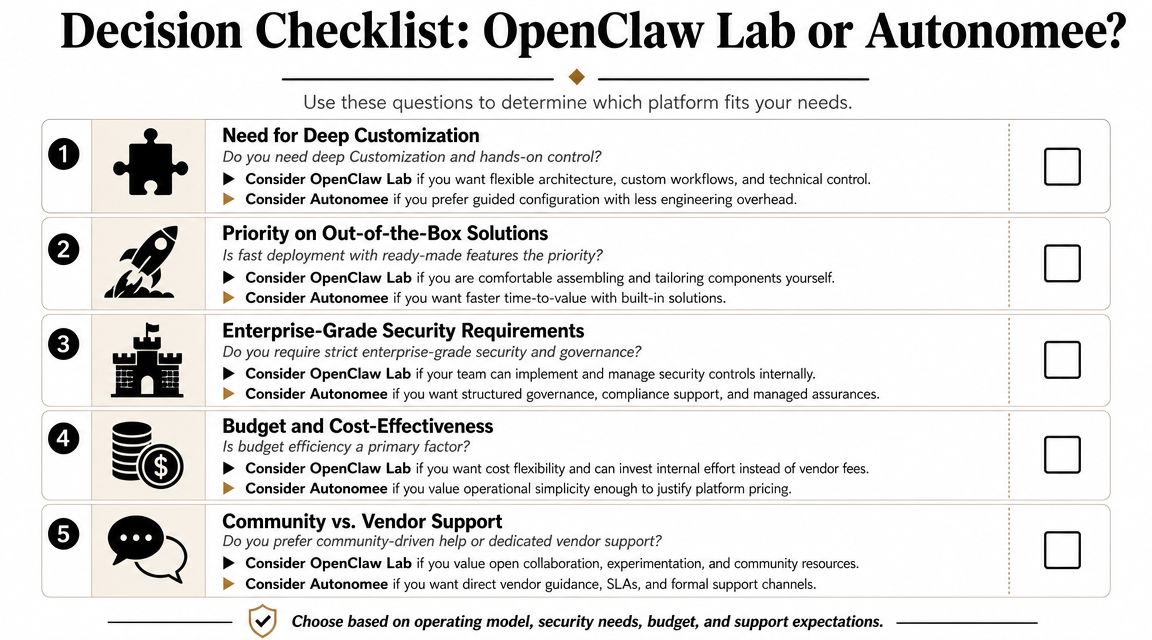
Fast recommendations by team type
Choose OpenClaw Lab if:
- You have technical depth and want direct control over runtime behavior.
- Your workflows depend on UI interaction across tools that don't offer reliable APIs.
- You're comfortable owning operations rather than outsourcing them.
Choose Autonomee if:
- Your team wants faster adoption with more guardrails.
- Business users need a simpler interface and less infrastructure complexity.
- You can accept opinionated boundaries in exchange for easier rollout.
Choose a managed OpenClaw path if:
- You need OpenClaw's flexibility but don't want to self-host every environment.
- You run multiple business contexts such as internal agents, client agents, or separate departmental deployments.
- Governance matters as much as capability because logs, access boundaries, and repeatable operations aren't optional.
If your deployment is still personal, you can optimize for flexibility. If it's becoming organizational, optimize for control. If it spans customers, optimize for isolation first.
If you're leaning toward OpenClaw but don't want to build and maintain the full stack yourself, Donely is one option to evaluate. It provides managed OpenClaw-powered instances, centralized monitoring and billing, per-instance RBAC, and isolated environments for personal, team, or client workloads from a single dashboard.